
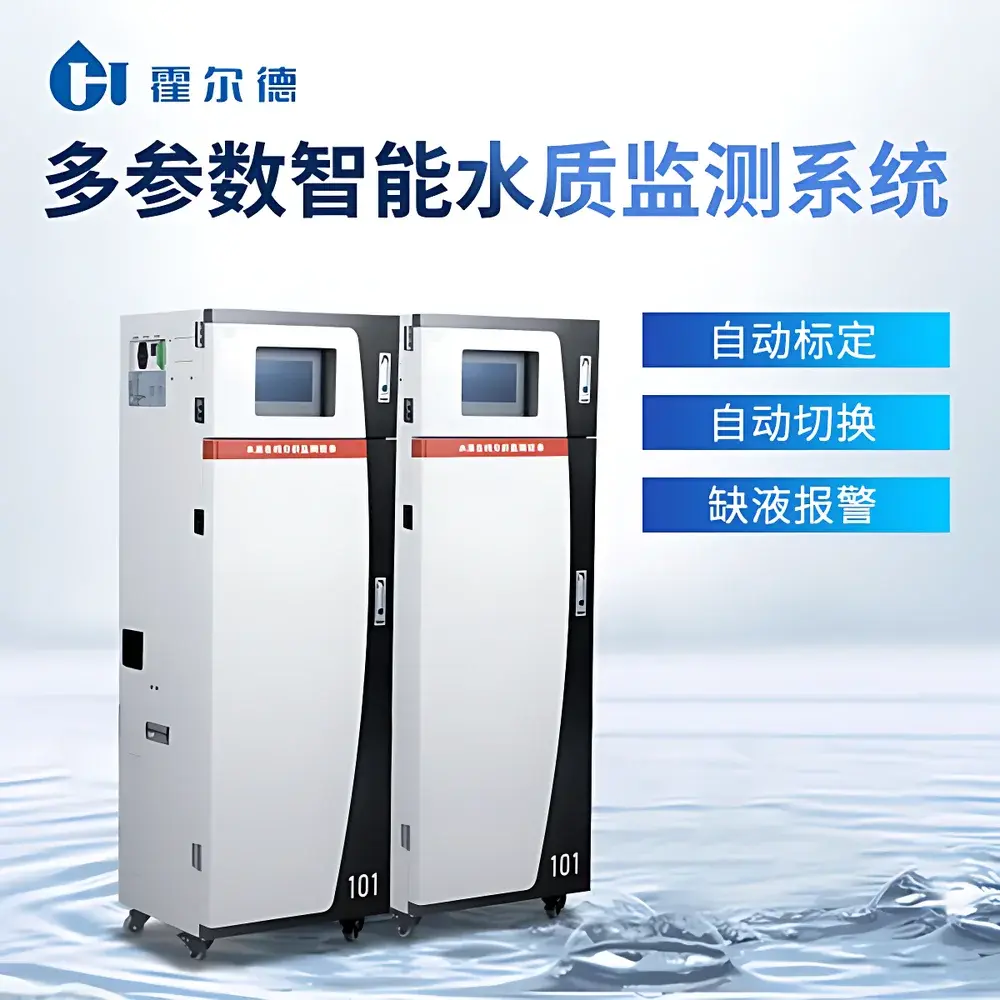
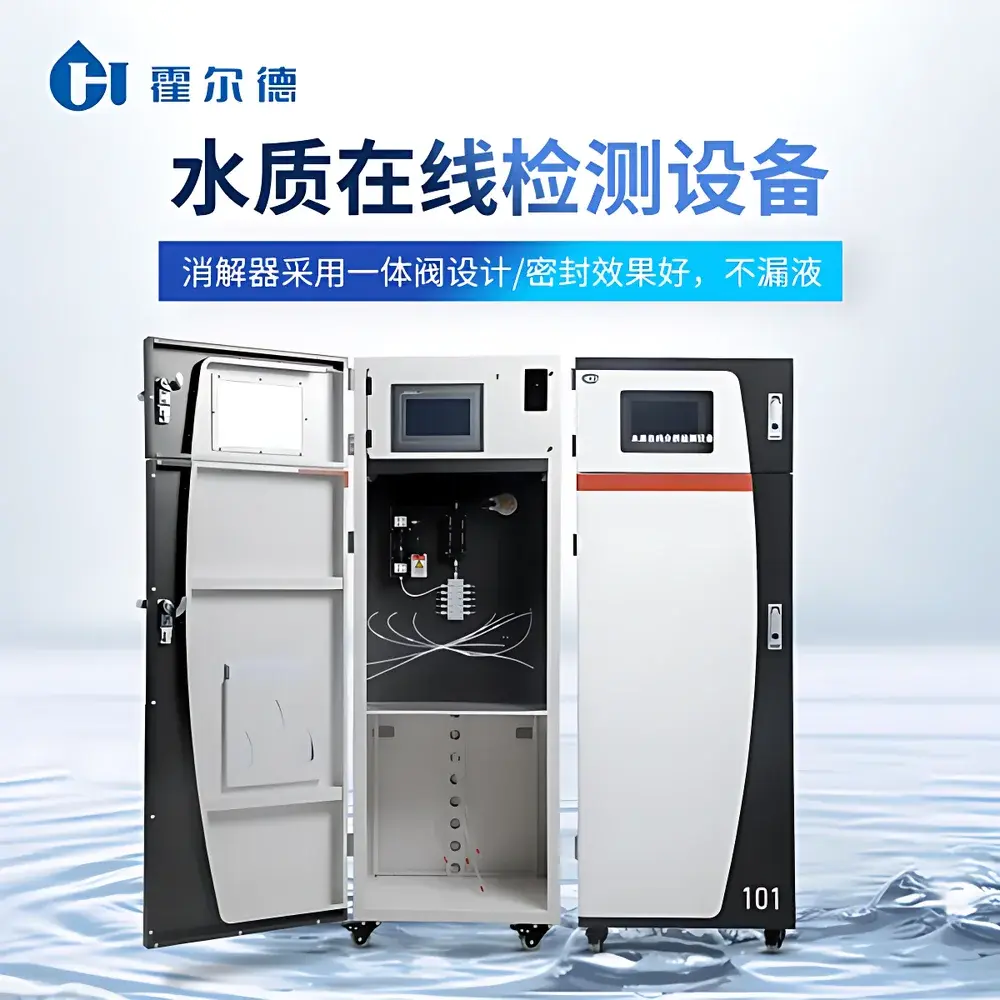
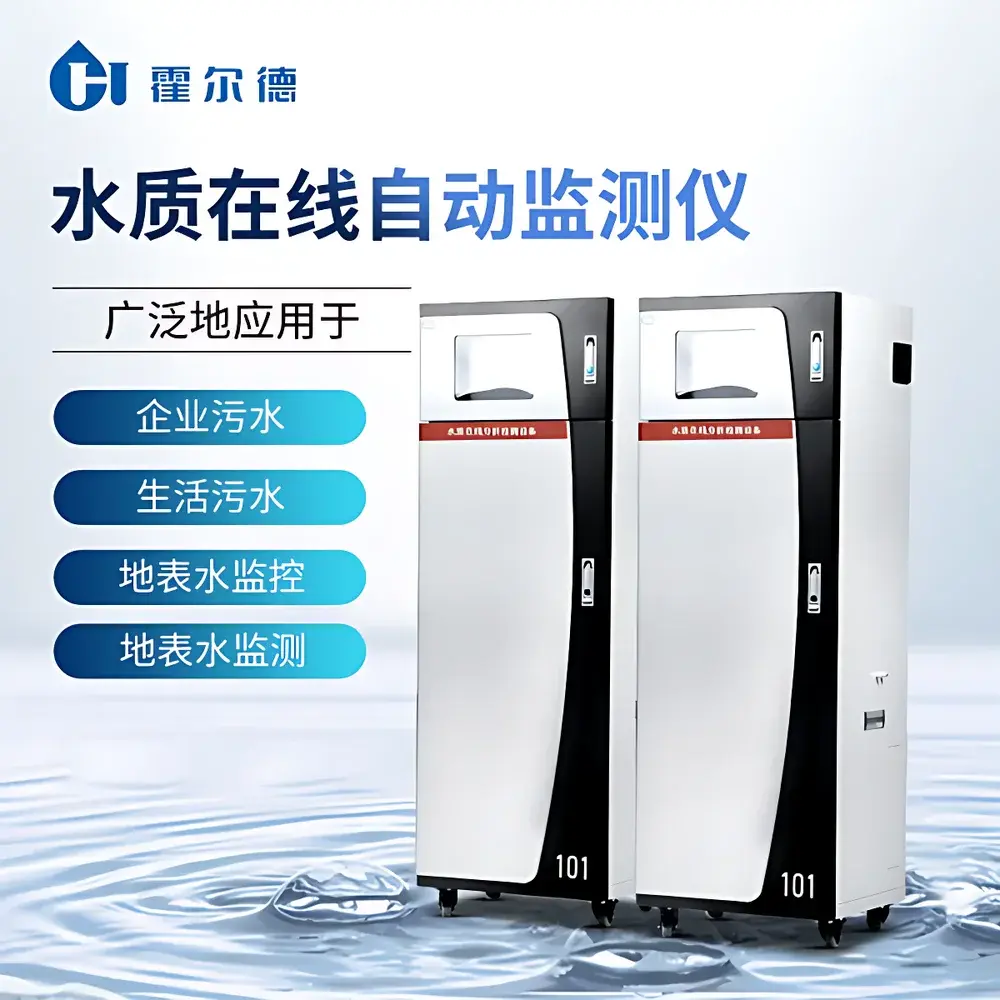
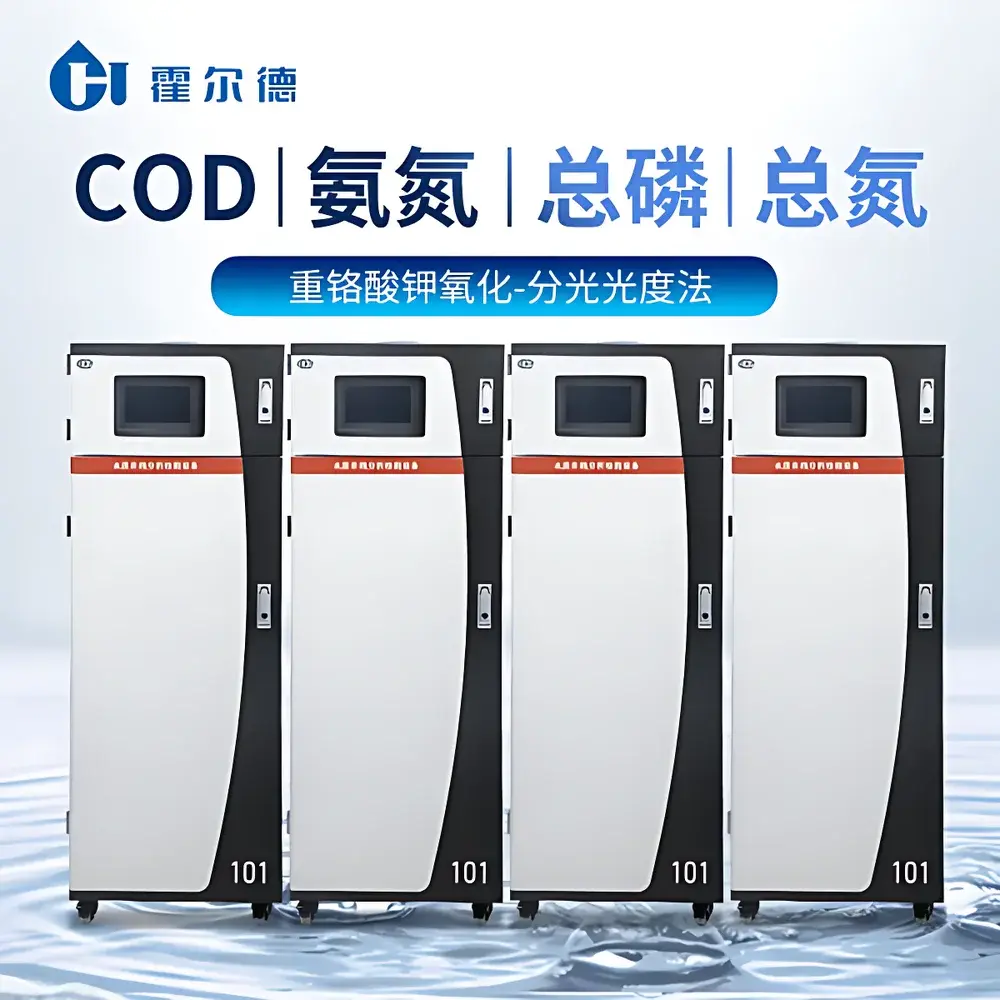
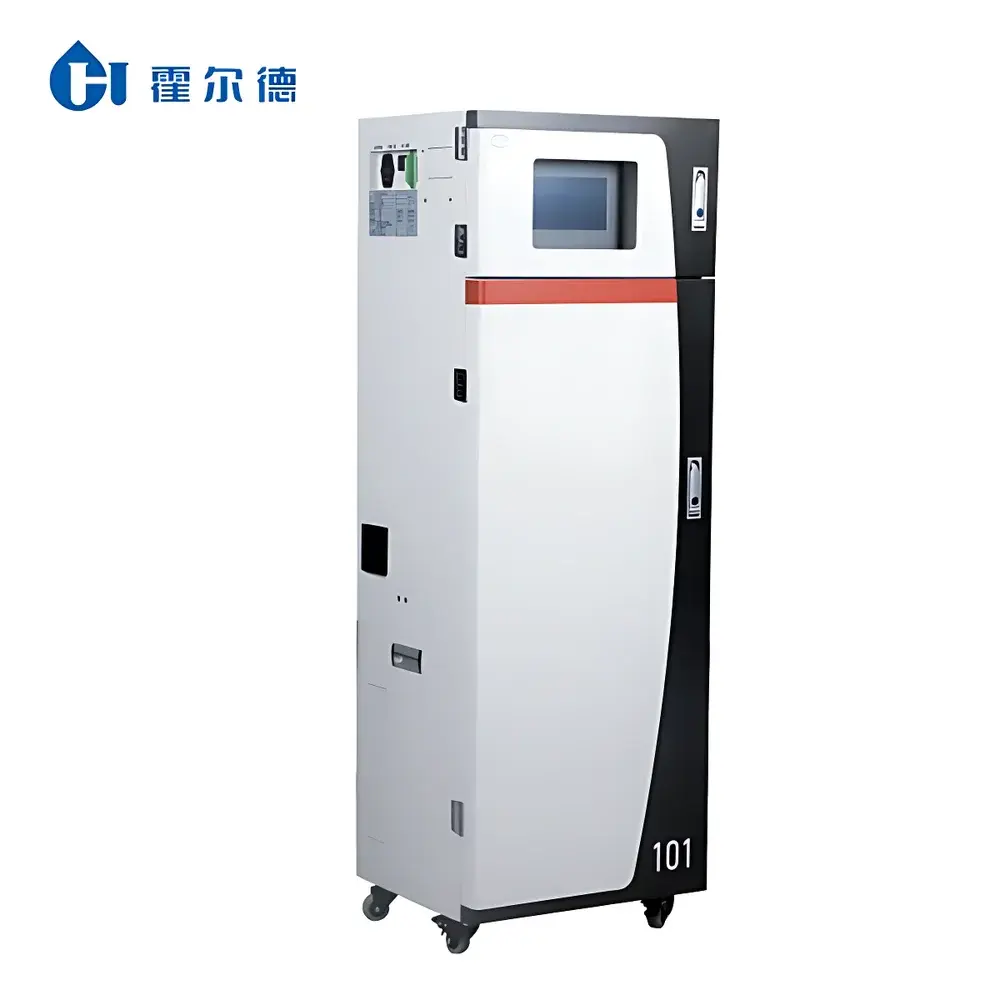
Horde Electric HD-101 Online COD Analyzer
| Brand | Horde Electric |
|---|---|
| Origin | Shandong, China |
| Manufacturer Type | Original Equipment Manufacturer (OEM) |
| Country of Origin | China |
| Model | HD-101 |
| Measurement Principle | Potassium Dichromate Oxidation–Spectrophotometric Method |
| Measurement Range | (15–1000) mg/L, (50–3000) mg/L, (200–10000) mg/L (expandable) |
| Zero Drift | ±5 mg/L |
| Span Drift | ±5% F.S. |
| Accuracy | ±10.0% of reading |
| Limit of Quantitation | 15 mg/L |
| Repeatability | ≤5.0% RSD |
| Cycle Time | ≤60 min |
| Insulation Resistance | >20 MΩ |
| MTBF | ≥720 h |
| Communication Interfaces | RS232 / RS485, 4–20 mA analog output |
| Dimensions (L×W×H) | 500 × 440 × 1440 mm |
| Weight | 55 kg |
| Display | 7-inch capacitive touchscreen |
| Controller | Industrial PLC-based embedded system |
| Operating Temperature | 5–40 °C |
| Operating Humidity | 20–85% RH (non-condensing) |
| Power Supply | AC 220 V ±25%, 50 Hz ±0.5 Hz |
| Rated Power Consumption | 100 W |
Overview
The Horde Electric HD-101 Online COD Analyzer is an industrial-grade, fully automated water quality monitoring system engineered for continuous, unattended measurement of Chemical Oxygen Demand (COD) in wastewater and surface water streams. It implements the standardized potassium dichromate oxidation–spectrophotometric method (aligned with ISO 6060 and HJ 399–2007), where organic matter in the sample is oxidized under strong acidic conditions at elevated temperature, followed by quantification of residual dichromate via absorbance detection at 600 nm. This gravimetrically traceable, reference-method-compliant architecture ensures regulatory acceptability for discharge compliance reporting, process control in municipal and industrial wastewater treatment plants, and long-term environmental surveillance programs. The instrument features a modular fluidic path with segregated reagent, cleaning, and waste lines—minimizing cross-contamination risk and reducing hazardous waste volume by up to 40% compared to conventional systems.
Key Features
- Triple-range auto-switching capability (15–1000 mg/L, 50–3000 mg/L, 200–10000 mg/L) enables seamless adaptation to variable influent strength without manual intervention.
- Dedicated dual-line fluid handling: independent cleaning solution delivery and waste effluent routing significantly lower disposal costs and simplify hazardous waste management per EPA 40 CFR Part 261 guidelines.
- Integrated industrial PLC controller with real-time diagnostics supports robust operation under fluctuating ambient conditions (5–40 °C, 20–85% RH).
- 7-inch high-resolution capacitive touchscreen interface with localized English firmware provides intuitive navigation, on-device calibration logging, and event-driven alarm visualization (e.g., low reagent, pump failure, optical path obstruction).
- Proprietary interference-resistant reagent formulation mitigates matrix effects from chloride ions (<2000 mg/L), turbidity (<100 NTU), and chromaticity—validated against synthetic and field-collected wastewater matrices.
- Embedded algorithmic correction for baseline drift and photometric nonlinearity improves long-term stability, achieving ≤5.0% repeatability (RSD) and <±10.0% measurement error across full operational range.
Sample Compatibility & Compliance
The HD-101 is validated for direct analysis of raw sewage, secondary effluent, industrial process water, and ambient surface water (rivers, lakes, reservoirs). It accommodates suspended solids up to 150 mg/L without pre-filtration and tolerates pH 4–10. All wetted components—including sampling probe, peristaltic tubing, reaction coil, and optical cell—are chemically inert (PTFE, quartz, borosilicate glass) to ensure compatibility with aggressive oxidant chemistry and prevent adsorption artifacts. The analyzer meets electromagnetic compatibility requirements per IEC 61326-1, safety standards per IEC 61010-1, and supports audit-ready data integrity through time-stamped calibration records, operator logins, and change history tracking—facilitating alignment with GLP, ISO/IEC 17025, and EPA-approved monitoring protocols.
Software & Data Management
Firmware includes embedded data logger with 32 GB internal storage (expandable via microSD), retaining ≥12 months of 15-minute interval measurements, calibration events, and fault logs. Standard communication protocols include Modbus RTU over RS485 and ASCII over RS232, enabling integration into SCADA, DCS, or cloud-based IoT platforms (e.g., ThingWorx, Ignition). Analog 4–20 mA outputs are isolated and configurable for primary COD signal or diagnostic status (e.g., maintenance due, reagent level). Remote firmware updates and secure parameter configuration are supported via TLS-encrypted web interface (HTTPS), compliant with basic cybersecurity hygiene for industrial edge devices.
Applications
- Real-time effluent monitoring at municipal wastewater treatment plants for regulatory reporting under national discharge permits.
- In-process COD tracking in pharmaceutical, food & beverage, textile, and chemical manufacturing facilities to optimize aeration, coagulation, and biological treatment stages.
- Early-warning detection of upstream contamination events in river basin monitoring networks.
- Performance verification of tertiary treatment units (e.g., ozonation, activated carbon filtration) via paired inlet/outlet measurement.
- Research-grade longitudinal studies requiring high-frequency, low-maintenance COD profiling in ecological field stations.
FAQ
Does the HD-101 support remote calibration verification?
Yes—via onboard standard addition functionality and digital certificate logging; all calibrations are timestamped, user-attributed, and exportable as CSV.
What maintenance intervals are recommended for routine operation?
Reagent replacement every 30 days (typical), optical cell cleaning every 7 days, and full system validation quarterly per ISO 17025 Annex A.2.
Can the instrument be integrated into existing plant DCS using Modbus TCP?
The native protocol is Modbus RTU over RS485; Modbus TCP requires external gateway configuration—details provided in the Integration Manual v3.2.
Is the analyzer certified for use in Zone 2 hazardous areas?
No—it is rated for general-purpose indoor installation (IP54 enclosure); explosion-proof variants are not available.
How does the system handle high-chloride wastewater samples?
The proprietary reagent matrix includes mercury sulfate masking agent, validated for chloride interference suppression up to 2000 mg/L, per HJ 399–2007 Annex B.







