
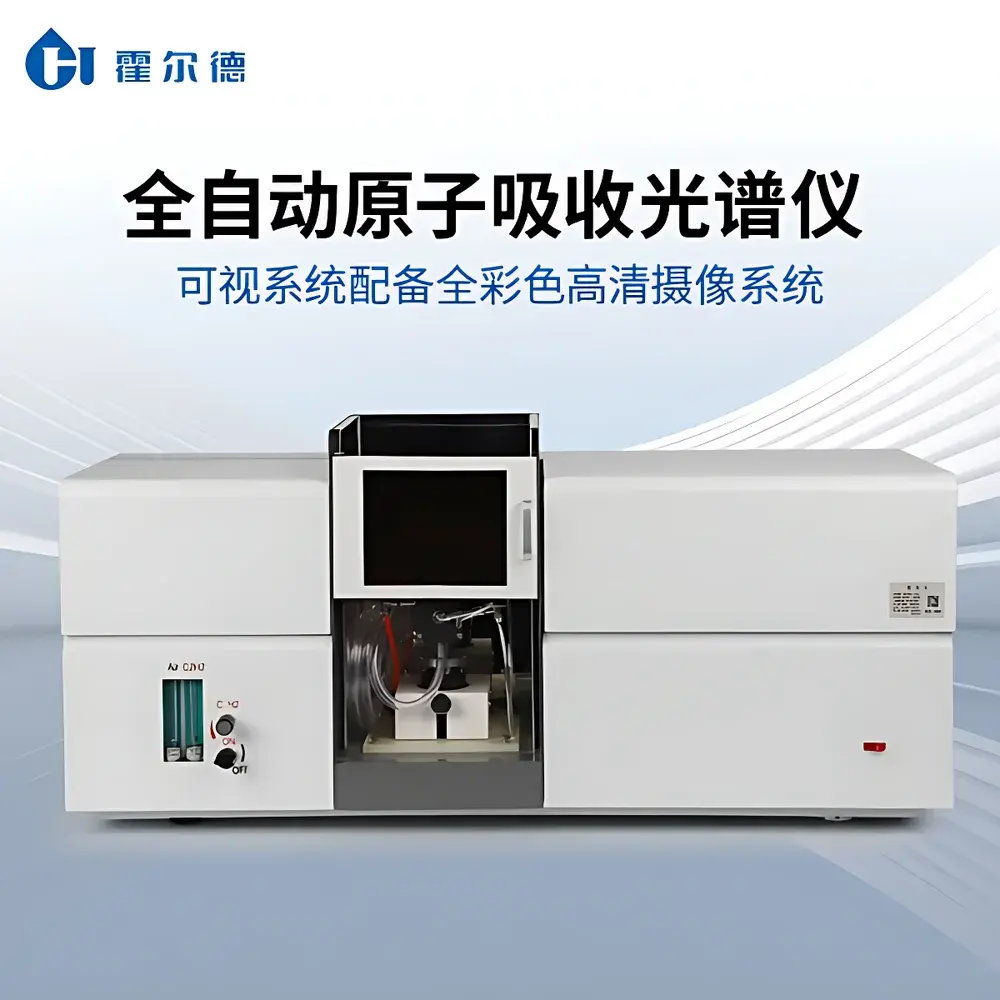
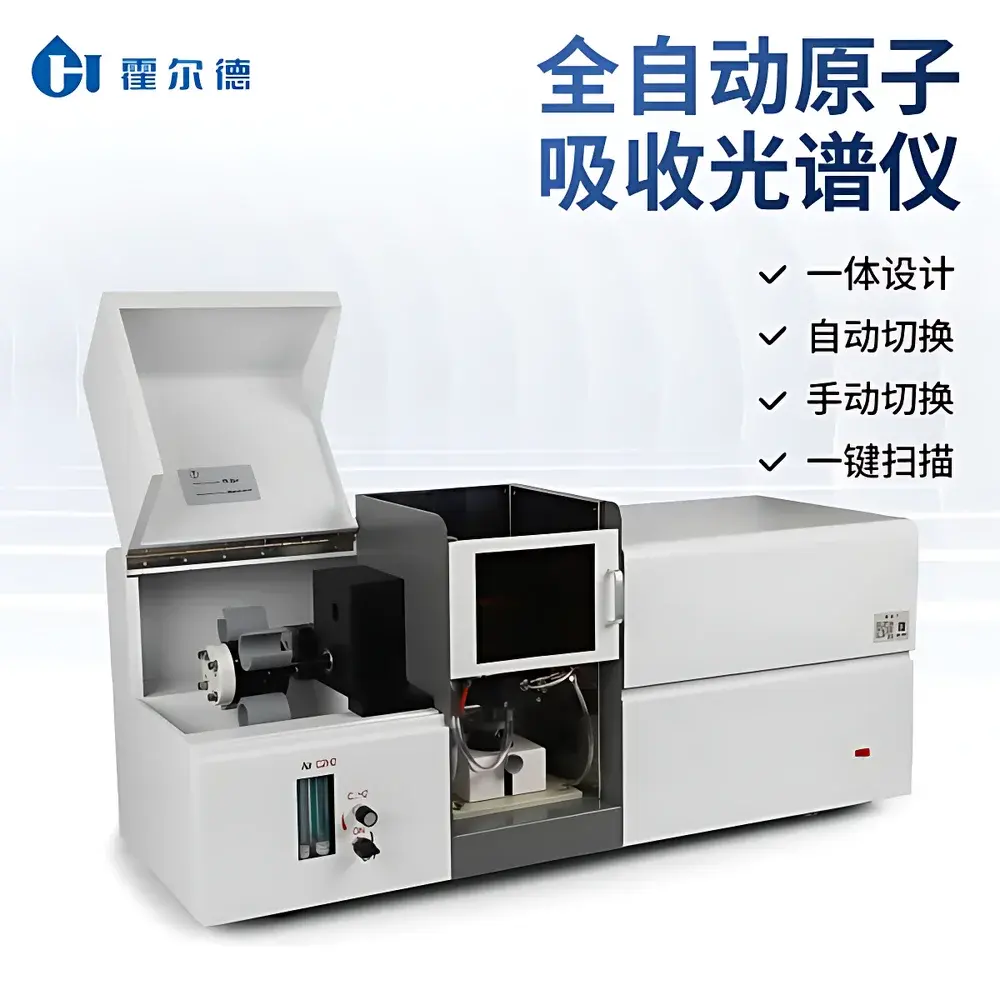
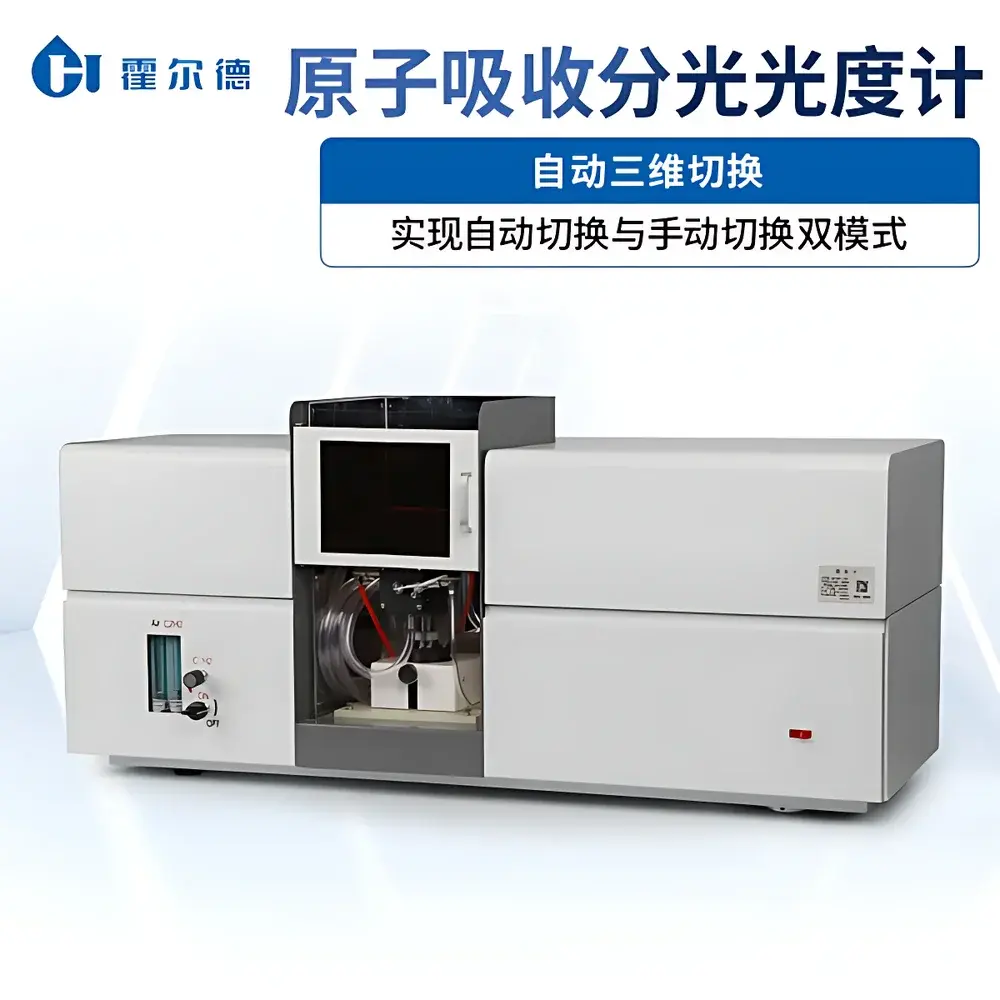
Horde Electric HD-AAS4H Flame Atomic Absorption Spectrometer
| Brand | Horde Electric |
|---|---|
| Origin | Shandong, China |
| Manufacturer Type | Authorized Distributor |
| Instrument Type | Flame AAS |
| Model | HD-AAS4H |
| Wavelength Range | 185–900 nm |
| Monochromator | Czerny-Turner enhanced optical system |
| Grating Density | 1800 lines/mm |
| Spectral Bandwidth | 0.2 / 0.4 / 1.0 / 2.0 nm (auto-switchable) |
| Wavelength Accuracy | ≤ ±0.1 nm |
| Wavelength Repeatability | ≤ ±0.025 nm |
| Resolution | 0.2 nm (Cu 324.7 nm, 0.2 nm bandwidth) |
| Baseline Drift | 0.003 ABS/30 min (static), 0.005 ABS/15 min (dynamic) |
| Detector | Hamamatsu photomultiplier tube |
| Background Correction | Deuterium lamp |
| Characteristic Concentration (Cu) | 0.025 µg/mL/1% |
| Detection Limit (Cu) | 0.006 µg/mL |
| Precision (RSD) | ≤ 0.5% |
| Atomizer | Titanium 0.5 mm × 100 mm burner head |
| Nebulizer | High-efficiency glass nebulizer with metal cap |
| Spray Chamber | Corrosion-resistant all-plastic chamber |
| Safety System | Real-time acetylene leak detection, flame-out monitoring, gas pressure interlock, automatic shutdown |
| Lamp System | Motorized turret for 4/6/8 lamp positions |
| Data Interface | RS232, USB |
| Software | Windows-compatible AAS control suite with dual-language UI (EN/CN), remote calibration support, GLP-compliant audit trail, multi-format export (CSV, PDF, Excel) |
Overview
The Horde Electric HD-AAS4H is a high-performance flame atomic absorption spectrometer engineered for precise, reproducible quantification of trace and ultra-trace metallic elements in liquid samples. Based on the fundamental principle of atomic absorption spectroscopy—where ground-state atoms in a flame absorb characteristic radiation emitted by a hollow cathode lamp—the HD-AAS4H delivers robust analytical performance across routine and regulatory laboratory environments. Its dual-beam optical architecture compensates for source intensity fluctuations and electronic drift, ensuring stable baseline conditions critical for low-concentration measurements. The instrument operates within a broad spectral range (185–900 nm), enabling analysis of over 70 elements—including Na, K, Ca, Mg, Fe, Zn, Cu, Pb, Cd, and Cr—using air-acetylene flame atomization. Designed for compliance-driven workflows, the HD-AAS4H supports data integrity requirements aligned with ISO/IEC 17025, USP <731>, and EPA Method 7000B for environmental and clinical applications.
Key Features
- Motorized multi-lamp turret (4/6/8 position) with automatic 3D alignment, energy balancing, and simultaneous preheating—reducing turnaround time between elemental analyses.
- Intelligent wavelength scanning and peak search: One-click automated wavelength optimization with memory retention of instrument parameters per method.
- Dual-beam optical path with Czerny-Turner monochromator (1800 lines/mm grating) and auto-switchable spectral bandwidths (0.2/0.4/1.0/2.0 nm) to match analytical sensitivity and selectivity requirements.
- Deuterium-lamp background correction for accurate compensation of non-specific absorption from complex matrices (e.g., soil digests, biological fluids, industrial effluents).
- Integrated safety architecture: Real-time monitoring of acetylene pressure, flame status, and gas leakage; automatic cutoff upon flame extinction or abnormal pressure drop.
- Modular expandability: Native compatibility with optional hydride generation (HG-AAS) and graphite furnace (GF-AAS) accessories—enabling seamless transition from flame to sub-ppt detection limits without hardware replacement.
- Comprehensive software suite featuring GLP-compliant audit trail, electronic signature support, and full 21 CFR Part 11 readiness for regulated pharmaceutical and clinical labs.
Sample Compatibility & Compliance
The HD-AAS4H accepts aqueous and acid-digested samples (HNO₃, HCl, HF-based) with total dissolved solids ≤ 0.2%. It accommodates standard 16-mm borosilicate glass tubes and integrates seamlessly with autosamplers (optional). All wet chemistry protocols adhere to ASTM D1688 (copper in water), ISO 11885 (water quality—determination of selected elements), and GB/T 5750.6-2023 (Chinese drinking water standards). The instrument’s mechanical design meets IEC 61010-1 safety requirements for laboratory equipment, and its emission profile complies with CISPR 11 Class B electromagnetic compatibility standards. Routine performance verification follows manufacturer-recommended QC checks—including hollow cathode lamp intensity stability, wavelength accuracy validation using holmium oxide reference filter, and continuing calibration verification (CCV) per EPA guidance.
Software & Data Management
The HD-AAS4H runs on a dedicated Windows-native application supporting both English and Chinese interfaces. The single-window interface displays real-time absorbance, peak shape, and signal-to-noise ratio during acquisition. Data processing includes linear and quadratic calibration curve fitting, automatic outlier rejection, and statistical evaluation (mean, SD, RSD, confidence intervals). Reports are exportable in CSV, PDF, and Excel formats—with customizable templates for LIMS integration. Audit trails log all user actions, parameter changes, and calibration events with timestamps and operator IDs. Remote diagnostics and software updates are supported via secure HTTPS connection. The system maintains full traceability for ISO 17025 accreditation audits and FDA inspection readiness.
Applications
The HD-AAS4H serves as a core analytical platform in environmental monitoring (heavy metals in wastewater, soil leachates), clinical toxicology (blood Pb, urinary Cd), agricultural testing (nutrient cations in fertilizers, trace contaminants in feed), metallurgical QC (alloy composition verification), and food safety (As, Hg, Ni in processed foods). Its flame-based configuration provides optimal throughput for high-volume screening—processing up to 120 samples per 8-hour shift with <1% RSD precision. In combination with hydride generation, it extends capability to volatile elements (As, Se, Sb, Bi, Te), while future GF-AAS coupling enables detection of refractory elements (Al, V, Ti) at sub-ng/mL levels.
FAQ
What sample preparation methods are recommended for optimal HD-AAS4H performance?
Acid digestion using EPA Method 3050B (for soils/sediments) or microwave-assisted digestion per ASTM D5683 is strongly advised. Samples must be filtered (0.45 µm) and diluted to ensure matrix compatibility and avoid nebulizer clogging.
Does the HD-AAS4H support regulatory compliance for pharmaceutical laboratories?
Yes—the software includes 21 CFR Part 11-compliant features including role-based access control, electronic signatures, and immutable audit trails required for GMP/GLP environments.
Can the instrument be integrated into an existing LIMS infrastructure?
Yes—via standardized RS232 or USB virtual COM port, supporting ASTM E1384 and HL7-compatible data exchange protocols.
Is technical support and method validation assistance available internationally?
Horde Electric partners with certified regional service centers offering on-site installation qualification (IQ), operational qualification (OQ), and application-specific method transfer support.
What maintenance intervals are recommended for long-term reliability?
Daily: Nebulizer cleaning, burner head inspection. Weekly: Optical alignment verification, deuterium lamp intensity check. Annually: Full PM including photomultiplier voltage calibration and gas line integrity testing.
Related Products




