
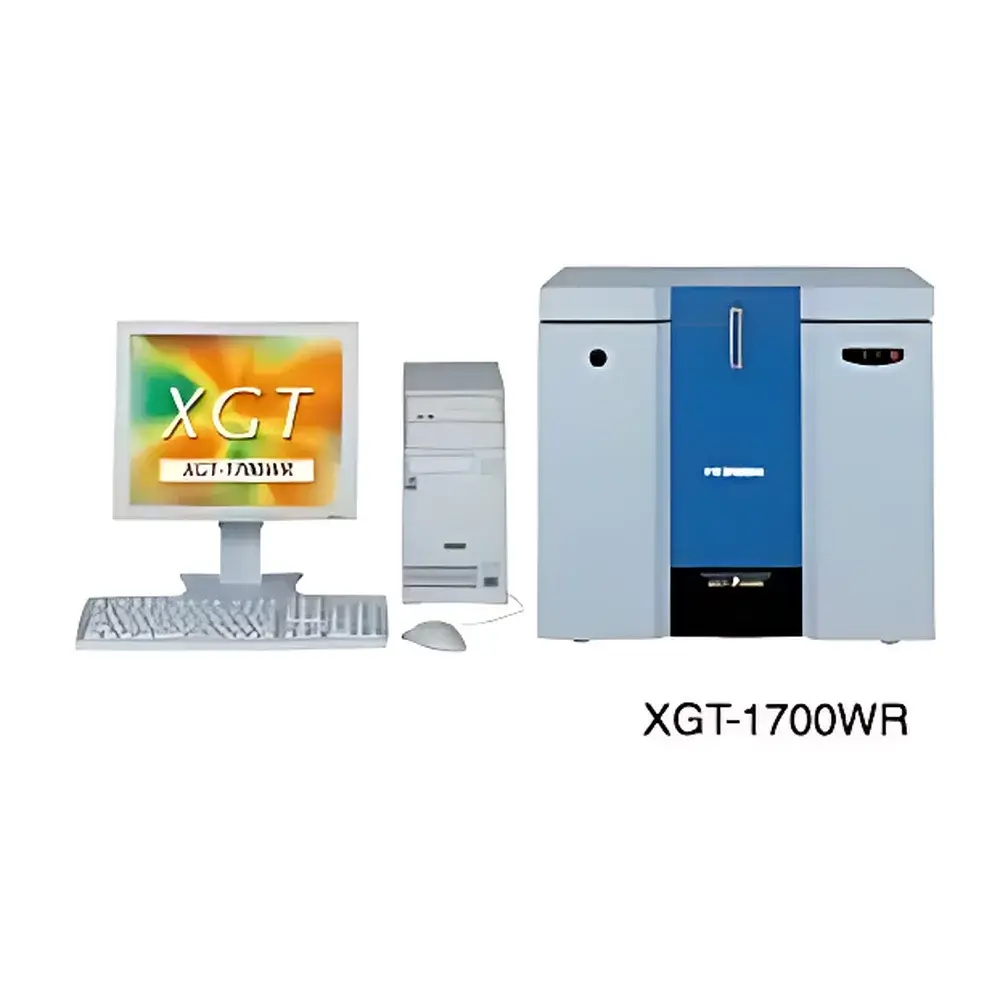
Horiba XGT-1700 Wavelength Dispersive X-Ray Fluorescence Spectrometer
| Origin | Japan |
|---|---|
| Manufacturer Type | Authorized Distributor |
| Origin Category | Imported |
| Model | XGT-1700 |
| Price Range | USD 42,000–70,000 |
| Instrument Type | Scanning |
| X-ray Tube Power | Not Applicable (Rh anode, max 50 kV / 1 mA) |
| Elemental Range | Na to U |
| Detection Limits | Cd ≤ 2 ppm, Pb ≤ 5 ppm, Cl ≤ 50 ppm |
| Sample Chamber Max Size | 460 × 360 × 150 mm |
| X-ray Beam Diameters | Φ1.2 mm and Φ3.0 mm (motorized switching) |
| Detector | High-Purity Silicon XEROPHY Detector |
| Liquid Nitrogen Capacity | 3 L |
| LN₂ Consumption | <1 L/day (only during operation) |
| Optical Magnification | 50× (coaxial with X-ray beam) |
| Software | Automated qualitative/quantitative analysis (fundamental parameters method, calibration curve method, single-point correction) |
| PC Requirements | Pentium IV ≥1.8 GHz, ≥1 GB RAM, ≥120 GB HDD, Windows XP, 17″ monitor, color inkjet printer |
| Ambient Temp | 10–35 °C (optimal), 5–40 °C (operational) |
| Humidity | ≤80% RH at 5–31 °C |
| Power Supply | AC 100/120/220/240 V ±10%, 50/60 Hz |
| Power Consumption | ≤1.3 kVA (system-wide) |
| Weight | ~265 kg (analysis unit only) |
| Dimensions | Analyzer Unit: 610(W) × 750(D) × 500(H) mm |
| Signal Processing Unit | 220(W) × 500(D) × 480(H) mm |
Overview
The Horiba XGT-1700 is a high-resolution wavelength dispersive X-ray fluorescence (WDXRF) spectrometer engineered for non-destructive elemental analysis of solid, powdered, and thin-film samples in industrial QA/QC, materials science, and regulatory compliance laboratories. Unlike energy-dispersive systems (EDXRF), the XGT-1700 employs sequential crystal diffraction optics—using analyzing crystals such as LiF(200), PET, or TAP—to resolve characteristic X-ray lines with superior peak-to-background ratios and spectral resolution. This architecture enables precise quantification across the full elemental range from sodium (Na, Z=11) to uranium (U, Z=92), including light elements down to Na under atmospheric conditions—without vacuum or helium purge. The instrument integrates a high-stability Rh-target X-ray tube (max 50 kV / 1 mA), motorized dual-beam optics (Φ1.2 mm and Φ3.0 mm collimation), and a coaxial 50× optical microscope for precise sample positioning and feature-specific micro-analysis. Designed for long-term stability and reproducibility, the XGT-1700 conforms to ISO 21043 (XRF general requirements) and supports trace-level detection limits—Cd ≤ 2 ppm, Pb ≤ 5 ppm, Cl ≤ 50 ppm—under routine operating conditions.
Key Features
- Motorized dual-beam collimation system enabling rapid switching between Φ1.2 mm (high spatial resolution) and Φ3.0 mm (enhanced intensity) excitation spots
- Coaxial 50× optical imaging aligned with X-ray focal point for accurate region-of-interest selection and mapping verification
- High-purity silicon XEROPHY detector with liquid nitrogen cooling (3 L dewar, <1 L/day consumption), ensuring low-noise spectral acquisition and extended detector lifetime
- Rh anode X-ray source optimized for broad-line excitation and minimal Bremsstrahlung background, supporting both light-element (Na–F) and heavy-metal (Pb, Cd, Hg, Cr) analysis
- Robust mechanical design with vibration-damped optical bench and temperature-stabilized goniometer, minimizing drift during multi-hour scans
- Modular signal processing unit (220 × 500 × 480 mm) decoupled from the analyzer head for service accessibility and electromagnetic isolation
Sample Compatibility & Compliance
The XGT-1700 accommodates flat, irregular, and layered samples up to 460 × 360 mm in footprint and 150 mm in height—compatible with standard PCBs, metal alloys, geological slabs, polymer films, and coated substrates. Analysis occurs under ambient atmosphere, eliminating the need for evacuation or gas purging—a critical advantage for hygroscopic, volatile, or large-format specimens. The system complies with IEC 61000-6-3 (EMC emissions) and IEC 61000-6-2 (immunity), and its software architecture supports audit-trail logging per FDA 21 CFR Part 11 requirements when deployed in GLP/GMP-regulated environments. Routine calibration verification adheres to ASTM E1621 (standard practice for WDXRF elemental analysis) and ISO 8258 (Shewhart control charts for analytical process monitoring).
Software & Data Management
The integrated Horiba XGT software suite provides fully configurable workflows for qualitative identification (peak search, library matching), quantitative analysis (fundamental parameters method, empirical calibration curves, single-point normalization), and automated batch processing. Users define multi-step analysis programs—including stage movement, beam size selection, dwell time, and detector gain—that execute unattended. All spectra, metadata, and processing logs are stored in a relational database with time-stamped entries, user authentication, and version-controlled method files. Export formats include ASCII, CSV, and XML for integration with LIMS platforms (e.g., Thermo Fisher SampleManager, LabWare LIMS). Data integrity safeguards include electronic signatures, session locking, and automatic backup to network drives.
Applications
- RoHS and ELV directive screening: Quantitative determination of restricted substances (Cd, Pb, Hg, Cr⁶⁺, Br) in electronics, plastics, and automotive components
- Geochemical assay: Major oxide (SiO₂, Al₂O₃, Fe₂O₃) and trace element (Ni, Co, Zn, REEs) profiling in soils, ores, and ceramics
- Metallurgical QA: Alloy grade verification (e.g., stainless steels, superalloys), coating thickness and composition (Zn/Ni/Cr on steel), and inclusion analysis
- Forensic and art conservation: Non-invasive pigment identification, provenance studies of pigments and glass, and corrosion layer characterization
- Pharmaceutical packaging: Elemental verification of container-closure systems (Al, Si, Ca, Ti) and leachable metal screening (Fe, Ni, Cr)
FAQ
Does the XGT-1700 require vacuum or helium purge for light-element analysis?
No. The instrument performs Na–F analysis under ambient air using optimized crystal/detector geometry and background subtraction algorithms.
Can the system perform mapping or line-scan analysis?
Yes. The motorized XYZ stage supports programmable raster scanning with spatial resolution down to 10 µm (Φ1.2 mm beam), generating elemental distribution maps.
Is liquid nitrogen refilling automated?
No—manual refilling is required. However, the 3 L dewar and <1 L/day consumption support ≥72 hours of continuous operation between fills.
What standards are supported for calibration?
Certified reference materials (CRMs) from NIST, BAM, and JSS are compatible. The software includes preloaded calibration sets for common matrices (glass, steel, soil, polymer).
How is data security ensured in regulated environments?
User roles, electronic signatures, audit trails, and encrypted database backups comply with 21 CFR Part 11 and ISO/IEC 17025 documentation requirements.




