
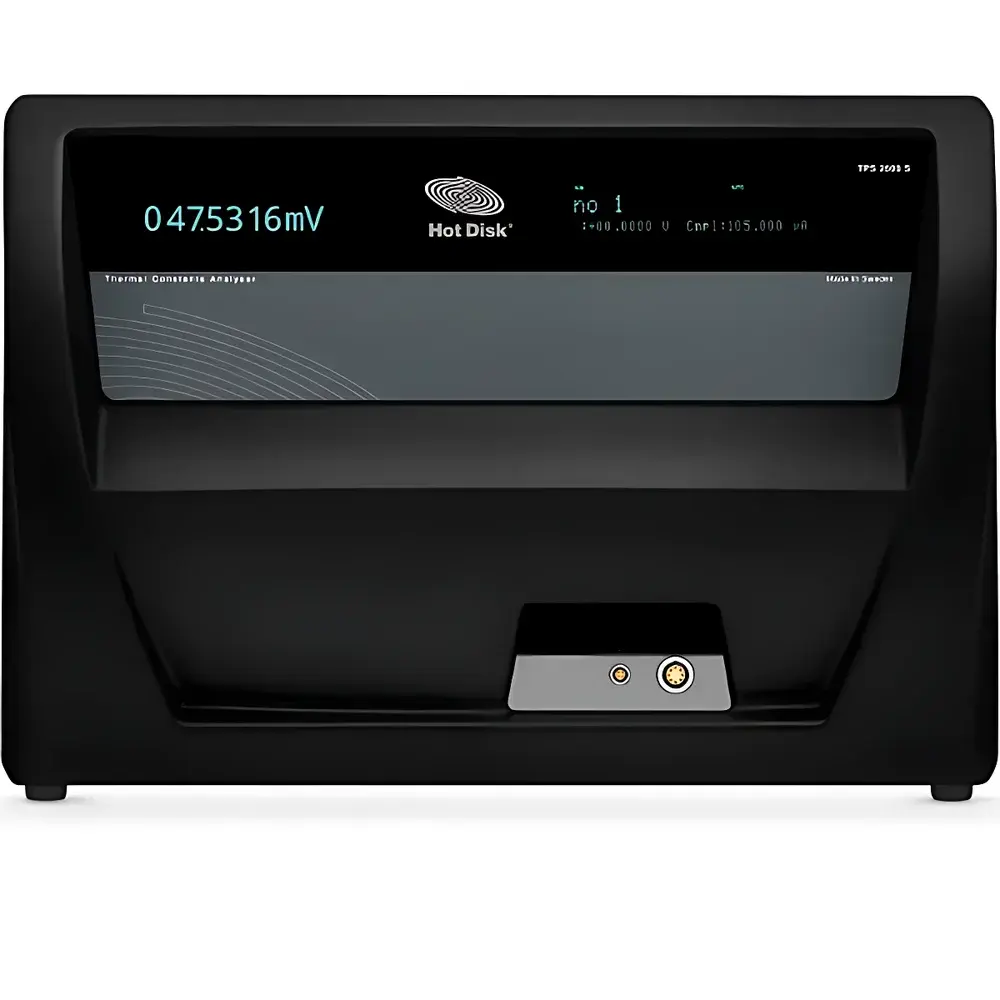
Hot Disk 2500S Transient Plane Source Thermal Conductivity Analyzer
| Brand | Hot Disk |
|---|---|
| Origin | Sweden |
| Model | 2500S |
| Measurement Principle | Transient Plane Source (TPS) Method |
| Thermal Conductivity Range | 0.005–2000 W/m·K |
| Temperature Range | 30 K to 1000 °C |
| Accuracy | ±3% |
| Repeatability | <1% |
| Sample Forms | Solids, Liquids, Powders, Pastes, Thin Films, Coatings, Anisotropic & Composite Materials |
| Test Atmosphere | Air, Vacuum, or Inert Gas |
| Dimensions (L×W×H) | 500 × 450 × 320 mm |
| Probe Diameter Options | 2–29.4 mm |
| Additional Outputs | Thermal Diffusivity (±5%), Volumetric Heat Capacity (±7%) |
Overview
The Hot Disk 2500S is a high-precision, benchtop thermal property analyzer engineered for the rapid and contactless determination of thermal conductivity, thermal diffusivity, and volumetric heat capacity using the Transient Plane Source (TPS) method. Unlike steady-state or guarded-hot-plate techniques, the TPS principle relies on a symmetric, double-sided sensor that acts simultaneously as both heater and temperature sensor. When energized with a constant current pulse, the sensor induces a transient temperature rise in the surrounding material; the resulting voltage response is analyzed to extract thermal transport properties without requiring thermal equilibrium. This physics-based approach eliminates interfacial contact resistance errors common in comparative or static methods—making it especially suitable for heterogeneous, anisotropic, or low-conductivity materials where conventional contact thermometry introduces significant uncertainty. The system operates across an exceptionally broad thermal range—from cryogenic conditions (30 K) to high-temperature environments (up to 1000 °C)—and supports configurable environmental chambers for controlled-atmosphere testing (air, vacuum, or inert gas).
Key Features
- True transient measurement: Full thermal property extraction within seconds per test, enabling high-throughput screening without thermal soak time.
- Multi-parameter output: Simultaneous calculation of thermal conductivity (k), thermal diffusivity (α), and volumetric heat capacity (ρcp) from a single measurement event.
- Modular probe architecture: Interchangeable sensor diameters (2 mm to 29.4 mm) optimized for specific sample geometries and thermal ranges—e.g., micro-probes for thin films or large-diameter sensors for bulk composites.
- Minimal sample preparation: Requires only nominally flat, clean surfaces; no polishing, metallization, or bonding agents needed—critical for preserving native microstructure in fragile or reactive samples.
- Robust thermal control integration: Compatible with external cryostats, high-temperature furnaces, and environmental enclosures meeting ASTM E1225 and ISO 22007-2 validation requirements.
- Traceable calibration: Factory-calibrated against NIST-traceable reference materials (e.g., Pyroceram 9606, graphite, copper) with documented uncertainty budgets per ISO/IEC 17025.
Sample Compatibility & Compliance
The 2500S accommodates diverse physical forms—including isotropic solids, porous ceramics, polymer melts, nanoparticle suspensions, phase-change materials, anisotropic laminates, and functional coatings—without modification to core hardware. Its non-destructive, symmetric heating geometry ensures reliable data for materials with high interfacial resistance (e.g., thermal interface materials, battery electrode stacks, or ceramic matrix composites). All measurements comply with international standards governing transient thermal analysis: ISO 22007-2 (plastics), ASTM D5470 (thermal transmission properties of thermally conductive electrical insulation materials), and IEC 60250 (dielectric properties at audio frequencies). For regulated industries, optional software modules support 21 CFR Part 11-compliant audit trails, electronic signatures, and raw-data archiving aligned with GLP/GMP documentation practices.
Software & Data Management
Thermal Conductivity Analysis Software (TCAS) v5.x provides full instrument control, real-time signal visualization, automated curve fitting, and multi-layered reporting. It implements advanced deconvolution algorithms to separate boundary effects from intrinsic material response, particularly critical when testing thin films (<100 µm) or layered structures. Raw voltage-time datasets are stored in HDF5 format with embedded metadata (timestamp, ambient pressure, probe ID, operator credentials), ensuring FAIR (Findable, Accessible, Interoperable, Reusable) data principles. Export options include CSV, Excel, and XML schemas compatible with LIMS integration. Optional Python and MATLAB APIs enable custom script-driven batch processing and correlation with finite-element thermal simulations.
Applications
- Advanced materials R&D: Characterizing thermal anisotropy in carbon fiber composites, thermal barrier coatings for turbine blades, and phonon-scattering mechanisms in thermoelectrics.
- Energy storage: Quantifying through-plane vs. in-plane conductivity in lithium-ion battery separators, cathode slurries, and solid-state electrolytes under variable SOC and temperature.
- Electronics thermal management: Validating TIM performance across power cycling, measuring junction-to-case resistance in packaged ICs, and mapping thermal gradients in PCB substrates.
- Geosciences & nuclear engineering: Measuring thermal diffusivity of refractory oxides, molten salt simulants, and irradiated fuel cladding materials under simulated reactor conditions.
- Pharmaceutical development: Assessing thermal stability of lyophilized formulations, excipient compatibility in hot-melt extrusion, and heat transfer behavior in transdermal patches.
FAQ
How does the TPS method differ from laser flash analysis (LFA)?
TPS measures thermal conductivity directly via transient heating of a planar sensor embedded between two sample halves, whereas LFA infers diffusivity from rear-surface temperature rise after a short laser pulse. TPS provides absolute k-values without calibration standards; LFA requires known reference materials for α-to-k conversion.
Can the 2500S measure anisotropic thermal conductivity?
Yes—by orienting rectangular or dual-sensor probes and performing directional scans, the system quantifies principal thermal conductivities (kx, ky, kz) in orthotropic materials such as graphite, wood, or unidirectional composites.
Is vacuum-compatible testing supported out-of-the-box?
The base unit includes vacuum-rated feedthroughs and flange-mounting interfaces; optional high-vacuum chambers (10−6 mbar) and differential pressure monitoring are available as configured systems.
What is the minimum sample thickness required for valid measurement?
For standard double-sided configuration, minimum thickness is 2× probe radius + 1 mm; single-sided mode enables testing of substrates as thin as 0.5 mm with appropriate backing material.
Does the system support automated temperature ramping during measurement?
Yes—integrated PID-controlled temperature stages allow programmed linear or stepwise ramps (0.1–5 °C/min) with synchronized property acquisition at user-defined setpoints.



