
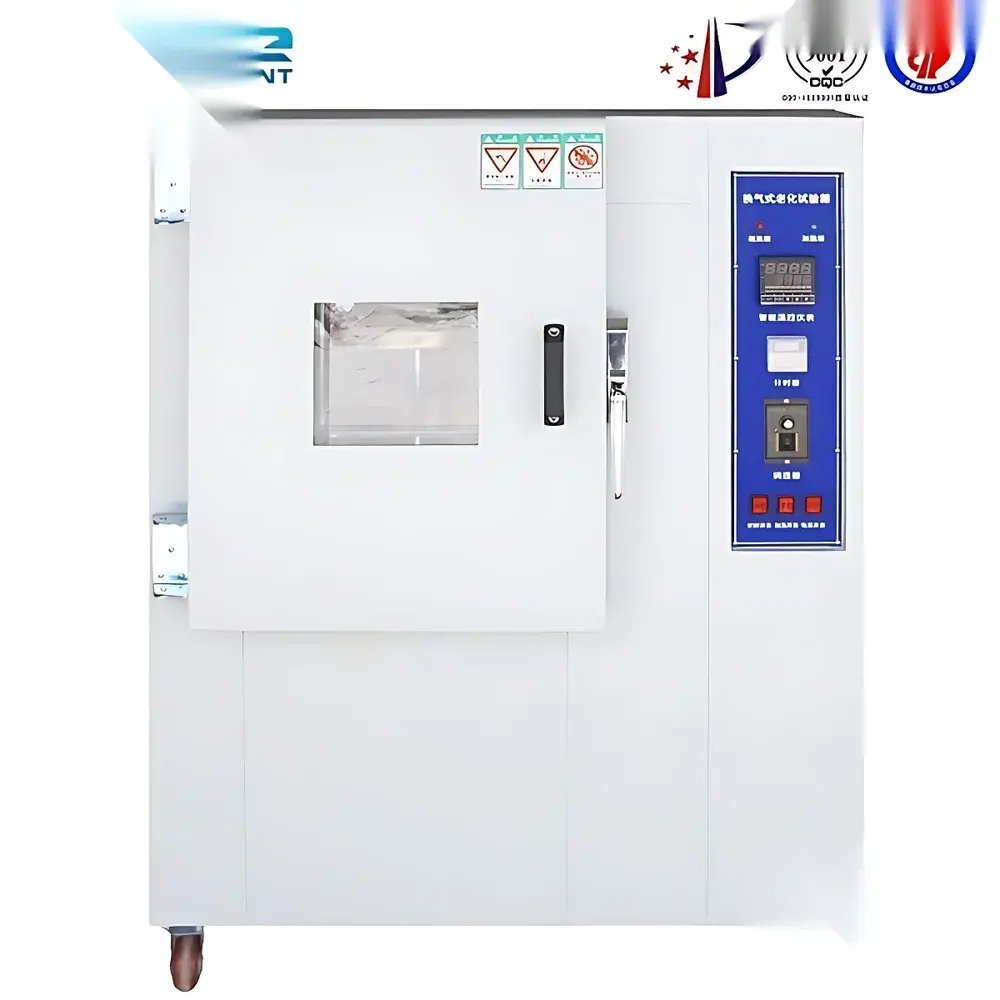
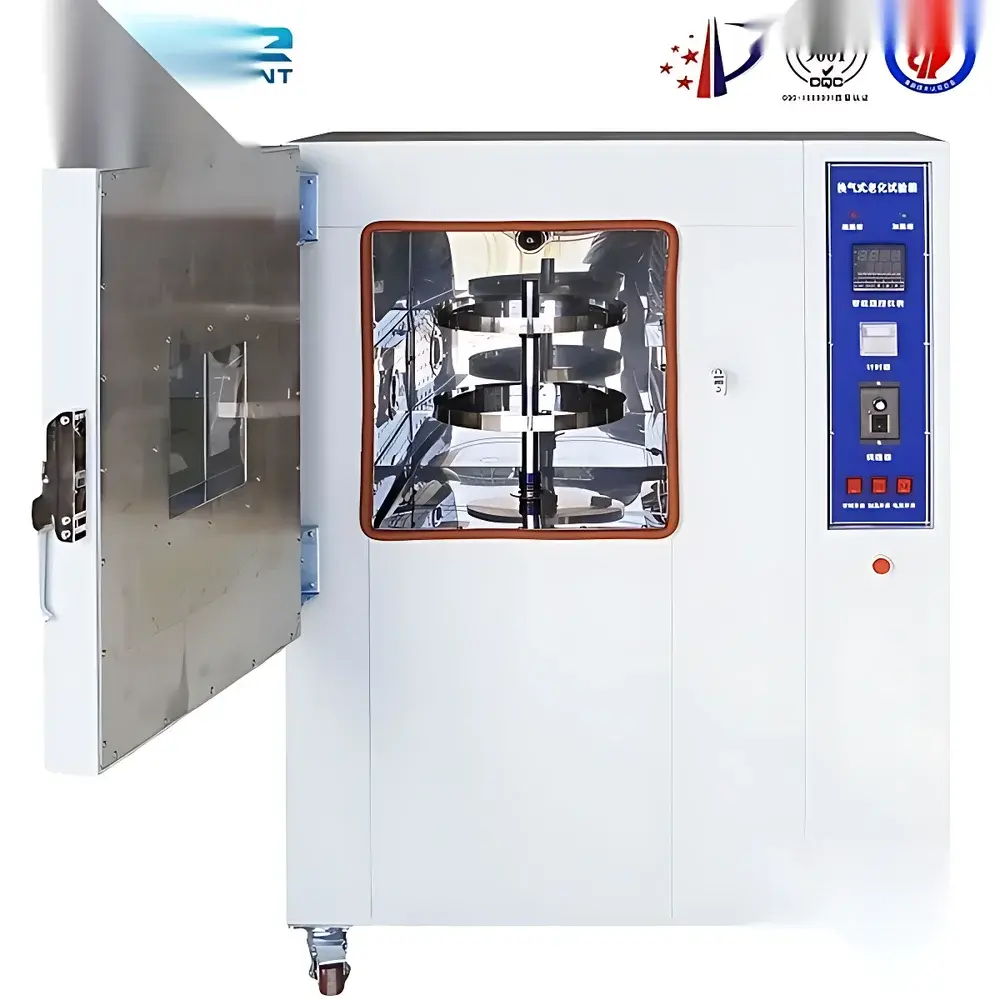
OK-HQ-90 High-Temperature Air-Circulating Aging Test Chamber
| Brand | Other Brands |
|---|---|
| Origin | Imported |
| Manufacturer Type | Authorized Distributor |
| Model | OK-HQ-90 |
| Temperature Range | RT+10°C to 200°C |
| Temperature Uniformity | ±2°C |
| Temperature Fluctuation | ±0.5°C |
| Air Exchange Rate | 2–100 cycles/hour |
| Adjustable Air Exchange Time | 1 min–99 h |
| Internal Chamber Dimensions (W×D×H) | 450×450×500 mm |
| External Dimensions (W×D×H) | 1100×830×1600 mm |
| Power Rating | 4.0 kW |
| Controller | LED Digital PID Microprocessor Controller (Set/Display Resolution: 0.1°C) |
| Timer Range | 1–9999 min |
| Rotating Turntable Diameter | Φ250 mm |
| Test Port | One Ø50 mm port on left side |
| Compliance | ASTM D5423-09 (Type II), ASTM D5374-93 (2005), UL 1581, GB/T 2423.2, IEC 60068-2-2, JIS C 0068, VDE 0470 |
Overview
The OK-HQ-90 High-Temperature Air-Circulating Aging Test Chamber is an engineered environmental test system designed for accelerated thermal aging evaluation of polymeric and insulating materials under controlled, continuously refreshed atmospheric conditions. Based on the principle of forced convection with programmable air exchange, it replicates long-term thermal degradation effects—such as oxidation, embrittlement, discoloration, and loss of mechanical integrity—in a condensed timeframe. Its operational architecture adheres to the fundamental requirements of ASTM D5423-09 (Type II laboratory ovens) and ASTM D5374-93(2005), ensuring traceable, repeatable, and standards-compliant aging protocols for wire & cable insulation, rubber compounds, textile laminates, and plastic components used in electrical, automotive, and aerospace applications.
Key Features
- Precision-engineered air exchange regulation system enabling adjustable air replacement rates from 2 to 100 cycles per hour—critical for simulating real-world ventilation-dependent aging mechanisms.
- Microprocessor-based PID temperature controller with 0.1°C setpoint and display resolution, integrated timer (1–9999 minutes), and over-temperature cut-off protection.
- Horizontal forced-air circulation system with high-temperature-resistant centrifugal blower and symmetrical baffle design ensures ±2°C temperature uniformity across the 450 × 450 × 500 mm stainless steel (SUS304) working chamber.
- Double-wall construction: inner chamber fabricated from polished SUS304 stainless steel; outer shell formed from A3 cold-rolled steel with electrostatic powder coating for corrosion resistance and structural rigidity.
- Insulation using high-density ultra-fine glass fiber cotton (≥100 mm thickness) minimizes thermal leakage and improves energy efficiency during extended high-temperature operation (up to 200°C).
- Standard horizontal rotating turntable (Φ250 mm) enables uniform exposure of multi-sided or asymmetric specimens to thermal and airflow gradients.
- Large observation window with tempered glass and built-in LED illumination allows real-time visual monitoring without thermal interruption.
- Dedicated Ø50 mm test port on the left chamber wall facilitates external power/signal line integration for in-situ resistance, tensile, or dielectric measurements during aging cycles.
Sample Compatibility & Compliance
The OK-HQ-90 accommodates flat, cylindrical, or flexible specimens—including insulated wires, elastomeric gaskets, PVC sheathing, silicone hoses, and nonwoven fabrics—without dimensional interference. Its validated thermal profile and air exchange fidelity meet mandatory pre-conditioning and aging requirements specified in UL 1581 (Section 1060), IEC 60811-501, GB/T 2951.12, VDE 0470-1, and JIS C 0068. The chamber’s design supports GLP-aligned test execution: all operating parameters (set temperature, dwell time, air exchange count, and cycle history) are manually logged and can be cross-referenced against calibration records. While not natively 21 CFR Part 11 compliant, its deterministic control logic and stable thermal output enable integration into validated QA workflows when paired with external electronic lab notebooks (ELNs) or LIMS systems.
Software & Data Management
The OK-HQ-90 operates via a standalone LED-based microcontroller interface with no embedded software stack or network connectivity. All operational parameters—including target temperature, dwell duration, air exchange frequency, and cumulative runtime—are entered and monitored locally. For traceability, users are advised to maintain manual logs aligned with ISO/IEC 17025 documentation practices. Optional analog outputs (0–5 V or 4–20 mA) for temperature and airflow status may be interfaced with third-party data acquisition systems for continuous trending. Firmware updates are not supported; calibration verification must be performed annually using NIST-traceable thermocouples and calibrated anemometers per ASTM E740.
Applications
- Evaluation of thermal oxidative stability in PVC, PE, EPDM, and silicone-based insulation materials per UL 1581 Clause 1060.
- Pre-aging treatment of specimens prior to tensile, elongation, or dielectric strength testing per ASTM D412 and IEC 60243-1.
- Accelerated life modeling of automotive wiring harnesses exposed to under-hood thermal environments.
- Compliance verification for RoHS-exempt high-temperature polymers requiring extended thermal endurance validation.
- Quality assurance screening of batch-to-batch consistency in extruded cable jacket compounds.
FAQ
What standards does the OK-HQ-90 explicitly support?
It meets the physical and operational criteria defined in ASTM D5423-09 (Type II), ASTM D5374-93(2005), UL 1581, GB/T 2423.2, IEC 60068-2-2, JIS C 0068, and VDE 0470-1.
Can the air exchange rate be verified independently?
Yes—using calibrated anemometry at the exhaust and intake ducts, combined with chamber volume calculation (0.101 m³), users can validate actual air changes per hour (ACH) against set values.
Is the turntable speed adjustable?
No—the turntable rotates at fixed low speed (typically <1 rpm) to ensure mechanical stability at elevated temperatures; speed adjustment is not provided.
Does the unit include temperature calibration certification?
No factory-issued calibration certificate is included; users must perform initial and periodic verification using accredited reference standards per ISO/IEC 17025 requirements.
What maintenance is required for sustained accuracy?
Monthly inspection of door gasket integrity, quarterly cleaning of air inlet filters and blower housing, and annual recalibration of the temperature sensor and controller input circuitry.



