
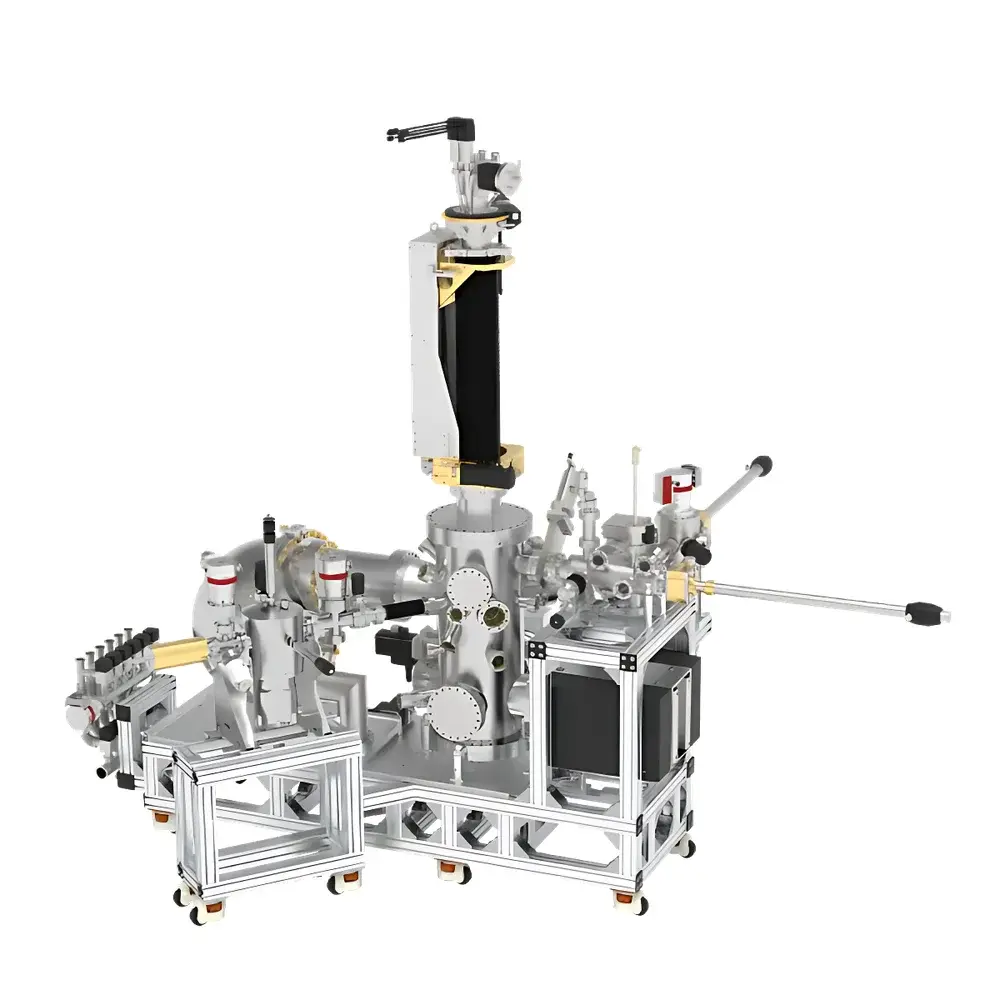
HR-ARPES200 High-Resolution Angle-Resolved Photoemission Spectroscopy System
| Brand | Csi-lab |
|---|---|
| Model | HR-ARPES200 |
| Energy Resolution | ≤1.8 meV |
| Base Temperature | ≤6.0 K |
| Photon Flux | ≥6×10¹¹ ph/s |
| Origin | Jiangsu, China |
| Distribution Type | Authorized Distributor |
Overview
The HR-ARPES200 is a high-performance, ultra-high-vacuum (UHV) angle-resolved photoemission spectroscopy (ARPES) system engineered for quantitative electronic band structure mapping of crystalline and low-dimensional quantum materials. Based on the fundamental principle of the photoelectric effect—where incident photons eject electrons from a sample surface whose kinetic energy and emission angle are measured to reconstruct the material’s momentum-resolved electronic dispersion—this system delivers sub-meV energy resolution and sub-degree angular precision. Designed for operation at cryogenic temperatures down to 6.0 K, the HR-ARPES200 enables studies of delicate quantum phenomena including superconducting gaps, topological surface states, charge density waves, and Mott insulating behavior. Its integrated UHV chamber (<5×10⁻¹¹ mbar base pressure), in-situ sample preparation capabilities (including resistive heating, electron-beam evaporation, and ion sputtering), and precise 6-axis manipulator ensure experimental reproducibility and surface integrity across extended measurement campaigns.
Key Features
- Ultra-high energy resolution: ≤1.8 meV at helium lamp (21.2 eV He I) or synchrotron-compatible monochromated sources, enabling gap-size quantification in unconventional superconductors and fine structure analysis of van Hove singularities.
- Cryogenic sample stage with active cooling to ≤6.0 K using closed-cycle helium refrigeration; temperature stability <±10 mK over 24 h for long-duration Fermi surface mapping.
- High-flux photon source delivering ≥6×10¹¹ photons per second at the sample position—optimized for signal-to-noise ratio without compromising resolution via slit-limited optics or excessive monochromator attenuation.
- Double-focusing hemispherical electron analyzer with 150 mm mean radius, 128-channel detector array, and motorized entrance slit (adjustable 10–200 µm) for simultaneous energy–angle acquisition.
- Integrated six-axis UHV manipulator (XYZ translation + polar/azimuthal tilt + rotation) with bakeable ceramic feedthroughs and real-time position feedback for precise crystallographic alignment.
- Modular vacuum architecture compliant with ISO-KF and CF flange standards; base pressure <5×10⁻¹¹ mbar after 72-h bakeout at 150 °C, supporting in-situ cleavage, thin-film growth, and surface dosing experiments.
Sample Compatibility & Compliance
The HR-ARPES200 accommodates single crystals, exfoliated 2D flakes (graphene, TMDs, MXenes), epitaxial thin films (oxide heterostructures, iron-based superconductors), and air-sensitive samples via load-lock transfer. Sample holders support electrical transport pre-characterization and in-situ field application (up to ±9 T with optional split-coil magnet integration). All vacuum components meet ASTM E595 outgassing specifications for UHV applications. The system design adheres to ISO 27423 (vacuum equipment safety), IEC 61000-6-3 (EMC emissions), and supports GLP-compliant documentation workflows through timestamped metadata logging and audit-trail-enabled instrument control.
Software & Data Management
Control and data acquisition are managed via CsiLab’s proprietary ARPES Suite v4.2—a Python-based platform with modular drivers for hardware synchronization (delay generators, piezo stages, photon choppers). Real-time spectral visualization includes Fermi surface reconstruction, MDC/EDC fitting, and band curvature extraction using non-linear least-squares algorithms. Raw data is saved in HDF5 format with embedded metadata (sample ID, temperature, photon energy, slit width, lens mode), ensuring FAIR (Findable, Accessible, Interoperable, Reusable) compliance. Export modules support ASCII, NetCDF, and direct import into Igor Pro, MATLAB, and Python (SciPy/NumPy) environments. Optional 21 CFR Part 11-compliant configuration available with electronic signatures, role-based access control, and immutable audit logs.
Applications
- Mapping quasiparticle interference patterns and scattering vectors in correlated electron systems.
- Resolving k-dependent superconducting gap anisotropy in cuprates and Fe-based superconductors.
- Identifying Dirac and Weyl node locations and Berry curvature distributions in topological semimetals.
- Tracking band renormalization and many-body effects under electrostatic gating or chemical doping.
- Validating first-principles DFT band calculations against experimental dispersion relations with sub-10 meV fidelity.
- Time-resolved ARPES (tr-ARPES) readiness via optional pump-probe optical delay line integration (femtosecond laser compatibility).
FAQ
What vacuum level does the HR-ARPES200 achieve, and how is it maintained?
The system reaches a base pressure of <5×10⁻¹¹ mbar after standard UHV bakeout; maintenance relies on a combination of turbomolecular pumping (with Ti-sublimation and NEG pump augmentation) and all-metal sealed CF flanges.
Is the analyzer compatible with variable photon energies?
Yes—the electron optics and pass energy calibration are software-adjustable across 5–100 eV photon ranges; optional monochromator integration supports synchrotron beamline coupling.
Can the system perform in-situ sample cleavage or thin-film deposition?
Yes—integrated cleaving stage (mechanical or thermal), e-beam evaporator (3-source capability), and residual gas analyzer (RGA) enable full surface science workflows without venting.
Does the HR-ARPES200 support automated angular mapping over large k-space regions?
Yes—motorized goniometer with <0.005° step resolution and synchronized CCD readout enables unattended Fermi surface scans over ±15° × ±15° in <4 hours.
What training and technical support options are provided?
Csi-lab offers on-site installation commissioning, 5-day hands-on user training (including data reduction pipelines), and remote diagnostics via secure TLS-encrypted VNC; extended warranty and service contracts include annual performance verification against NIST-traceable reference standards.





