
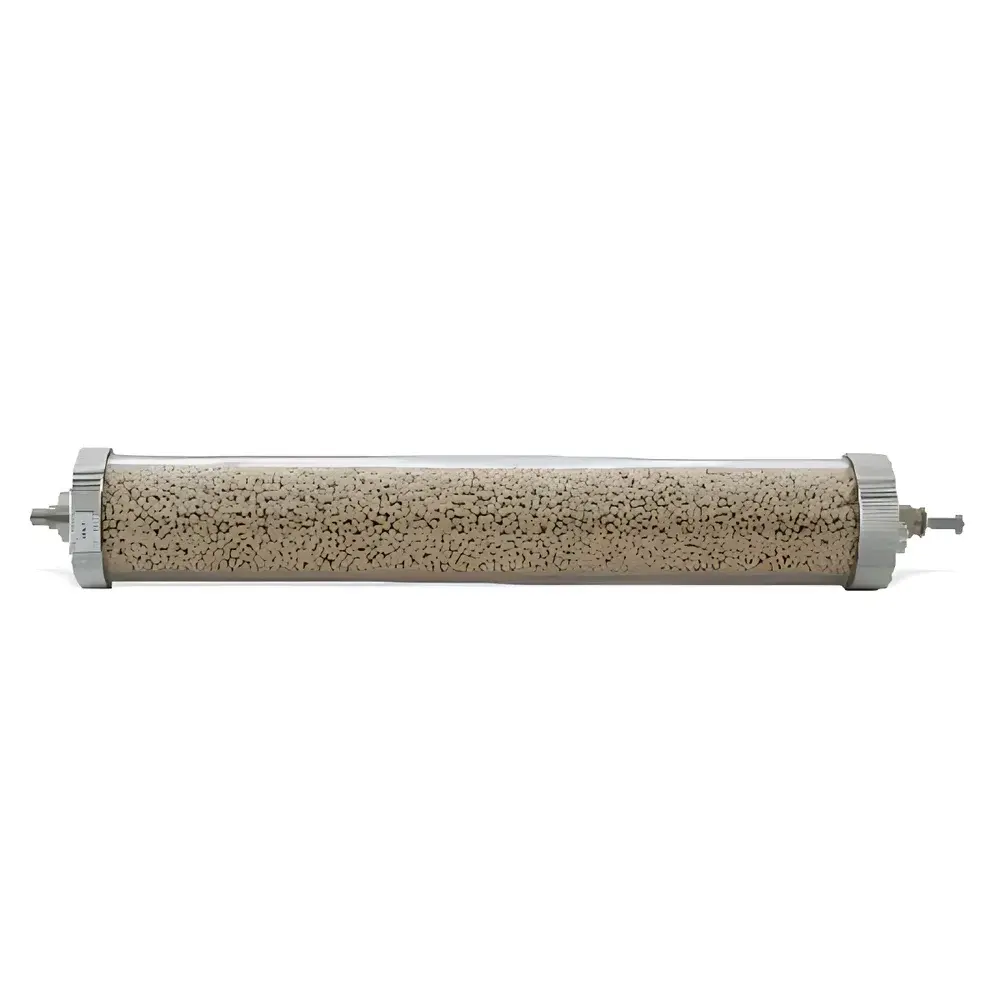
HRH-DRY2 Aerosol Diffusion Dryer
| Brand | Huironghe |
|---|---|
| Origin | Beijing, China |
| Manufacturer Type | Distributor |
| Country of Origin | China |
| Model | HRH-DRY2 |
| Price | Upon Request |
| Dimensions (D × L) | φ76 mm × 484 mm |
| Inlet/Outlet Tubing | One end 8×12 mm silicone tubing, other end 6.5×10 mm PU tubing |
| Chamber Material | High-transparency acrylic |
| Desiccant Type | Molecular sieve |
| Maximum Flow Rate | 4 L/min |
| Construction | Stainless steel semi-permeable tube core, acrylic housing |
Overview
The HRH-DRY2 Aerosol Diffusion Dryer is an engineered component for precision aerosol conditioning in laboratory and research-grade environmental monitoring systems. It operates on the principle of water vapor diffusion across a semi-permeable stainless steel membrane—separating the humid aerosol stream from the desiccant phase without physical contact between particles and drying media. This passive, non-thermal drying mechanism preserves particle integrity, minimizes coagulation and wall loss, and enables stable generation of dry, solid-phase aerosols—including monodisperse polystyrene latex (PSL) spheres and crystalline salt nuclei (e.g., NaCl, NH₄NO₃). Designed for integration downstream of nebulizers, atomizers, or condensation particle generators, the HRH-DRY2 serves as a critical interface between wet aerosol generation and downstream instrumentation such as SMPS systems, optical particle sizers, CPCs, and filter-based mass concentration analyzers.
Key Features
- Non-contact diffusion drying: Humid aerosol flows through a stainless steel semi-permeable tube; water vapor diffuses outward into a surrounding molecular sieve bed—no particle–desiccant interaction occurs, ensuring <1% particle loss across typical operating ranges (0.5–4 L/min).
- Corrosion-resistant construction: All aerosol-wetted surfaces consist of electropolished 316 stainless steel and high-clarity, UV-stable acrylic housing—suitable for extended use with acidic, saline, or hygroscopic aerosols.
- Regenerable desiccant system: Integrated molecular sieve (3 Å or 4 Å) offers high water adsorption capacity and thermal stability; fully regenerable via in-situ heating (180–220 °C under dry N₂ purge) or oven baking—supporting >50 drying cycles without performance degradation.
- Modular, low-pressure-drop design: Optimized internal geometry maintains pressure drop <120 Pa at 4 L/min, minimizing impact on upstream generator stability and flow control accuracy.
- Visual process monitoring: Transparent acrylic chamber allows real-time observation of desiccant color indicators (e.g., cobalt chloride–impregnated sieves) to assess saturation state and schedule regeneration.
Sample Compatibility & Compliance
The HRH-DRY2 supports aerosols spanning 10 nm to 10 µm aerodynamic diameter, including aqueous salt solutions (NaCl, (NH₄)₂SO₄), organic solvents (e.g., DEHS, dioctyl sebacate), and polymer colloids (PSL, silica suspensions). It complies with ISO 27427:2016 (aerosol generation and conditioning), ASTM D6625 (standard practice for aerosol generation for inhalation toxicology), and supports GLP-compliant workflows when paired with validated flow controllers and traceable calibration protocols. The stainless steel core meets FDA-compliant surface finish standards (Ra ≤ 0.8 µm), and the entire unit is compatible with cleanroom Class 1000 environments.
Software & Data Management
While the HRH-DRY2 is a passive, hardware-only conditioner (no embedded electronics or firmware), it integrates seamlessly into automated aerosol test benches via analog pressure/flow sensor inputs and digital I/O triggers. When used with third-party platforms such as TSI’s Aerosol Instrument Manager (AIM) or Cambustion’s DiSCmini Control Suite, its operational status (e.g., desiccant saturation warning via integrated humidity sensor add-on) can be logged alongside size distribution, number concentration, and mass data—enabling full audit trails per 21 CFR Part 11 requirements when deployed in regulated QC/QA labs.
Applications
- Preparation of dry, solid calibration standards for optical particle counters and laser diffraction analyzers.
- Generation of crystalline condensation nuclei for cloud condensation nuclei (CCN) counter calibration and atmospheric nucleation studies.
- Stabilization of hygroscopic aerosols prior to electrical mobility classification (e.g., DMA–CPC coupling).
- Low-loss conditioning of pharmaceutical dry powder inhaler (DPI) plumes for in vitro deposition testing (ISO 27427 Annex B).
- Supporting ISO 14644-3 cleanroom particle challenge tests using monodisperse PSL aerosols.
FAQ
Does the HRH-DRY2 require power or compressed air?
No—it is a passive diffusion-based dryer with no moving parts, electrical components, or pneumatic interfaces.
Can it be used with organic solvent-based aerosols?
Yes, provided the solvent exhibits low volatility at ambient temperature and does not degrade molecular sieve integrity (e.g., avoids chlorinated hydrocarbons or strong acids); compatibility verification is recommended for non-aqueous systems.
What is the expected desiccant lifetime under continuous 4 L/min operation?
With inlet RH <85%, typical service interval is 8–12 hours before regeneration; actual duration depends on aerosol water content and ambient humidity.
Is the stainless steel tube replaceable?
Yes—the semi-permeable tube is a field-serviceable component with standardized O-ring seals; replacement kits are available with certified dimensional and permeability documentation.
Does it meet explosion-proof requirements for hazardous area use?
Not inherently—but optional ATEX-certified enclosure variants (II 2G Ex db IIB T4 Gb) can be configured upon request for Zone 1 deployment.







