
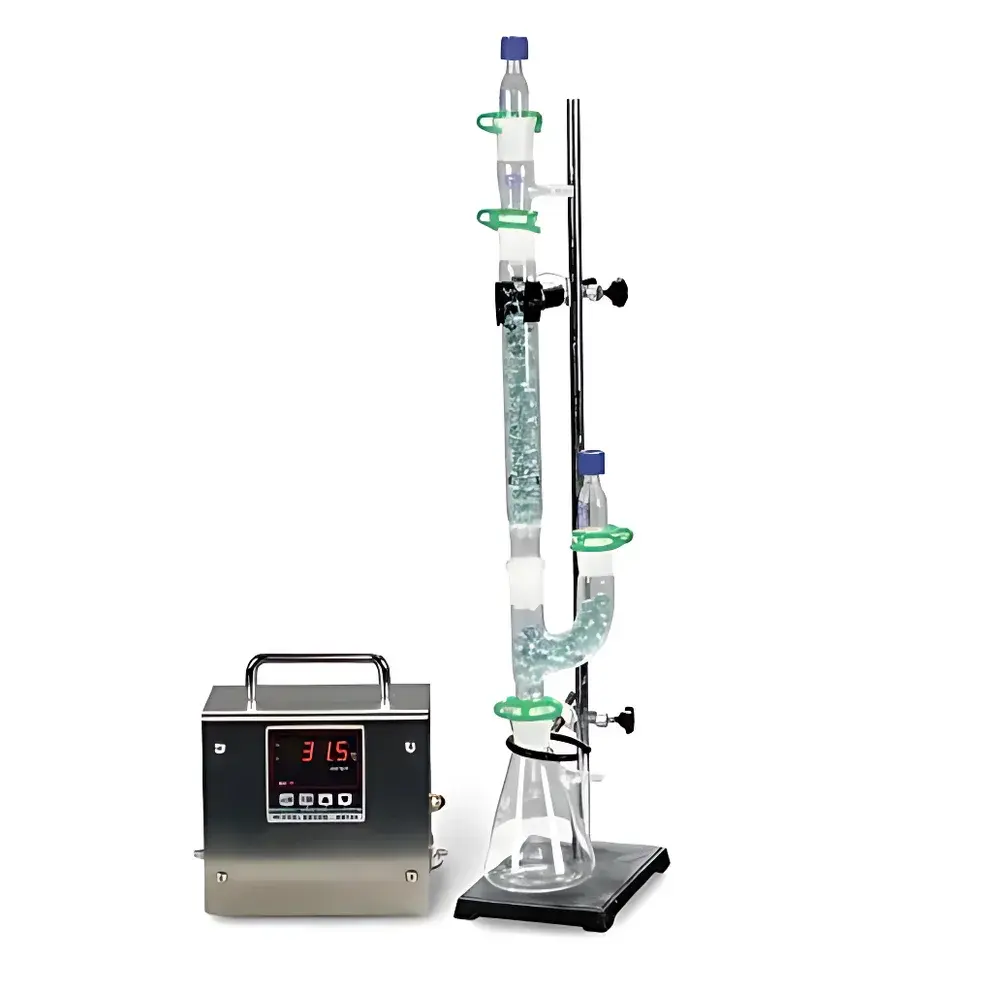
HRH-VOC186 VOC Gas Quantitative Generator
| Brand | Huironghe |
|---|---|
| Origin | Beijing, China |
| Manufacturer Type | Authorized Distributor |
| Country of Origin | China |
| Model | HRH-VOC186 |
| Price | Upon Request |
| Volatilization Rate | 0–5 mL/min |
| Gas Flow Rate | 0–20 L/min |
| Heating Temperature Range | 20–60 °C |
Overview
The HRH-VOC186 VOC Gas Quantitative Generator is an engineered calibration and exposure source system designed for precise, reproducible generation of volatile organic compound (VOC) gas standards in controlled laboratory and testing environments. It operates on the principle of temperature-regulated, convective volatilization from liquid-phase VOCs—such as ethanol, formaldehyde, toluene, and other low-boiling-point solvents—using a glass-bead packed column to maximize surface area and mass transfer efficiency. Unlike passive diffusion or syringe-pump-based methods, this generator delivers dynamically stable output concentrations (ppb to ppm range) by decoupling liquid delivery rate from carrier gas flow, enabling independent control over vapor production kinetics and dilution ratio. It is intended for use in inhalation toxicology studies, method validation of online VOC analyzers (e.g., PID, FID, GC-MS, PTR-TOF), and occupational hygiene exposure assessment under ISO 8518, ASTM D5197, and OSHA Method 1007-compliant protocols.
Key Features
- Temperature-controlled convective volatilization using a precision-heated glass-bead packed column, ensuring uniform thermal distribution and minimizing thermal degradation of thermally labile VOCs
- Independent adjustment of liquid volatilization rate (0–5 mL/min) and carrier gas flow (0–20 L/min), supporting wide dynamic concentration ranges with high repeatability (±2% RSD over 4-hour operation)
- Sealed, leak-tight generation chamber constructed from borosilicate glass and PTFE-sealed fittings, compliant with Class II biosafety enclosure interface requirements
- Digital PID temperature controller with ±0.5 °C stability across 20–60 °C operating range, programmable via front-panel interface or optional RS-485/Modbus RTU communication
- Integrated flow meters (thermal mass type) for both liquid feed and gas output, traceably calibrated to NIST-traceable standards
- No moving parts in the vaporization zone—eliminating wear-related drift and enabling long-term unattended operation during chronic exposure studies
Sample Compatibility & Compliance
The HRH-VOC186 supports a broad spectrum of water-miscible and water-immiscible VOCs, including aldehydes (formaldehyde, acetaldehyde), alcohols (methanol, ethanol, isopropanol), ketones (acetone, MEK), aromatic hydrocarbons (benzene, toluene, xylene), and chlorinated solvents (dichloromethane, chloroform). Compatibility is verified per ASTM D5197 Annex A1 for vapor pressure–temperature correlation and validated against certified reference materials (CRMs) from NIST (e.g., SRM 1861, SRM 1862). The system meets mechanical safety requirements per IEC 61010-1 and is suitable for integration into GLP-compliant inhalation exposure chambers (e.g., whole-body or nose-only rodent systems) where audit-ready documentation of gas generation parameters is required.
Software & Data Management
While the base unit operates via standalone analog/digital controls, optional firmware upgrade enables data logging of temperature, liquid flow, and gas flow at 1 Hz resolution via USB-C or Ethernet. Logged data exports in CSV format with embedded timestamps and operator ID fields—fully compatible with 21 CFR Part 11-compliant electronic lab notebook (ELN) platforms. All configuration changes are recorded in an immutable audit trail, including parameter setpoints, session start/stop times, and calibration event logs. Remote monitoring and control are supported through standard Modbus TCP protocol, facilitating integration into centralized environmental test facility SCADA systems.
Applications
- Calibration and challenge testing of real-time VOC sensors (PID, MOS, electrochemical) and continuous emission monitoring systems (CEMS)
- Inhalation toxicity dose-response studies in OECD 412 (subacute inhalation) and OECD 413 (chronic inhalation) guideline-compliant test facilities
- Validation of indoor air quality (IAQ) sensor networks and HVAC control algorithms under controlled VOC perturbation
- Development and verification of sorbent tube sampling methods (e.g., OSHA ID-255, NIOSH 1501) with known concentration spikes
- Performance evaluation of catalytic oxidation scrubbers and activated carbon filters under realistic breakthrough conditions
FAQ
Can the HRH-VOC186 generate formaldehyde gas without decomposition?
Yes—when operated below 45 °C with optimized carrier gas humidity control (optional humidifier module), formaldehyde generation maintains >95% molecular integrity over 8-hour continuous operation, as confirmed by FTIR and DNPH-HPLC validation.
Is it possible to integrate this generator with an existing exposure chamber’s PLC?
Yes—the device provides native Modbus RTU (RS-485) and optional Modbus TCP interfaces, allowing direct read/write access to all operational parameters and status registers.
What maintenance is required for long-term stability?
Routine maintenance includes quarterly verification of liquid flow meter calibration, annual replacement of PTFE septa and glass bead packing (if exposed to high-boiling residues), and biannual leak-checking per ISO 16000-23 Annex B.
Does the system support multi-component VOC mixtures?
Yes—sequential or simultaneous generation of up to three VOCs is achievable using optional dual- or triple-channel liquid delivery modules, with individual temperature and flow control per channel.
Related Products







