
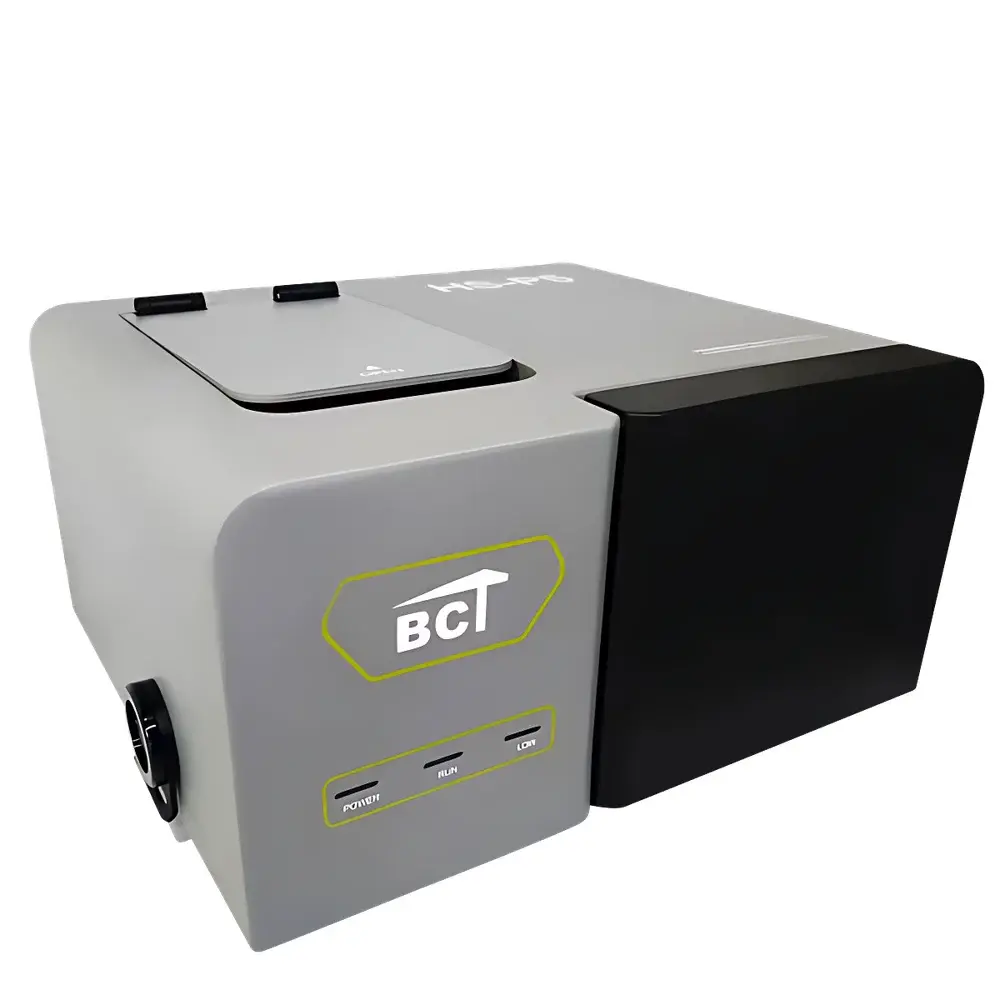
HS-P5 Portable Headspace Sampler
| Brand | BCT |
|---|---|
| Origin | Beijing, China |
| Manufacturer Type | Original Equipment Manufacturer (OEM) |
| Country of Origin | Domestic (China) |
| Model | HS-P5 |
| Instrument Type | Portable |
| Power Supply | Internal Rechargeable Battery or External DC Input |
| Sample Position Capacity | 5 Heated Vials |
| Compatibility | Designed for Coupling with BCT ER Series and P8800 Portable GC-MS Systems |
| Cleaning Function | Integrated Tubing Purge Cycle |
| Operational Mode | Headspace Equilibration with Pre-concentration Estimation Algorithm |
| User Interface | Embedded Control Software with Voice Guidance |
Overview
The HS-P5 Portable Headspace Sampler is a field-deployable, OEM-engineered sampling interface developed by BCT for direct coupling with portable gas chromatography–mass spectrometry (GC-MS) platforms—particularly the BCT P8800 system. It operates on the principle of static headspace analysis: volatile organic compounds (VOCs) partition from solid or liquid matrices (e.g., soil slurries, aqueous samples, or industrial residues) into the vapor phase above the sample under controlled thermal equilibration. This thermodynamic partitioning enables quantitative transfer of analytes without solvent extraction or derivatization, preserving sample integrity and minimizing matrix interference. Engineered for rapid deployment in time-critical scenarios, the HS-P5 eliminates off-site transport and cold-chain logistics—critical factors that compromise VOC stability due to volatilization, adsorption loss, oxidation, or microbial degradation during transit. Its integrated thermal control architecture ensures reproducible equilibration across variable ambient conditions, supporting method transferability between field and laboratory environments.
Key Features
- Five-position heated sample carousel with independent temperature control (range: 40–150 °C, ±0.5 °C stability), enabling parallel equilibration of heterogeneous samples.
- Dual power architecture: rechargeable lithium-ion battery (≥6 h continuous operation at 80 °C) and universal DC input (12–24 V), validated for use in vehicles, mobile labs, and remote sites without grid access.
- Automated headspace injection sequence with real-time voice-guided prompts in English—supporting hands-free operation under PPE or low-visibility conditions.
- Onboard pre-concentration estimation algorithm: calculates approximate analyte concentration trends prior to GC-MS injection using equilibrium constants and vial headspace volume, aiding preliminary triage decisions.
- Self-cleaning gas pathway: programmable carrier-gas purge cycle (He or N₂) between runs minimizes carryover and cross-contamination, meeting ASTM D6866-22 requirements for environmental VOC profiling.
- Modular mechanical interface compliant with ISO 8573-1 Class 4 compressed air specifications, ensuring compatibility with BCT ER-series thermal desorbers and P8800 GC-MS inlet systems.
Sample Compatibility & Compliance
The HS-P5 accommodates standard 10–22 mL crimp-top headspace vials (including EPA-compliant 20 mL amber glass vials with PTFE/silicone septa). It supports heterogeneous matrices per US EPA Method 502.2 (VOCs in drinking water), Method 8260D (VOCs in solids and liquids), and ISO 17993:2021 (field-based VOC screening). All wetted surfaces are passivated stainless steel or fused silica-lined, preventing catalytic degradation of reactive compounds (e.g., chlorinated ethenes, aldehydes). Firmware complies with GLP data integrity principles: audit trail logging, user authentication, and timestamped method parameters—aligned with FDA 21 CFR Part 11 electronic record requirements when paired with validated GC-MS software.
Software & Data Management
Control is managed via embedded Linux-based firmware with a touchscreen GUI (800×480 resolution) and optional Bluetooth 5.0 connectivity for remote configuration via Android/iOS companion app. All method parameters—including equilibration time, oven ramp rate, vial pressurization setpoint, and purge duration—are stored as encrypted .cfg files with SHA-256 checksum validation. Raw thermal and pressure logs are exportable in CSV format for traceability. When interfaced with BCT’s P8800 GC-MS, the HS-P5 synchronizes trigger signals via TTL-level I/O, enabling fully automated acquisition sequences with retention-time-aligned metadata embedding.
Applications
- Environmental Emergency Response: Real-time VOC fingerprinting in contaminated soil cores or surface water following chemical spills—supporting immediate risk classification per WHO IPCS guidelines.
- Industrial Hygiene Monitoring: ODS (ozone-depleting substances) screening in manufacturing facilities per Montreal Protocol Annex A monitoring protocols; workplace air sampling for benzene, styrene, and xylene isomers.
- Public Health Surveillance: Field quantification of disinfection by-products (e.g., chloroform, bromodichloromethane) in municipal water distribution systems per WHO Guidelines for Drinking-water Quality (4th ed.).
- Regulatory Compliance Testing: On-site verification of wastewater discharge compliance against local limits (e.g., China’s GB 31571–2015, EU Industrial Emissions Directive 2010/75/EU).
FAQ
Can the HS-P5 be used with non-BCT GC-MS systems?
Yes—provided the external instrument accepts TTL-triggered headspace injection and supports configurable carrier gas pressure profiles (0–30 psi range). Pinout documentation and protocol specifications are available under NDA.
What is the maximum allowable moisture content in solid samples?
Samples with ≤30% w/w free water are compatible; higher moisture levels may condense in transfer lines and require optional chilled trap integration.
Is method validation support available?
BCT provides IQ/OQ documentation templates aligned with ISO/IEC 17025:2017 and assists with site-specific PQ execution for EPA, CNAS, or ILAC-accredited laboratories.
How often must the internal tubing be replaced?
Under routine use (≤20 injections/day), fused silica transfer lines maintain performance for ≥12 months; replacement kits include calibration certificates traceable to NIST SRM 1648a.





