
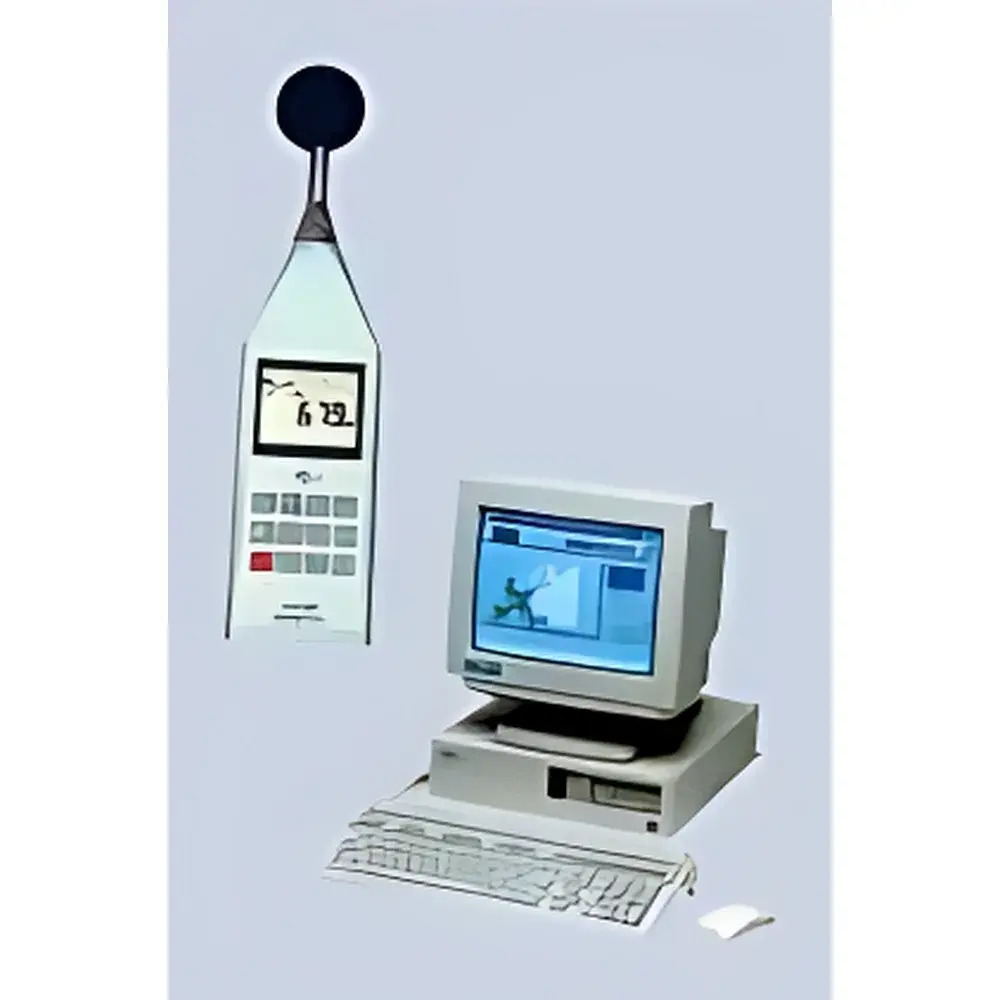
HS6288B Portable Intelligent Noise Spectrum Analyzer
| Origin | China |
|---|---|
| Manufacturer Type | Distributor |
| Model | HS6288B |
| Price | USD 1,390 (FOB) |
| Frequency Range | 31.5 Hz – 8 kHz |
| Sound Pressure Level Range | 35–130 dB(A), 40–130 dB (Linear) |
| Self-Noise | <20 dB(A) |
| Time Weighting | Fast (F), Slow (S), Max Hold |
| Measurement Functions | Leq, LAE, LN (L10/L50/L90), Lmin, Lmax, SD, Ld, Ln, Ldn |
| Measurement Durations | Manual trigger, 10 s, 1 min, 5 min, 10 min, 20 min, 1 h, 8 h, 24 h, and full-hour synchronized logging |
| Display | 54 × 42 mm LCD with analog bar graph, real-time time stamp, measurement mode indicator, and 1/1-octave center frequency readout |
| Interface | RS-232 serial port for PC connectivity and data export |
| Standard Accessories | HS6288B(D) main unit, 4784A thermal printer (with charger), mounting bracket, software CD, thermal paper roll, 18″ protective carrying case, windscreen, screwdriver |
| Optional Accessories | 5 m / 10 m extension cables, Class 1 acoustic calibrator (e.g., HS6020) |
Overview
The HS6288B Portable Intelligent Noise Spectrum Analyzer is a Class 2 compliant sound measurement instrument engineered for field-deployable environmental noise assessment, occupational health monitoring, and regulatory compliance verification. It operates on the principle of precision electret condenser microphone transduction coupled with digital signal processing (DSP) to deliver calibrated A-weighted and linear sound pressure level (SPL) measurements across a defined 1/1-octave band spectrum. Designed in accordance with IEC 61672-1:2013 (Electroacoustics — Sound level meters — Part 1: Specifications), the HS6288B supports standardized time-weighted averaging (Fast and Slow), statistical analysis (L10, L50, L90, Leq, Lmax, Lmin), and long-term integrated metrics including Ldn, Ld, and Ln. Its embedded 1/1-octave band analysis capability enables spectral decomposition at nine center frequencies (31.5 Hz, 63 Hz, 125 Hz, 250 Hz, 500 Hz, 1 kHz, 2 kHz, 4 kHz, and 8 kHz), facilitating source identification, noise barrier evaluation, and frequency-specific regulatory checks per ISO 1996-2 or national emission standards.
Key Features
- Integrated dual-module architecture: Main analyzer unit with built-in DSP engine and detachable thermal printer (Model 4784A) for on-site hardcopy output of spectra and statistics
- Large-format LCD display (54 × 42 mm) featuring simultaneous analog bar graph, numeric SPL readout, time-stamped logging status, and real-time 1/1-octave center frequency indication
- Flexible measurement scheduling: Supports manual initiation, fixed-duration modes (10 s to 24 h), and synchronized hourly logging for continuous 24-hour environmental monitoring campaigns
- Comprehensive statistical engine: Computes Leq, LAE, L10/L50/L90, Lmin, Lmax, standard deviation (SD), day-night average (Ldn), and time-of-day partitioned indices (Ld, Ln)
- RS-232 serial interface compliant with standard PC COM port protocols, enabling bidirectional communication for firmware updates, configuration download, and raw data retrieval
- Robust mechanical design housed in an IP54-rated 18″ protective case with integrated windscreen, mounting bracket, and battery-powered operation for extended field use
Sample Compatibility & Compliance
The HS6288B is optimized for airborne acoustic measurements in outdoor environments, industrial perimeters, transportation corridors, construction sites, and urban residential zones. It accepts standard 1/2″ electret condenser microphones (IEC 61094-4 compliant) and is compatible with optional extension cables (5 m / 10 m) for remote sensor placement. All measurements adhere to IEC 61672-1:2013 Class 2 performance requirements for frequency weighting, time weighting, linearity, and dynamic range. The instrument meets national metrological verification requirements under JJG 188–2017 (China) and supports traceable calibration using Class 1 pistonphone or sound calibrators (e.g., HS6020, optional). Data integrity is maintained through internal clock synchronization and non-volatile memory storage—critical for GLP-aligned reporting and audit-ready documentation.
Software & Data Management
The included Windows-compatible software (supplied on CD) provides post-acquisition visualization, spectral overlay, statistical summary generation, and customizable report templates in PDF/CSV formats. Raw time-series and octave-band datasets are exported via RS-232 with timestamped metadata, supporting integration into enterprise environmental management systems (EMS) or third-party analytics platforms. Audit trails—including operator ID, calibration history, measurement start/stop times, and configuration parameters—are embedded in exported files. While the HS6288B does not implement FDA 21 CFR Part 11 electronic signature controls, its data structure conforms to ISO/IEC 17025 documentation requirements for accredited laboratories performing environmental noise assessments.
Applications
- Environmental impact assessment (EIA) baseline and post-construction noise surveys
- Municipal compliance monitoring against local noise ordinances (e.g., nighttime Lnight limits)
- Industrial hygiene programs evaluating worker exposure per OSHA 1910.95 or ISO 1999
- Transportation noise mapping for road, rail, and airport infrastructure projects
- Educational acoustics labs requiring hands-on spectral analysis training
- Building acoustics pre-commissioning tests (e.g., façade transmission loss estimation via spectral subtraction)
FAQ
What acoustic standards does the HS6288B comply with?
It conforms to IEC 61672-1:2013 Class 2 for sound level meters and supports measurement methodologies aligned with ISO 1996-2 (acoustics — description, measurement and assessment of environmental noise).
Can the instrument perform real-time 1/1-octave analysis during measurement?
Yes — it executes automatic sweep across all nine center frequencies (31.5 Hz to 8 kHz) and displays cumulative band energy in real time; final spectra are printed or exported upon completion.
Is external power required for extended logging?
No — the main unit and printer operate on rechargeable Ni-MH batteries (included); typical runtime exceeds 12 hours under continuous Leq + octave logging mode.
How is calibration verified in the field?
Using an optional Class 1 acoustic calibrator (e.g., HS6020), users can perform pre- and post-measurement checks traceable to national standards; calibration events are logged with date/time stamps.
Does the software support multi-instrument data aggregation?
Yes — the desktop application allows import and comparative plotting of datasets from multiple HS6288B units, enabling spatial noise contouring or temporal trend analysis across monitoring networks.







