
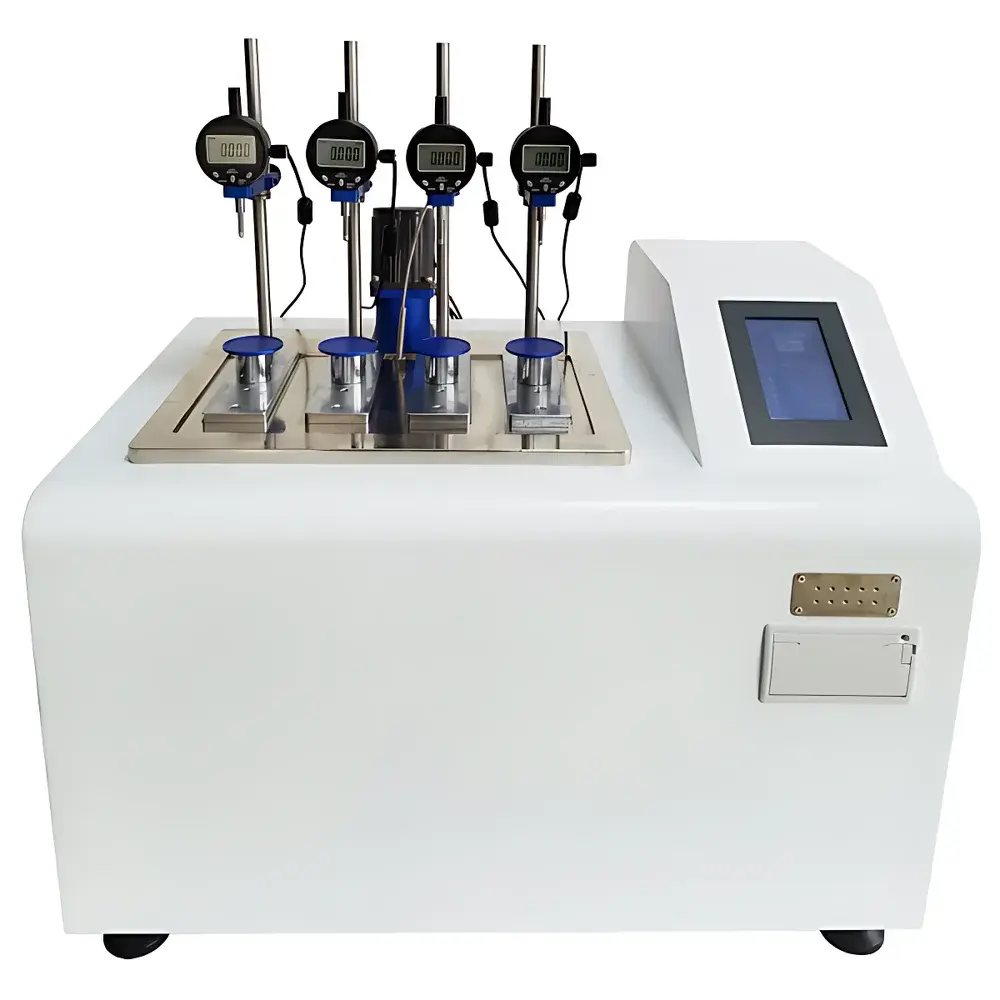
HT-1633-BA-4 Hongtuo Heat Deflection Temperature (HDT) and Vicat Softening Temperature (VST) Tester
| Brand | Hongtuo |
|---|---|
| Model | HT-1633-BA-4 |
| Temperature Range | Ambient to 300 °C |
| Heating Rate Options | (120 ±10) °C/h, (12 ±1) °C/6 min, (50 ±5) °C/h, (5 ±0.5) °C/6 min |
| Temperature Accuracy | ±0.5 °C |
| Temperature Resolution | 0.1 °C |
| Deflection Measurement Range | 0–10 mm |
| Deflection Resolution | ±0.001 mm |
| Specimen Stations | 4 independent test positions |
| Standard Span | 64 mm or 100 mm (per ISO 75 & ASTM D 648) |
| Load Bar + Platter Mass | 68 g |
| Heating Medium | Methyl Silicone Oil |
| Cooling Method | Integrated Forced-Air or External Water Cooling |
| Heating Power | 1.5 kW |
| Oil Bath Capacity | ~13 L |
| Dimensions (L×W×H) | 650 × 460 × 840 mm |
Overview
The HT-1633-BA-4 Hongtuo Heat Deflection Temperature (HDT) and Vicat Softening Temperature (VST) Tester is a precision-engineered instrument designed for standardized thermal performance evaluation of thermoplastic polymers, elastomers, and electrically insulating materials. It operates on two distinct ASTM/ISO-compliant principles: (1) the heat deflection temperature under load (HDT), defined as the temperature at which a standardized test specimen deflects by 0.25 mm under a specified flexural stress; and (2) the Vicat softening temperature (VST), determined by the temperature at which a 1 mm² needle penetrates 1 mm into the material surface under a defined axial load. Both methods rely on controlled thermal ramping in a silicone oil bath, high-resolution linear displacement sensing, and real-time synchronized acquisition of temperature and deformation data. The system employs a programmable logic controller (PLC) architecture with PID-based thermal regulation, ensuring repeatable ramp profiles across multiple simultaneous test stations — critical for QC laboratories operating under ISO/IEC 17025 or GMP-aligned quality systems.
Key Features
- Four independent test stations enable parallel HDT and VST determinations — significantly increasing throughput for batch verification and comparative material screening.
- Precision PID temperature control delivers four selectable heating rates: (120 ±10) °C/h and (50 ±5) °C/h for HDT; (12 ±1) °C/6 min and (5 ±0.5) °C/6 min for VST — fully compliant with ASTM D 648, ASTM D 1525, ISO 75-2:2013, and GB/T 1633–2000.
- High-stability load train: each station uses a calibrated 68 g load bar and platter, with optional standard and custom weights (1 g to 2000 g) enabling full compliance with ISO 75 Part 2 (method A/B/C) and ASTM D 648 (0.45 MPa, 1.82 MPa, or user-defined stress levels).
- Sub-micron deflection resolution (±0.001 mm) via linear variable differential transformer (LVDT)-based displacement sensors ensures traceable measurement uncertainty per ISO/IEC 17025 Clause 7.6.
- Dual cooling options — integrated forced-air convection or external water-cooling interface — support rapid thermal cycling between tests without oil replacement.
- Touchscreen HMI with embedded PLC firmware provides intuitive setup, real-time curve visualization (temperature vs. deflection), automatic endpoint detection, and hardware-enforced thermal cut-off at user-defined upper limits or system fault conditions.
Sample Compatibility & Compliance
The HT-1633-BA-4 accommodates standard rectangular bars (e.g., 80 × 10 × 4 mm per ISO 75) and cylindrical specimens per ASTM D 1525. Test spans are configurable to 64 mm or 100 mm, aligning with both international and Chinese national standards. All mechanical loading components — including Vicat needles (1 mm² flat tip), HDT indenters, and calibrated weight sets — conform to dimensional tolerances specified in ISO 75-3 and ASTM D 648 Annex A1. The instrument meets electromagnetic compatibility (EMC) requirements per IEC 61326-1 and includes dual-layer electrical safety: grounded chassis design and leakage current protection circuitry compliant with IEC 61010-1. Documentation supports audit readiness for GLP, GMP, and ISO 9001 environments.
Software & Data Management
While the core controller operates via standalone touchscreen interface, optional USB data export enables CSV-formatted time-series logs (timestamp, bath temperature, sensor voltage, calculated deflection, applied load). Each test record includes metadata: operator ID, sample ID, standard selected (e.g., “ASTM D 648 Method A”), heating rate, span length, and load configuration. Audit-trail functionality logs all parameter changes, start/stop events, and system alerts — supporting FDA 21 CFR Part 11 alignment when deployed with validated third-party LIMS integration. Calibration certificates for temperature sensors (Pt100 class A) and displacement transducers are provided with initial commissioning and recommended annually per ISO/IEC 17025 Clause 6.4.
Applications
- Quality control of injection-molded thermoplastics (PP, ABS, PC, POM) against HDT/VST specifications in automotive and electronics supply chains.
- R&D screening of polymer blends and filled composites (e.g., glass-fiber-reinforced PA6) for thermal stability benchmarking.
- Verification of pipe and fitting materials per GB/T 8802 (equivalent to ISO 2507-1), particularly for hot-water distribution systems.
- Third-party testing labs performing accredited determinations under CNAS (China National Accreditation Service) or A2LA scope.
- Educational use in polymer engineering curricula for hands-on demonstration of thermomechanical transitions and viscoelastic behavior near Tg.
FAQ
What standards does this instrument fully support?
ASTM D 648 (HDT), ASTM D 1525 (VST), ISO 75-1/2/3 (2013 edition), GB/T 1633–2000 (VST), GB/T 1634.1–2004 (HDT), and GB/T 8802–2001 (pipe softening).
Can it perform both HDT and VST tests simultaneously?
Yes — all four stations operate independently; users may configure mixed-mode runs (e.g., two HDT + two VST) within a single thermal cycle.
Is calibration documentation included?
Yes — factory calibration certificates for temperature sensors (traceable to NIM, China) and displacement transducers are supplied; annual recalibration is recommended.
What maintenance is required for the silicone oil bath?
Oil level and clarity should be verified before each test series; replacement is advised every 12 months or after 200 thermal cycles above 250 °C to prevent oxidative degradation.
Does the system support automated reporting?
Raw data export is native; structured PDF/Excel reporting requires optional software module compatible with Windows 10/11 and compliant with ISO/IEC 17025 data integrity requirements.





