
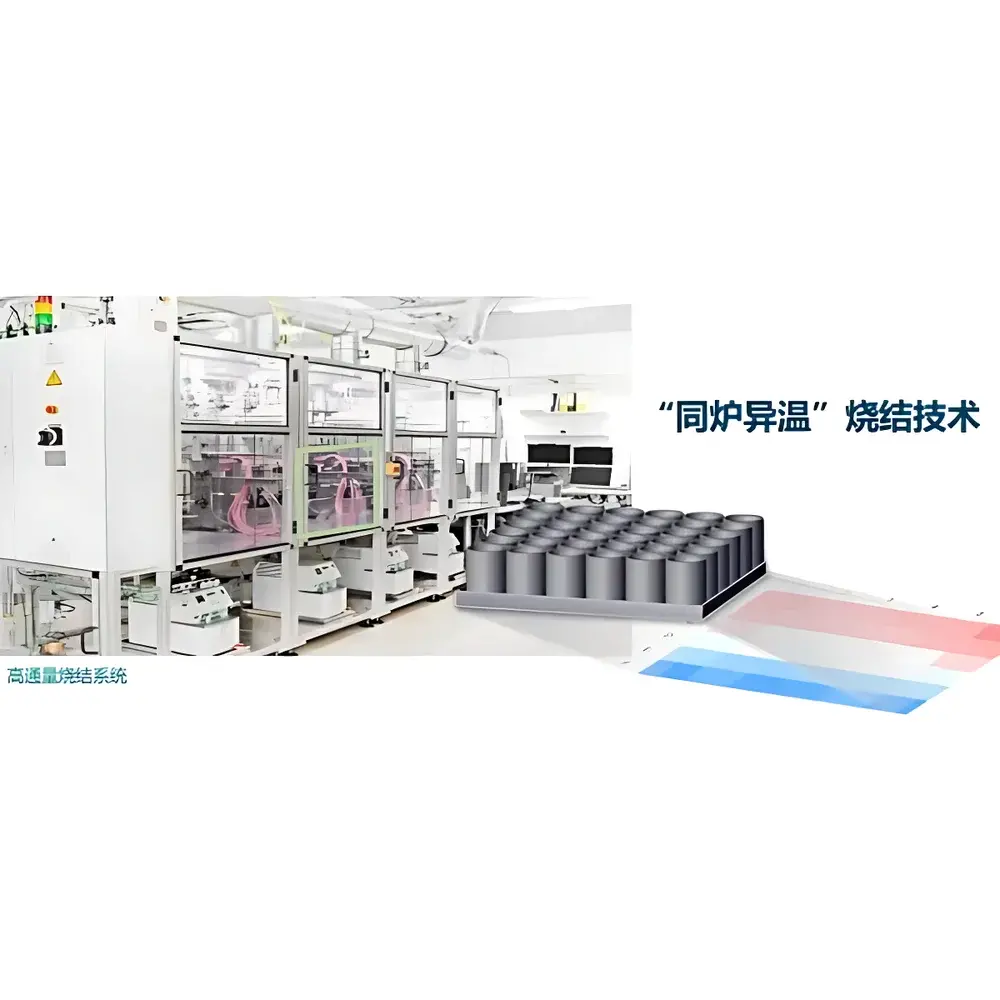
hte HTS-1050 High-Throughput Solid-State Synthesis & Sintering System for Battery Cathode Materials
| Brand | hte |
|---|---|
| Origin | Germany |
| Product Type | Lab-scale High-Throughput Sintering Reactor |
| Configuration | 4×36 or 2×25 Independent Sample Channels |
| Crucible Capacity | Customizable (e.g., 36 × 10 g) |
| Max Operating Temperature | 1050 °C |
| Atmosphere Control | Oxidizing (O₂), Reducing (e.g., Syngas), Inert (N₂/Ar) |
| Temperature Gradient Resolution | ±0.5 °C per Zone |
| Heating/Cooling Rate Control | Programmable (0.1–20 °C/min) |
| Gas Flow Precision | ±1% FS Mass Flow Control |
| Data Acquisition | Real-time T, P, gas composition, dwell time, ramp profiles |
| Compliance | GLP-ready architecture, FDA 21 CFR Part 11–compatible audit trail (via hteControl v5.2) |
Overview
The hte HTS-1050 is a modular, high-throughput solid-state synthesis and sintering system engineered for the accelerated development of cathode active materials (CAMs) and precursor compounds (pCAMs) for lithium-ion and all-solid-state batteries (ASSBs). Unlike conventional tube furnaces or batch kilns, the HTS-1050 implements a “same-furnace, multi-temperature” architecture—leveraging spatially resolved heating zones and independently monitored crucibles to execute parallel thermal treatments across statistically significant experimental design (DOE) matrices. Each channel operates under fully decoupled thermal and atmospheric control, enabling simultaneous evaluation of compositional variants, dopant levels, stoichiometric deviations, and atmosphere-dependent phase evolution—all within a single sintering run. The system bridges the gap between fundamental solid-state reaction kinetics research and scalable process validation, supporting material synthesis from gram- to kilogram-equivalent lab batches with direct relevance to industrial calcination protocols.
Key Features
- Independent thermal zoning with real-time, per-channel thermocouple feedback and closed-loop PID regulation (±0.5 °C stability at 1050 °C)
- Configurable channel layouts: standard 4×36 or 2×25 arrangements; modular expansion supports up to 144 discrete sample positions
- Integrated mass flow controllers (MFCs) for precise, automated delivery of O₂, N₂, Ar, H₂, CO, or custom gas mixtures (±1% full-scale accuracy)
- Crucible platform with standardized geometry and optional inert linings (Al₂O₃, ZrO₂, or Pt-coated) for corrosion-resistant CAM processing
- Lab-in-Lab safety module: sealed, ventilated enclosure with pressure relief, gas leak detection, and emergency shutdown per IEC 61508 SIL2
- Full parameter logging: temperature ramps, dwell times, atmosphere transitions, cooling profiles, and gas partial pressures synchronized at 100 ms intervals
Sample Compatibility & Compliance
The HTS-1050 accommodates a broad spectrum of battery-relevant precursors and intermediates—including layered NMC (LiNiₓMnᵧCo_zO₂), spinel LMO (LiMn₂O₄), olivine LFP (LiFePO₄), sulfide-based ASSB electrolytes (e.g., Li₆PS₅Cl), and transition-metal oxide catalyst precursors. All thermal protocols comply with ASTM E1142 (standard guide for thermal analysis of battery materials) and ISO 11358-1 (polymer thermal degradation nomenclature adapted for inorganic solids). System firmware and hteControl software support 21 CFR Part 11 compliance through electronic signatures, role-based access control, immutable audit trails, and data integrity validation—enabling use in GMP-aligned R&D environments and regulatory submissions.
Software & Data Management
hteControl v5.2 serves as the central orchestration layer, integrating hardware control, experiment sequencing, and raw data ingestion into a unified relational database. Users define DOE templates (e.g., temperature gradient sweeps, pO₂ step changes, dwell time matrices) via drag-and-drop workflows; the software auto-generates executable thermal programs with interlocked safety checks. Post-run, metadata-rich datasets—including T-history curves, gas consumption logs, and chamber pressure transients—are exported in HDF5 or CSV format, compatible with Python/Pandas, MATLAB, or commercial cheminformatics platforms. Optional hteAnalytics modules enable multivariate correlation of sintering parameters with downstream XRD phase quantification, SEM morphology metrics, and electrochemical half-cell performance (dQ/dV, impedance growth, capacity retention).
Applications
- Rapid optimization of NMC811, NCA, and LMNO calcination profiles under oxygen-controlled atmospheres
- Phase-purity mapping of doped LFP across 25+ Li:Fe:P ratios and carbon-coating conditions
- Thermal stability screening of sulfide electrolytes (e.g., Li₃PS₄, Li₁₀GeP₂S₁₂) under inert vs. trace-moisture atmospheres
- Redox-driven synthesis of Mn-based cathodes (e.g., LiMnPO₄) using programmable syngas (H₂/CO/N₂) ramps
- Accelerated aging studies of pre-sintered powders under controlled thermal cycling protocols
- DOE-driven co-sintering of composite electrodes (CAM + solid electrolyte + conductive additive) for ASSB interface engineering
FAQ
Can the HTS-1050 be integrated with downstream characterization tools (e.g., XRD, ICP-MS)?
Yes—hte provides API-level integration hooks and standardized sample rack interfaces (ISO 8655-compliant tray dimensions) for robotic transfer to automated XRD autosamplers, dissolution stations, or particle size analyzers.
Does the system support rapid thermal processing (RTP) or only conventional ramp-hold-cool cycles?
Both modes are supported: users may define ultra-fast ramps (up to 20 °C/min) with sub-second dwell capability, or implement multi-stage isothermal holds with dynamic atmosphere switching.
How is cross-contamination between channels prevented during multi-atmosphere runs?
Each channel features isolated gas manifolds, dedicated exhaust scrubbing paths, and physical baffling; optional quartz diffusion barriers further suppress inter-channel vapor migration.
Is calibration traceable to national standards?
All thermocouples are NIST-traceable (as-shipped certificate); optional on-site calibration services include ISO/IEC 17025-accredited verification by hte’s metrology team.
What level of automation is available for powder loading and unloading?
hte offers optional robotic sample handlers (RSH-200 series) with vision-guided positioning and gravimetric verification, compatible with standard 96-well or custom crucible trays.




