
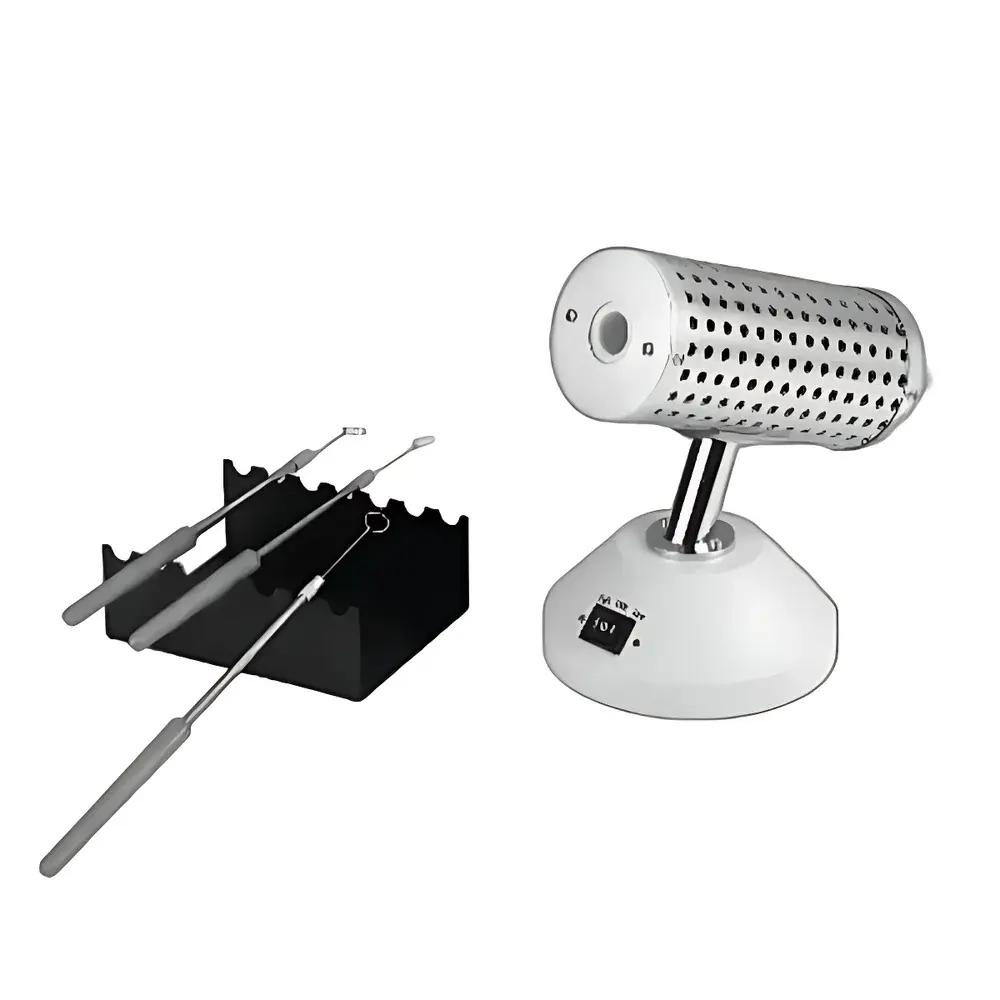
HuaDuanBio HD-ST20 Infrared Electric Sterilizer
| Brand | HuaDuanBio |
|---|---|
| Origin | Zhejiang, China |
| Manufacturer Type | Direct Manufacturer |
| Product Origin | Domestic (China) |
| Model | HD-ST20 |
| Price | Upon Request |
| Center Zone Temperature | 925 °C ±25 °C |
| Heating Zone Outer Diameter | φ15 mm |
| Heating Zone Length | 150 mm |
| Warm-up Time | ≤15 min |
| Standby Mode | Adjustable保温 setting for energy-efficient standby |
| Fuse Rating | 250 V, 3 A, 5×20 mm |
| Input Power | AC 220 V, 50–60 Hz, 150 W |
| Dimensions (W×D×H) | ≤120×155×180 mm |
| Standard Configuration | 1 × sterilizer main unit |
Overview
The HuaDuanBio HD-ST20 Infrared Electric Sterilizer is a compact, benchtop thermal sterilization device engineered for rapid, flame-free decontamination of microbiological tools—including inoculation loops, needles, forceps, and micro-spatulas—in compliance with standard aseptic technique requirements. Unlike open-flame sources such as alcohol burners, the HD-ST20 employs focused near-infrared radiation (wavelength range ~1–3 µm) to generate localized high-temperature zones via resistive heating of a ceramic emitter. This principle ensures stable thermal output without combustion byproducts, volatile fuel handling, or CO₂ generation—making it suitable for use inside biosafety cabinets (Class II A2/B2), laminar flow hoods, mobile laboratory units, and field-deployed microbiology stations. Its design prioritizes operational safety, spatial efficiency, and regulatory alignment with core GLP and ISO 13485-aligned laboratory workflows.
Key Features
- Stable high-temperature zone: Precisely maintained at 925 °C ±25 °C in the central irradiation area (φ15 mm × 150 mm), sufficient to incinerate microbial biomass—including spores of Bacillus stearothermophilus—within 5–8 seconds of contact.
- Rapid thermal response: Achieves operational temperature in ≤15 minutes from cold start, minimizing workflow interruption during high-throughput plating or serial dilution procedures.
- Energy-conscious standby mode: Integrated low-power保温 setting maintains emitter readiness at ~500 °C, reducing reheat time by >60% compared to full-cycle restarts—ideal for intermittent use across shift-based labs.
- Compact footprint & robust enclosure: Housing dimensions ≤120×155×180 mm allow placement in constrained spaces; IP20-rated chassis provides protection against accidental ingress of solid objects while ensuring electrical safety per IEC 61010-1.
- Fail-safe thermal protection: Equipped with a certified 250 V / 3 A fast-blow fuse (5×20 mm) and internal overtemperature cutoff, preventing sustained overheating under abnormal load conditions.
Sample Compatibility & Compliance
The HD-ST20 is validated for sterilizing stainless steel, nickel-chromium alloy, and platinum-wire implements commonly used in microbial isolation, streaking, and colony picking. It is not intended for plastic, coated, or heat-sensitive instruments. The device conforms to general safety requirements outlined in IEC 61010-1 (Safety Requirements for Electrical Equipment for Measurement, Control, and Laboratory Use) and supports adherence to USP <71>, ISO 11137, and CLSI M22-A3 guidelines for non-steam thermal decontamination of reusable lab tools. While not a Class I medical device per FDA 21 CFR Part 820, its consistent thermal profile enables traceable, auditable sterilization logs when integrated into documented SOPs for QC/QA microbiology laboratories.
Software & Data Management
The HD-ST20 operates as a standalone analog device with no embedded firmware, touchscreen, or digital interface—ensuring zero cybersecurity exposure and eliminating calibration drift associated with microcontroller-based timers. All operational parameters (power input, thermal stability, fuse integrity) are mechanically and electrically verified during factory acceptance testing (FAT), with documentation provided per ISO/IEC 17025-compliant quality records. Users may integrate usage logs manually into LIMS or electronic lab notebooks (ELN) via standardized timestamps and operator IDs, supporting 21 CFR Part 11-compliant audit trails when paired with institutional validation protocols.
Applications
- Routine sterilization of inoculation loops and needles prior to and between subcultures in bacterial/fungal identification workflows.
- Decontamination of microtools inside biosafety cabinets during BSL-2 and BSL-3 operations—eliminating flame hazards near HEPA-filtered airflow.
- Field microbiology deployments: Stable performance under variable ambient temperatures (5–40 °C) and voltage fluctuations (±10% of 220 V), validated for use in mobile diagnostic vans and remote surveillance labs.
- Teaching laboratories: Safe, repeatable demonstration of thermal sterilization principles without flammable solvent storage or ventilation dependencies.
- Pharmaceutical QC labs: Supporting Annex 1-aligned environmental monitoring tool preparation where steam autoclaving is impractical for small metallic items.
FAQ
What is the recommended dwell time for complete sterilization of an inoculation loop?
A minimum contact duration of 7–10 seconds within the central heating zone (925 °C) is required to ensure destruction of vegetative cells and resistant spores, per CLSI M22-A3 recommendations.
Can the HD-ST20 be used inside a Class II biosafety cabinet without compromising airflow?
Yes—the device produces no convective updraft or gaseous emissions; its low-profile geometry avoids obstruction of downward laminar flow, and it has been tested for compatibility with NSF/ANSI 49-certified cabinets.
Is periodic calibration required?
No routine calibration is mandated; however, users should verify center-zone temperature annually using a calibrated infrared pyrometer (e.g., ASTM E1256-compliant) as part of equipment qualification (IQ/OQ).
Does the unit support continuous operation?
It is rated for intermittent duty cycles (≤4 hours cumulative per day); extended unattended operation is not advised due to thermal fatigue considerations in the ceramic emitter assembly.
What maintenance is required?
Monthly visual inspection of the emitter surface for carbon buildup or cracking; cleaning only with dry lint-free cloth—no solvents or abrasives permitted.
Related Products




