
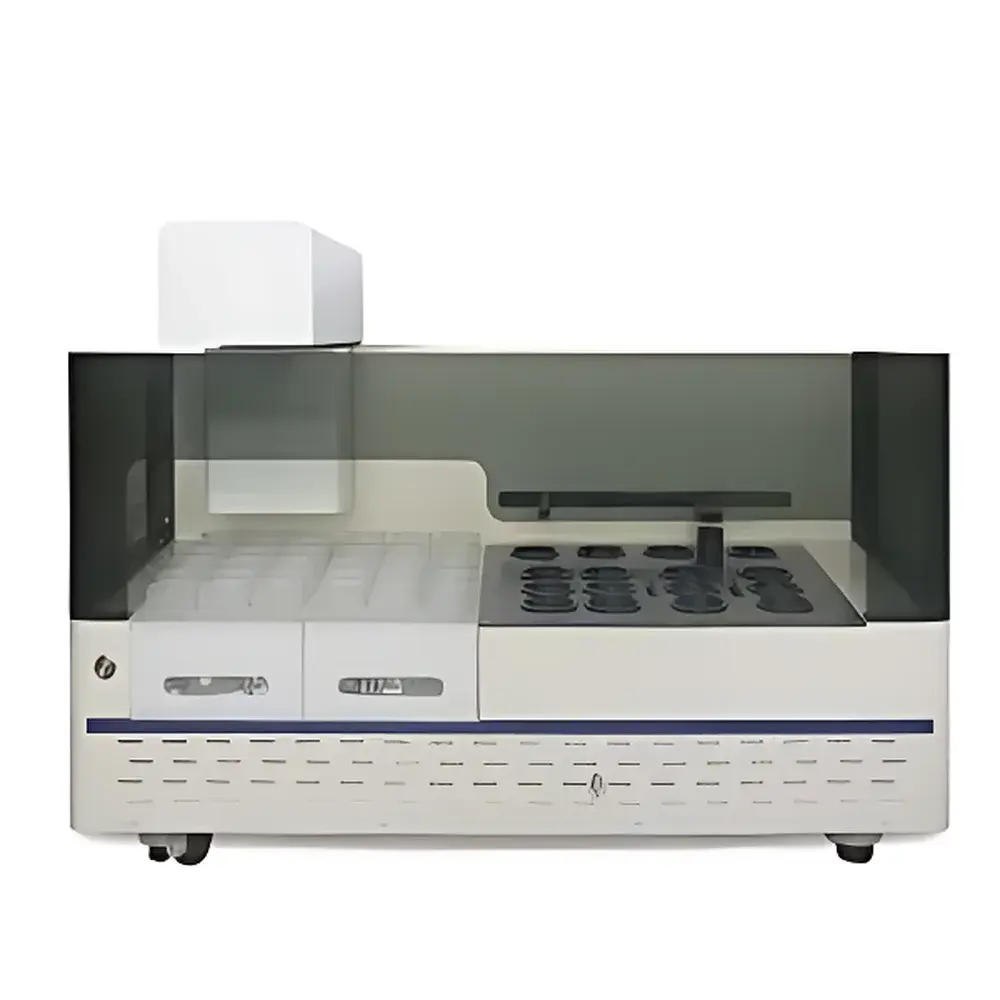
HUANKONG 1600 Intelligent Robotic Permanganate Index Analyzer
| Brand | HUANKONG |
|---|---|
| Origin | Shandong, China |
| Manufacturer Type | OEM Manufacturer |
| Product Type | Laboratory-Based Analyzer |
| Model | 1600 |
| Measurement Principle | Boiling Water Bath Oxidation with Potassium Permanganate Titration |
| Range | 0–6.0 mg/L |
| LOD | 0.05 mg/L |
| Analysis Time per Sample | ≤3 min |
| Compliance | GB/T 11892, GB/T 5750.7 |
Overview
The HUANKONG 1600 Intelligent Robotic Permanganate Index Analyzer is a fully automated laboratory system engineered for precise, reproducible determination of the permanganate index (CODMn) in water samples—strictly adhering to the classical titrimetric method defined in GB/T 11892 and GB/T 5750.7. Unlike semi-automated or modular platforms, this integrated analyzer implements the complete standardized workflow: acidification, controlled boiling water bath oxidation (exactly 30 minutes at ≥95 °C), cooling, back-titration with standardized sodium oxalate solution, and endpoint detection via dynamic colorimetric recognition. The system eliminates manual handling variability—including inconsistent heating duration, uncontrolled acid addition, subjective endpoint judgment, and cross-contamination—by embedding all critical process parameters within a closed, sensor-monitored architecture. Its design prioritizes metrological traceability, analytical robustness, and operational continuity in routine environmental quality control laboratories.
Key Features
- Fully autonomous sample processing: robotic arm transfers vials between stations without human intervention; supports non-fixed, user-replaceable sample trays for flexible batch configuration.
- Dual independent reagent delivery arms with dual precision peristaltic pumps for KMnO4 and Na2C2O4, ensuring stoichiometric accuracy and eliminating reagent carryover.
- 12-channel boiling water bath module with fiber-optic liquid level sensing, auto-refill capability, low-water alarm, and programmable immersion depth control to guarantee uniform thermal exposure across all samples.
- Triple parallel titration channels operating at constant temperature (±0.5 °C), enabling sequential or concurrent analysis of up to three samples post-digestion.
- Dynamic colorimetric endpoint detection: multi-angle, full-spectrum RGB imaging captures subtle hue shifts during titration—not fixed-threshold photometry—mimicking trained analyst observation while removing inter-operator bias.
- Real-time reagent volume monitoring with configurable alerts; on-screen positional mapping of all sample and reagent positions allows live queue editing (add/remove/replace) without interrupting active runs.
Sample Compatibility & Compliance
The 1600 Analyzer is validated for use with drinking water, surface water, source water, and groundwater matrices per national regulatory requirements. It maintains strict alignment with ISO/IEC 17025 principles for method validation and supports audit-ready documentation for GLP and GMP environments. All digestion and titration parameters—including bath temperature stability, reagent concentration tolerance (±1%), and endpoint repeatability (RSD ≤2.5% at 1.0 mg/L)—are continuously logged and exportable. The system meets the essential performance criteria outlined in GB/T 11892 for precision (within-lab reproducibility ≤5%), accuracy (recovery 95–105%), and interference resistance (Cl− ≤300 mg/L). No consumables (e.g., electrodes, membranes, or disposable cuvettes) are required; only certified-grade reagents and standard glassware are used.
Software & Data Management
The embedded workstation software provides end-to-end method execution control, real-time status visualization, and comprehensive data governance. Each analysis generates a timestamped, immutable audit trail including reagent lot numbers, bath temperature profiles, titration curves, endpoint coordinates, and operator ID (if authenticated). Data exports comply with ASTM E1469 and FDA 21 CFR Part 11 requirements—supporting electronic signatures, role-based access control, and secure database backup. Instrument logs retain ≥12 months of operational history and can be synchronized with LIMS via HL7 or CSV protocols. Software updates are delivered through encrypted firmware packages with version rollback capability.
Applications
This analyzer serves municipal water utilities conducting daily compliance monitoring under China’s Environmental Quality Standards for Surface Water (GB 3838); provincial environmental monitoring centers performing inter-laboratory proficiency testing; third-party testing labs requiring ISO/IEC 17025 accreditation; and research institutions studying organic load dynamics in watershed systems. It is especially suited for high-throughput labs processing >50 samples/day where manual method variability has historically compromised QA/QC metrics—including duplicate RSD, spike recovery consistency, and control chart stability.
FAQ
Does the system require calibration with certified reference materials?
Yes—initial system qualification requires verification using NIST-traceable potassium hydrogen phthalate or potassium iodate standards; subsequent daily calibration checks are performed automatically using internal reference solutions.
Can the instrument handle turbid or colored samples?
The system accommodates moderately turbid samples (NTU ≤20) and yellow-hued waters (absorbance ≤0.3 at 525 nm); for highly colored or suspended solids-rich matrices, optional pre-filtration modules are available.
Is remote monitoring supported?
Yes—via secure HTTPS web interface; users may view real-time run status, receive SMS/email alerts for maintenance events, and download raw data remotely after authentication.
What maintenance intervals are recommended?
Daily: visual inspection of bath water clarity and reagent levels; quarterly: optical path cleaning and pump tubing replacement; annually: full metrological verification by authorized service engineers.
How is method validation documented for regulatory submission?
The software generates a compliant validation report package—including precision, accuracy, LOD/LOQ, linearity (r² ≥0.999), and robustness testing results—formatted per CNAS-CL01:2018 Annex A requirements.
Related Products







