
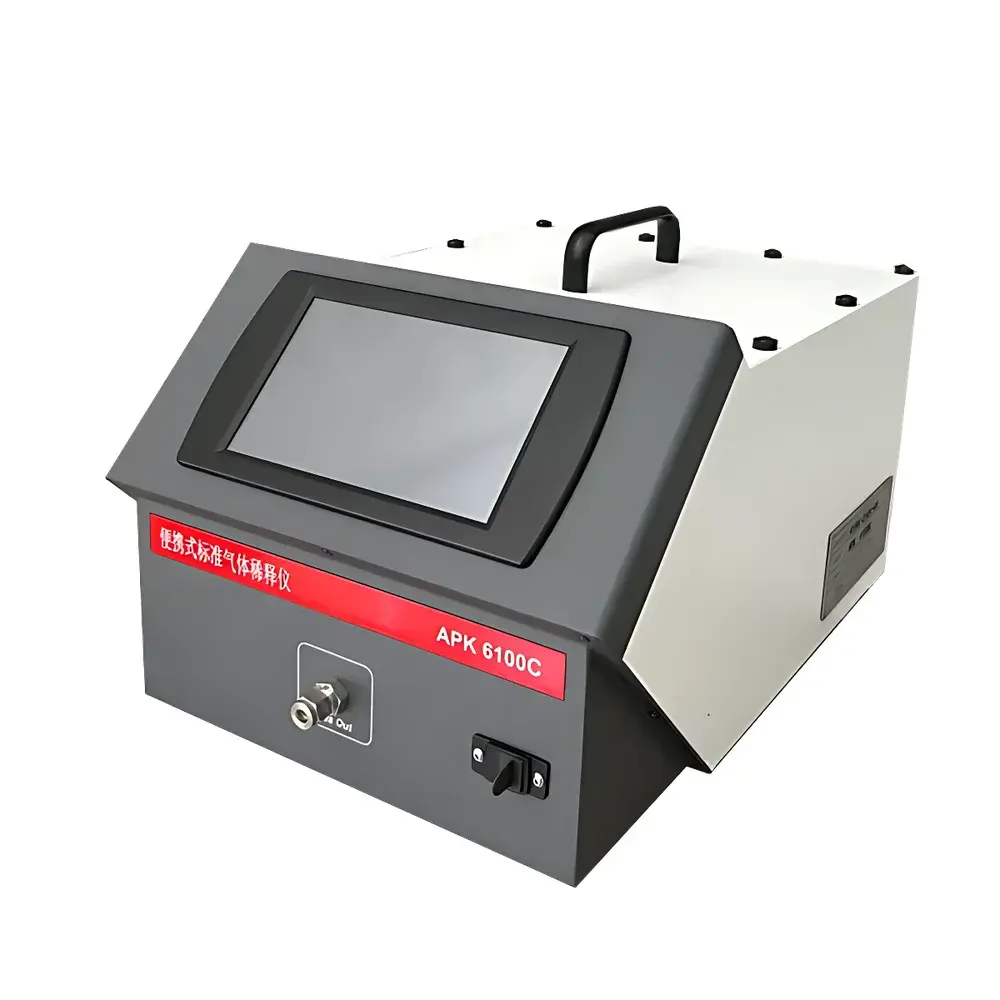
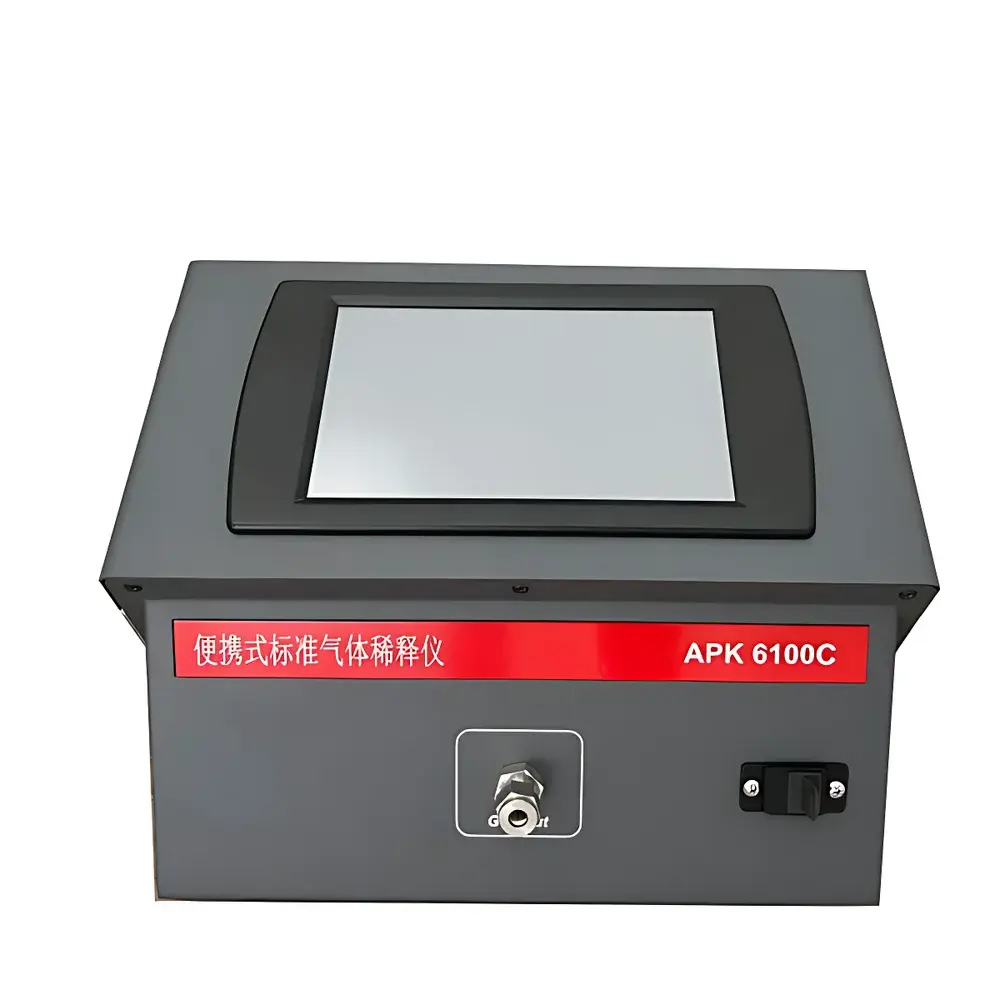
HUANKONG APK6100C Portable High-Precision Gas Dilution System
| Brand | HUANKONG |
|---|---|
| Origin | Shandong, China |
| Manufacturer Type | Direct Manufacturer |
| Model | APK6100C |
| Flow Control Accuracy | ±0.8% FS (typical for integrated thermal mass flow controllers) |
| Dilution Ratio Range | 1:500 (customizable) |
| Minimum Output Concentration | Sub-ppb to ppm level (dependent on source gas purity and flow stability) |
| Gas Channels | 4 independent MFC-controlled inlets |
| Display | 7-inch capacitive touchscreen interface |
| Materials of Construction | Fully silanized stainless steel flow path (optional) |
| Compliance | Designed to support ISO 6145-7, ASTM D6348, EPA Method 205, and GLP/GMP-aligned calibration workflows |
Overview
The HUANKONG APK6100C Portable High-Precision Gas Dilution System is an engineered solution for dynamic, gravimetrically traceable gas standard generation in both field and laboratory environments. It operates on the principle of continuous-flow, multi-channel mass flow-controlled dilution—leveraging calibrated thermal mass flow controllers (MFCs) to precisely meter primary standard gases and high-purity diluent (e.g., zero air or N₂) into a mixing manifold. This architecture ensures stable, real-time gas concentration output without reliance on static cylinder-based standards, thereby eliminating batch-to-batch variability and enabling on-demand preparation of calibration gases across ppb–ppm concentration ranges. Its portable form factor (≤12 kg, integrated battery option available) supports deployment at stack test sites, ambient monitoring stations, and mobile emissions laboratories—meeting the operational flexibility required by environmental compliance officers, stack testing contractors, and instrument validation specialists.
Key Features
- Four independently controlled gas inlets, each equipped with a certified thermal mass flow controller (±0.8% full-scale accuracy, repeatability ≤0.2% FS), enabling simultaneous dilution of up to four standard gases or sequential multi-gas blending.
- Configurable dilution ratios from 1:10 to 1:500 (standard), with extended-range firmware options supporting higher ratios upon request—optimized for low-concentration calibration of chemiluminescence NOx analyzers, pulsed fluorescence SO2 detectors, and electrochemical CO sensors.
- Full-system inertization capability: optional silanized stainless-steel flow path—including tubing, fittings, valves, and internal surfaces—validated for compatibility with reactive polar VOCs (e.g., H2S, formaldehyde, acetaldehyde) and sulfur-containing compounds per ASTM D5504 and EPA TO-15 protocols.
- Integrated 7-inch industrial-grade capacitive touchscreen HMI with intuitive wizard-driven workflow navigation, real-time flow/concentration visualization, and password-protected method storage (up to 99 user-defined profiles).
- High-output volumetric flow capacity: total blended flow adjustable from 0.1 to 10 L/min, accommodating diverse analyzer inlet requirements—from low-flow GC injectors to high-flow CEMS sample conditioning systems.
- Ruggedized aluminum chassis with IP54-rated enclosure, shock-absorbing feet, and dual power input (100–240 VAC / optional 24 VDC), ensuring stable operation under variable ambient temperature (5–40°C) and humidity (20–80% RH non-condensing).
Sample Compatibility & Compliance
The APK6100C supports dilution of certified reference materials (CRMs) traceable to NIST, BAM, or LNE standards—including single-component gases (SO2, NO, CO, O3) and multi-component blends (e.g., EPA Protocol Gases). When configured with silanized components, it maintains integrity for thermally labile and adsorptive species such as NH3, Cl2, and C2H4. The system design aligns with key regulatory frameworks: its documentation structure supports audit-ready GLP compliance; electronic logs meet FDA 21 CFR Part 11 requirements when paired with validated software; and its dilution methodology conforms to ISO 6145-7 (gas mixtures by dynamic volumetric method) and ASTM D6348 (determination of gaseous pollutants using dynamic dilution calibrators).
Software & Data Management
The embedded firmware provides time-stamped event logging (power cycles, method changes, flow deviations >1.5% FS), exportable via USB or Ethernet to CSV format. Optional PC-based configuration software (HUANKONG DiluSoft v3.x) enables remote parameter tuning, calibration certificate generation (with uncertainty budgets per GUM), and integration with LIMS via Modbus TCP. All data entries include operator ID, timestamp, and digital signature fields—enabling full traceability for ISO/IEC 17025-accredited laboratories conducting stack testing per EN 14181 or EPA PS-17.
Applications
- Field verification and span calibration of continuous emission monitoring systems (CEMS) for SO2, NOx, CO, and O2 in power plants and incinerators.
- Interference testing of gas analyzers—e.g., CO cross-sensitivity evaluation in NOx instruments using dynamically diluted CO/N2 mixtures.
- Preparation of low-concentration challenge gases for photolysis-based ozone monitors and cavity ring-down spectrometers (CRDS).
- Method validation studies requiring matrix-matched standards for EPA Method 320, TO-14A, and ISO 16017-1.
- Mobile laboratory support for ambient air quality surveys, where portability and rapid setup (<5 min) reduce downtime during site transitions.
FAQ
What certification standards apply to the mass flow controllers used in the APK6100C?
Each MFC is supplied with individual NIST-traceable calibration certificates (valid for 12 months), compliant with ISO/IEC 17025 requirements. Factory recalibration services are available annually.
Can the APK6100C be used with humidified zero air as a diluent?
Yes—when equipped with optional heated flow path and humidity-compensated MFCs, the system maintains accuracy at RH levels up to 80% at 25°C.
Is remote firmware update supported?
Firmware updates are performed via secure USB drive import; over-the-air (OTA) updates are not supported to ensure regulatory compliance and system integrity.
Does the system support audit trail functionality for GLP environments?
Yes—electronic logs record all critical actions with immutable timestamps and user authentication, meeting ALCOA+ principles for data integrity.
What maintenance intervals are recommended for silanized flow paths?
Silanized surfaces require no routine re-treatment under normal use; however, visual inspection and leak testing are advised every 6 months or after exposure to >1 ppm H2S or halogenated compounds.







