
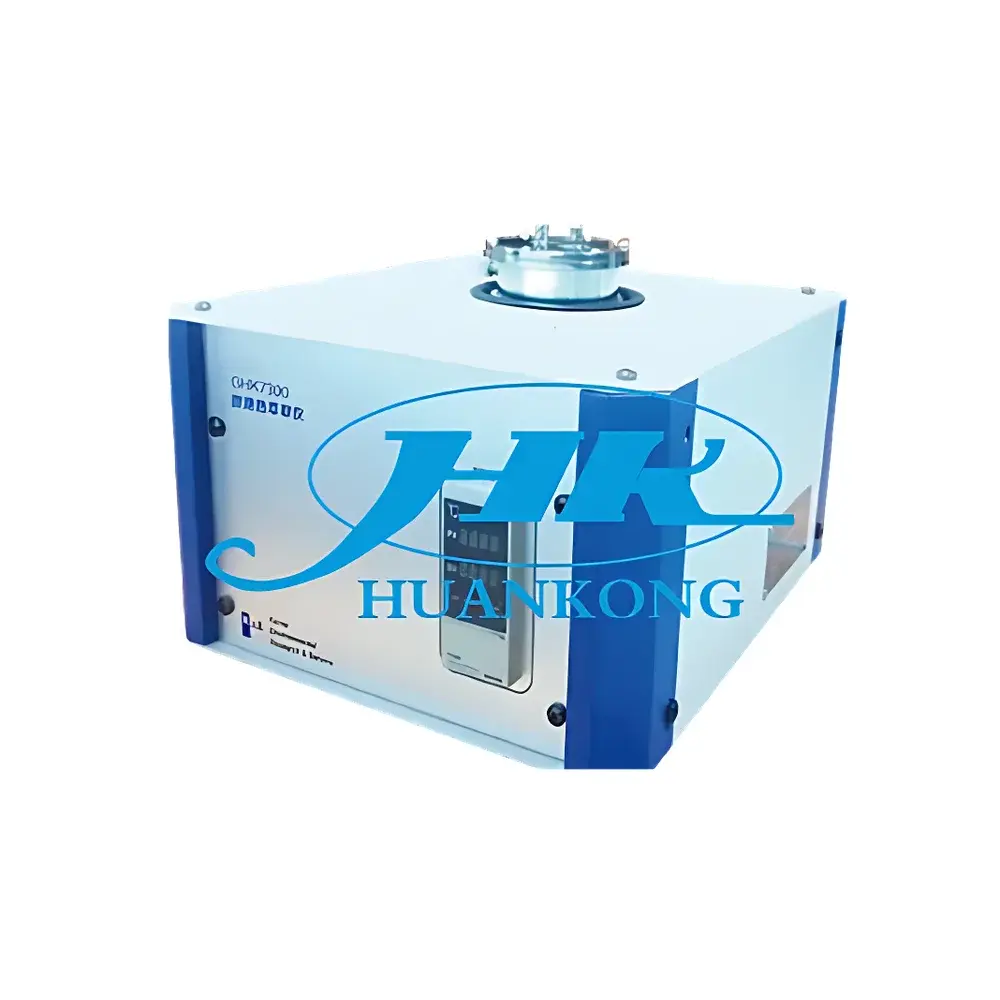
HUANKONG APK6300 Micro-Chamber Thermal Desorption Extractor
| Brand | HUANKONG |
|---|---|
| Origin | Shandong, China |
| Manufacturer Type | Direct Manufacturer |
| Origin Category | Domestic (China) |
| Model | APK6300 |
| Pricing | Available Upon Request |
| Chamber Volume | 50–500 mL (user-selectable) |
| Temperature Range | Ambient to 250 °C (PID-controlled) |
| Sealing | PTFE O-rings (rated to 250 °C) |
| Chamber Material | Stainless Steel (optional glass or quartz liners) |
| Flow Control | Digital pressure gauge + needle valve (mass flow controller optional) |
| Power Supply | AC 220 V, 50/60 Hz |
| Dimensions (W×H×D) | 410 × 310 × 350 mm |
Overview
The HUANKONG APK6300 Micro-Chamber Thermal Desorption Extractor is an engineered laboratory system designed for controlled thermal release and quantitative collection of volatile organic compounds (VOCs) and semi-volatile organic compounds (SVOCs) from solid and porous materials. It operates on the principle of dynamic headspace thermal desorption: a precisely heated, sealed micro-chamber subjects test specimens to elevated temperatures under inert gas purge, volatilizing target analytes which are then swept through a conditioned adsorbent trap—such as Tenax TA, Carbopack B/C, or DNPH-coated cartridges—for subsequent analysis by gas chromatography (GC) or high-performance liquid chromatography (HPLC). Unlike static headspace or solvent extraction methods, this approach delivers higher sensitivity, improved reproducibility, and minimal matrix interference—particularly critical for low-emission material screening in regulatory and R&D environments.
Key Features
- Modular micro-chamber architecture with user-selectable internal volume (50 mL to 500 mL), enabling method scalability from small coupons to full-size composite panels.
- PID-controlled heating system with stable temperature regulation from ambient up to 250 °C; temperature uniformity ±1.5 °C across chamber volume verified per ISO 16000-9 calibration guidelines.
- Stainless steel main chamber body with optional quartz or borosilicate glass liner—chemically inert, low-background, and compatible with aggressive VOC matrices.
- PTFE-sealed flanged interface with quick-release clamps ensures leak-tight operation at elevated temperatures and simplifies chamber cleaning and sample loading.
- Integrated digital pressure monitoring and fine-adjustment flow control via precision needle valve; optional mass flow controller (MFC) available for ISO 16000-6 compliant volumetric flow calibration (e.g., 10–200 mL/min).
- Compact benchtop footprint (410 × 310 × 350 mm) with CE-compliant electrical safety design and overtemperature cut-off protection.
Sample Compatibility & Compliance
The APK6300 accommodates heterogeneous solid samples—including laminated wood products, polymeric composites (e.g., ABS, PP, PU foams), coated textiles, adhesives, sealants, and food-contact packaging—without requiring size reduction or solvent pretreatment. Its chamber geometry supports standardized test specimens per ASTM D5116, ISO 16000-9, EN 16516, and GB/T 27630. When coupled with certified thermal desorption autosamplers (e.g., Markes UNITY-xr, Gerstel TD-2), the system meets GLP data integrity requirements and supports audit-ready workflows compliant with FDA 21 CFR Part 11 when used with validated software platforms. All wetted surfaces meet USP Class VI biocompatibility criteria for extractables testing in medical device and pharmaceutical packaging applications.
Software & Data Management
While the APK6300 operates as a stand-alone hardware module, it integrates seamlessly with third-party thermal desorption GC/GC-MS systems and associated acquisition software (e.g., Agilent MassHunter, Thermo Chromeleon, Shimadzu LabSolutions). Temperature ramp profiles, dwell times, and purge flow parameters are manually set via front-panel controls but can be logged externally using optional RS-485 or analog 4–20 mA output interfaces. For fully automated compliance reporting, users may connect the unit to LIMS via programmable logic controllers (PLCs) or integrate into validated instrument networks supporting electronic signatures and audit trails per GMP Annex 11.
Applications
- Indoor air quality (IAQ) assessment of building materials (flooring, insulation, ceiling tiles) per ISO 16000-23 and California Section 01350.
- Regulatory emission testing for automotive interior components (dashboards, seat fabrics, trim) aligned with VDA 278 and GMW15635.
- Toy safety evaluation (EN71-9, ASTM F963) for formaldehyde, benzene, and phthalate esters.
- Electronics housing and PCB substrate outgassing characterization under JEDEC J-STD-020 thermal stress protocols.
- Food packaging migration studies (EU 10/2011) and personal care product container leachables profiling.
- Research into natural material emissions (bamboo, cork, hemp-based composites) and protective textile coatings (flame retardants, antimicrobials).
FAQ
What chamber volume should I select for my application?
Volume selection depends on specimen surface area-to-volume ratio and expected emission rate. For small coupons (<100 cm²), 50–100 mL is optimal; for full-size panels (≥500 cm²), 300–500 mL minimizes wall adsorption losses and improves quantitation accuracy.
Can the APK6300 be used for formaldehyde-specific analysis?
Yes—when paired with DNPH-silica cartridges and HPLC-UV detection, the system complies with ISO 16000-3 and EPA TO-11A for carbonyl compound quantification, including formaldehyde, acetaldehyde, and acetone.
Is quartz chamber lining necessary?
Quartz is recommended for high-temperature (>200 °C) or acidic VOC applications (e.g., chlorinated compounds) where stainless steel may catalyze degradation; standard stainless steel suffices for most polymer and wood emission studies.
Does the unit support automated sequential testing?
The APK6300 itself is manually operated, but it can be integrated into automated multi-chamber racks using external pneumatic manifolds and programmable timers—common in industrial QA labs performing batched emission screening.
What maintenance is required for long-term reliability?
Biannual verification of PTFE seal integrity, calibration of PID sensor against NIST-traceable reference thermometers, and periodic cleaning of chamber interior with methanol followed by nitrogen purge are recommended per ISO/IEC 17025 preventive maintenance guidelines.



