
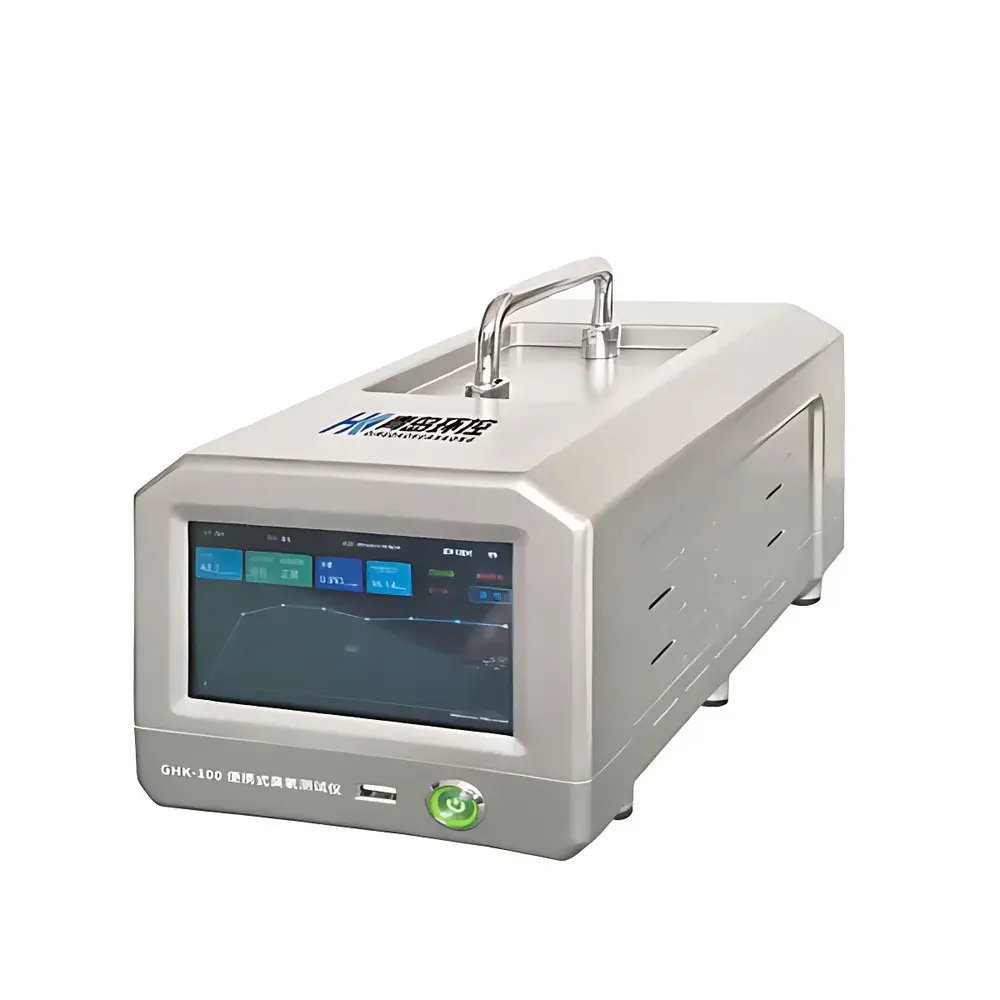
HUANKONG GHK-100 Portable Ozone Analyzer
| Brand | HUANKONG |
|---|---|
| Origin | Shandong, China |
| Manufacturer Type | Direct Manufacturer |
| Instrument Type | Portable |
| Measurement Range | 0–500 ppb (expandable) |
| Limit of Detection (LOD) | ≤1 ppb |
| Response Time (T90) | ≤20 s |
| Zero Drift | ±2 ppb max over 24 h |
| Resolution | ≤1% of full scale |
| Display | 5-inch capacitive touchscreen |
| Positioning | Integrated BeiDou/GPS dual-mode module |
| Power Supply | Rechargeable high-capacity Li-ion battery |
| Data Connectivity | Wi-Fi, 4G LTE, Bluetooth |
| Onboard Storage | 8 GB internal flash memory |
| Filter Maintenance | Replaceable particulate filter (days), hydrophobic ozone scrubber (6 months) |
| Compliance | GB/T 18883–2022, HJ 590–2010, JJG 1077–2012, HJ 654–2013 |
Overview
The HUANKONG GHK-100 Portable Ozone Analyzer is a field-deployable, UV photometric gas analyzer engineered for trace-level quantification of ozone (O₃) in ambient air. It operates on the principle of ultraviolet absorption spectroscopy at 254 nm, where ozone exhibits strong and selective absorbance—enabling direct, interference-free measurement without chemical conversion or scrubbing. The instrument’s optical path employs a high-stability, low-power UV LED source and a precision photodetector array, coupled with temperature- and pressure-compensated signal processing to ensure metrological integrity across variable environmental conditions. Designed for regulatory-grade monitoring, the GHK-100 meets the performance criteria defined in HJ 590–2010 (UV photometric method for ambient ozone) and aligns with the data quality objectives outlined in HJ 654–2013 for continuous ambient air monitoring systems. Its compact form factor, integrated positioning, and autonomous power architecture make it suitable for unattended mobile deployments—including vehicle-mounted networks, roadside micro-monitoring stations, and rapid-response emergency assessments.
Key Features
- UV photometric detection at 254 nm with optical path optimization for minimal stray light and thermal drift
- Real-time compensation for ambient temperature (−20 °C to 50 °C) and barometric pressure (60–110 kPa)
- 5-inch industrial-grade capacitive touchscreen with intuitive GUI supporting multilingual interface (English default)
- Dual-mode satellite positioning (BeiDou + GPS) enabling geotagged data logging and spatial correlation in cloud platforms
- Low-power UV optical module with >20,000-hour operational lifetime and zero warm-up requirement
- Onboard 8 GB non-volatile flash memory with automatic timestamped data archiving (1-second to 1-hour configurable logging intervals)
- Wireless telemetry via dual-band Wi-Fi (2.4/5 GHz) and embedded 4G LTE Cat-1 modem for secure MQTT/HTTPS data transmission
- Bluetooth 5.0 support for real-time pairing with certified thermal printers and mobile configuration tools
- Modular filtration system: front-end particulate filter (PM₂.₅/PM₁₀ rated) and hydrophobic ozone scrubber—designed for scheduled maintenance only, no routine calibration gases required
Sample Compatibility & Compliance
The GHK-100 is validated for continuous sampling of ambient air, indoor air, and workplace breathing-zone atmospheres. It accommodates flow rates from 0.3 to 1.0 L/min with built-in mass flow control and automatic backpressure regulation. The inlet path includes a heated Nafion™ membrane for humidity equilibration (optional), minimizing water vapor interference without catalytic removal that could degrade ozone. All measurement outputs comply with traceability requirements per JJG 1077–2012 (verification procedure for ozone analyzers) and are referenced to NIST-traceable ozone standards. The device satisfies data integrity provisions under GLP-aligned field operations and supports audit-ready metadata (e.g., GPS coordinates, sensor health flags, filter replacement timestamps). It is certified to meet electromagnetic compatibility (EMC) Class B and IP54 ingress protection standards for outdoor portable use.
Software & Data Management
The GHK-100 integrates with the HUANKONG Cloud Terminal—a secure, ISO/IEC 27001-aligned SaaS platform supporting role-based access control, multi-site dashboarding, and automated report generation (PDF/CSV). Raw data streams include calibrated O₃ concentration (ppb), auxiliary parameters (temperature, pressure, RH, GPS position), and diagnostic codes (lamp intensity, detector SNR, flow stability). The platform enables configurable alarm thresholds, historical trend analysis with linear regression and moving averages, and export-compliant data packages for regulatory submission (e.g., to local EPAs or occupational safety authorities). Firmware updates and remote parameter reconfiguration are performed over-the-air (OTA) with digital signature verification. Local data retrieval is supported via USB-C port and UVC-compatible mass storage mode.
Applications
- Ambient air quality monitoring networks—especially for EPA-designated ozone non-attainment zones requiring high-temporal-resolution data
- Mobile monitoring on research vehicles, bicycles, or drones for spatial mapping of ozone gradients near traffic corridors or industrial perimeters
- Indoor air quality assessment in schools, hospitals, and office buildings per GB/T 18883–2022 compliance frameworks
- Occupational exposure monitoring in water treatment plants, semiconductor cleanrooms, and UV disinfection facilities
- Emergency response during photochemical smog episodes or accidental ozone generator releases
- Method validation and intercomparison studies against reference-grade chemiluminescence or UV absorption analyzers
FAQ
What ozone measurement principle does the GHK-100 employ?
It uses UV absorption photometry at 254 nm, in accordance with HJ 590–2010 and ISO 13964:1998.
Is external calibration gas required for routine operation?
No—zero calibration is performed automatically using internal synthetic zero air; span verification may be conducted annually using certified ozone standard gas (NIST-traceable).
How is data integrity ensured during wireless transmission?
All telemetry uses TLS 1.2 encryption and message authentication codes (MAC); each data packet includes CRC-32 checksum and sequence numbering.
Can the GHK-100 operate continuously for more than 24 hours on battery?
Yes—rated for ≥36 hours of continuous operation at 1-minute logging interval under typical ambient conditions (25 °C, 50% RH).
Does the instrument support integration with third-party SCADA or IoT platforms?
Yes—via RESTful API and Modbus TCP protocol; documentation includes Swagger-defined endpoints and register maps.
Related Products







