
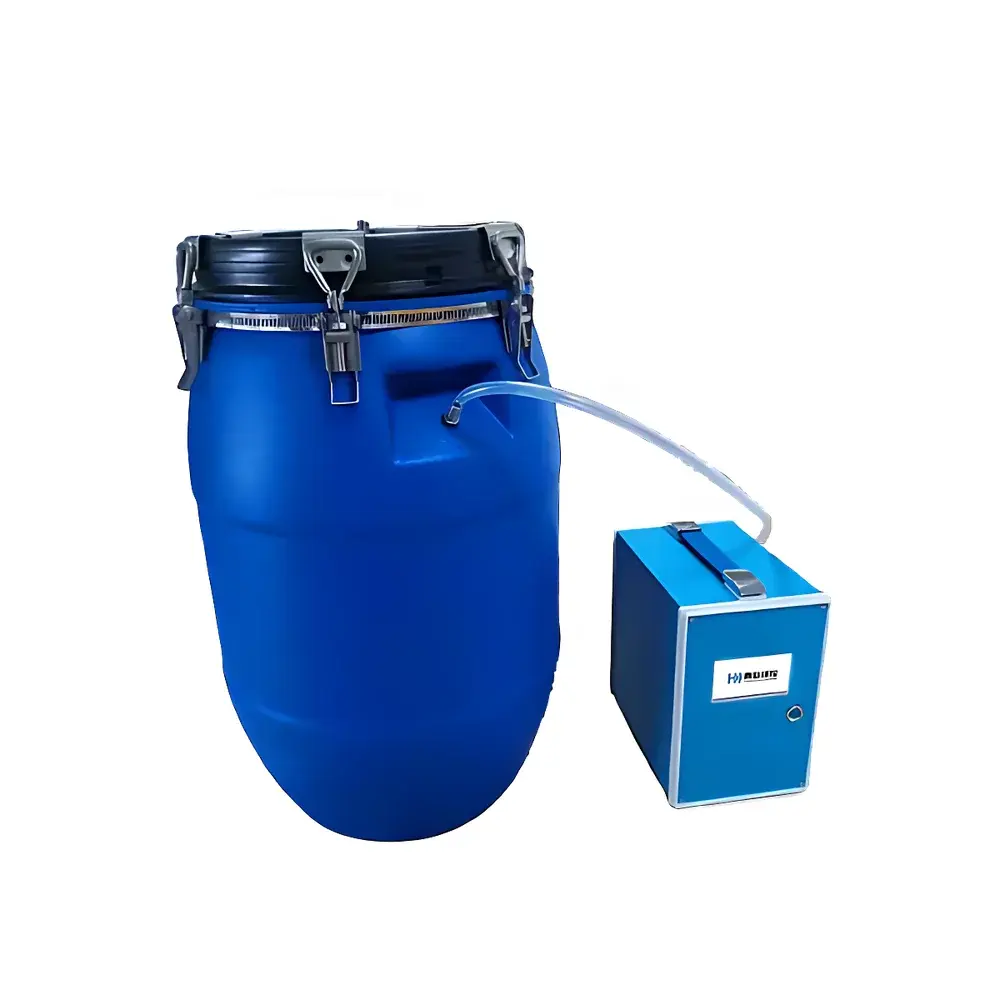
HUANKONG GHK-1400 Odor Sampling System
| Brand | HUANKONG |
|---|---|
| Origin | Shandong, China |
| Manufacturer Type | Direct Manufacturer |
| Product Category | Domestic |
| Model | GHK-1400 |
| Instrument Type | 24-Hour Constant-Temperature & Constant-Flow Gas Sampler |
| Configuration | Single-Channel Gas Sampler |
| Flow Rate Range | 12 L/min |
Overview
The HUANKONG GHK-1400 Odor Sampling System is a purpose-engineered, single-channel, constant-temperature and constant-flow gas sampler designed specifically for standardized olfactory assessment of ambient air and industrial exhaust streams. It operates on the principle of controlled volumetric aspiration—drawing representative gaseous samples at a precisely regulated flow rate (12 L/min) under stabilized thermal conditions—to ensure compliance with sensory-based odor quantification protocols. This system is not a sensor-based detector but a regulatory-grade sampling platform that enables reproducible collection of odorant-laden air into inert Tedlar® or Nalophan® bags for subsequent analysis via the triangular odor bag method (TOM), as defined in national and environmental standards including GB/T 14675–1993, HJ 1262–2022, and HJ 905–2017. Its engineering prioritizes metrological integrity: stable flow delivery under variable backpressure (up to −80 kPa), thermal consistency during extended operation, and material compatibility with volatile organic compounds (VOCs) and reactive sulfur/nitrogen species commonly associated with malodorous emissions.
Key Features
- Constant-flow sampling at 12 L/min with active pressure compensation, maintaining ±2% flow stability across load variations up to −80 kPa negative pressure
- Integrated high-efficiency rechargeable battery supporting ≥4 hours of continuous operation without external power—enabling field deployment in remote or infrastructure-limited monitoring sites
- Wide-temperature-range LCD interface (−20°C to 50°C operational envelope) with intuitive menu navigation and real-time display of flow rate, elapsed time, remaining battery, and pump status
- Dual-mode sampling control: programmable timed cycles (e.g., 10-min on / 5-min off over 24 h) or immediate manual initiation—each with independent start/stop logic and auto-termination
- Fully automated sequence management: pre-sampling line purge, sample aspiration, and post-sampling tube cleaning—all executed via embedded firmware without manual valve or tubing reconfiguration
- Chemically inert sampling pathway constructed entirely from PTFE (polytetrafluoroethylene), including tubing, connectors, and internal pump wetted surfaces—ensuring zero adsorption, leaching, or catalytic degradation of odor-active compounds such as hydrogen sulfide, mercaptans, indoles, or short-chain fatty acids
Sample Compatibility & Compliance
The GHK-1400 is validated for use with standard 1–10 L odor sampling bags compliant with ISO 16000-23 and ASTM D5403 specifications. Its flow accuracy and thermal regulation meet the performance criteria outlined in HJ 1262–2022 for “sampling devices used in conjunction with the three-point comparative odor bag method.” The system supports full traceability in GLP-aligned workflows: all sampling events—including start time, duration, flow setpoint, actual measured flow (via integrated thermal mass flow sensor), and battery voltage—are timestamped and stored internally. Data export is compatible with CSV format for integration into laboratory information management systems (LIMS). While not certified to IEC 61000 or ATEX, the unit is intended for use in non-hazardous environments per IEC 61010-1 safety requirements.
Software & Data Management
The GHK-1400 embeds a microcontroller-based firmware platform with non-volatile memory capable of storing ≥500 complete sampling logs. Each log includes date/time stamp, programmed flow rate, actual average flow, total sampling volume, pump runtime, and system fault flags (e.g., low battery, pressure timeout, temperature deviation). No proprietary desktop software is required; data retrieval occurs via USB-C interface using standard CDC ACM serial protocol, enabling direct import into Excel, Python pandas, or validated LIMS platforms. Audit trail functionality records all parameter changes and user-initiated actions—supporting alignment with FDA 21 CFR Part 11 principles where electronic records are subject to review during regulatory inspections.
Applications
- Regulatory odor monitoring at wastewater treatment plants, composting facilities, rendering operations, and livestock farms per local environmental authority mandates
- Baseline odor characterization during environmental impact assessments (EIAs) for new industrial developments
- Compliance verification against odor emission limits specified in discharge permits or municipal nuisance ordinances
- Source identification and dispersion modeling support through spatially distributed, time-synchronized sampling campaigns
- Method validation studies comparing TOM results with instrumental techniques (e.g., GC-MS, PTR-TOF-MS) under controlled field conditions
FAQ
Does the GHK-1400 include an integrated odor concentration analyzer?
No. It is a sampling device only—not an analytical instrument. Odor concentration determination requires subsequent sensory evaluation by trained human panelists using the triangular odor bag method.
Can the unit operate unattended for full 24-hour cycles?
Yes. When connected to AC power, it maintains precise constant-flow operation for 24 hours; on battery, it delivers ≥4 hours of continuous sampling—sufficient for most scheduled field deployments.
Is PTFE tubing supplied with the system?
Yes. One set of 1.5 m PTFE sampling tubing (6 mm OD) with PTFE-coated quick-connect fittings is included. Additional lengths or custom configurations are available upon request.
How is flow calibration performed?
The system features a factory-calibrated thermal mass flow sensor traceable to NIM (National Institute of Metrology, China). Field verification can be conducted using a primary-standard bubble meter or calibrated rotameter per HJ 905–2017 Section 6.3.
What maintenance intervals are recommended?
Pump diaphragm inspection every 6 months or after 500 hours of cumulative runtime; PTFE tubing replacement every 12 months or after exposure to highly corrosive matrices (e.g., biogas condensate).
Related Products







