
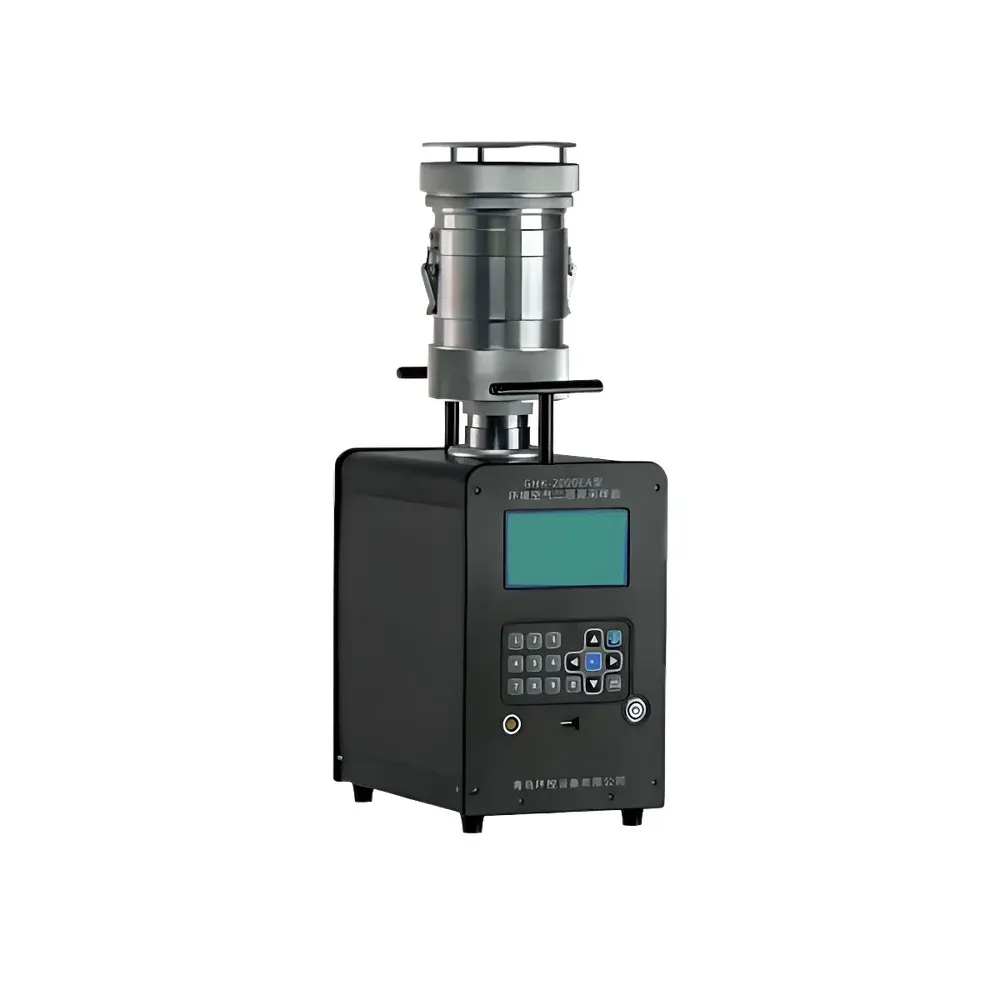
HUANKONG GHK-2000EA Environmental Air Dioxin Sampler
| Brand | HUANKONG |
|---|---|
| Origin | Shandong, China |
| Manufacturer Type | Direct Manufacturer |
| Country of Origin | China |
| Model | GHK-2000EA |
| Sampling Flow Rate Range | 220.0–1000.0 L/min |
| Compliance Standard | HJ 691–2014 |
| Weight | Not specified |
Overview
The HUANKONG GHK-2000EA Environmental Air Dioxin Sampler is a field-deployable, high-flow volumetric sampling system engineered for the quantitative collection of semi-volatile organic compounds (SVOCs) from ambient air and uncontrolled emission sources. It operates on the principle of isokinetic or constant-flow filtration and adsorption, enabling representative capture of dioxins (PCDD/Fs), polycyclic aromatic hydrocarbons (PAHs), polychlorinated biphenyls (PCBs), and other priority SVOCs defined under Chinese environmental monitoring frameworks. Designed in strict alignment with HJ 691–2014 *Technical Guidelines for Sampling Semi-Volatile Organic Compounds in Ambient Air*, the instrument supports subsequent high-resolution analytical workflows—including isotope-dilution HRGC-HRMS per HJ 77.2–2008—by ensuring trace-level analyte integrity, minimal breakthrough, and metrologically sound flow control across variable environmental conditions.
Key Features
- Compact, lightweight chassis optimized for field mobility and rapid deployment; integrated carrying handle and optional tripod mounting support flexible installation at regulatory sampling heights (e.g., 1.5–3 m above ground level).
- Precision-controlled sampling via closed-loop feedback regulation, maintaining constant volumetric flow (220.0–1000.0 L/min) despite dynamic backpressure changes induced by filter/adsorbent media loading or ambient temperature shifts.
- Modular, plug-in sampling head interface with O-ring sealed coupling—ensures leak-tight connection (<0.5% leakage at 10 kPa differential pressure) and enables tool-free replacement of quartz fiber filters and polyurethane foam (PUF)/XAD-2 cartridges.
- Onboard environmental sensor suite continuously records and logs real-time ambient temperature (±0.5 °C), barometric pressure (±0.1 kPa), actual flow rate (±2% full scale), elapsed time, and power interruption events.
- Embedded microcontroller with non-volatile memory retains up to 100 complete sampling session records—including pre- and post-calibration flow data, cumulative volume (at standard conditions), and fault diagnostics—even after unexpected power loss.
- Industrial-grade imported centrifugal blower rated for >20,000 hours MTBF; engineered with thermal overload protection and automatic shutdown upon current surge or motor stall.
Sample Compatibility & Compliance
The GHK-2000EA accommodates standardized 100 mm or 150 mm diameter quartz fiber filters (QFF) paired with PUF/XAD-2 backup adsorbent cartridges, fully compatible with EPA Method 23, EN 1948, and HJ 77.2–2008 sample preparation protocols. Its flow stability and pressure compensation logic meet the ±5% tolerance requirement for volumetric accuracy specified in HJ 691–2014. All firmware and hardware design elements adhere to GLP-aligned data integrity principles: timestamps are hardware-synchronized, parameter logging is immutable during active sampling, and calibration history is cryptographically timestamped and retained in device memory. While not certified to IEC 61000-6-3 or ATEX, the unit complies with GB/T 18204.1–2013 electromagnetic compatibility requirements for environmental monitoring instrumentation.
Software & Data Management
Data export is supported via USB 2.0 interface using proprietary PC-based configuration and retrieval software (Windows 10/11 compatible). The application enables batch download of sampling logs, generation of ISO/IEC 17025-compliant audit trails—including operator ID, calibration certificate numbers, and instrument serial traceability—and automated conversion of raw volumetric data to standard temperature and pressure (STP: 273.15 K, 101.325 kPa) using integrated meteorological inputs. All stored records include digital signatures verifying temporal sequence and preventing post-hoc modification—supporting regulatory readiness for inspection under China’s Ministry of Ecology and Environment (MEE) QA/QC guidelines.
Applications
- Ambient air monitoring networks for dioxin hotspot screening near waste incineration facilities, metallurgical plants, and chemical manufacturing sites.
- Source testing of fugitive emissions from open storage piles, landfills, and remediation zones where SVOC volatilization occurs.
- Long-term trend analysis in background stations requiring low-maintenance, high-reliability sampling over multi-week campaigns.
- Method validation studies supporting accreditation to CNAS-CL01:2018 (equivalent to ISO/IEC 17025:2017) for environmental laboratories.
- Research applications involving congener-specific partitioning studies between gaseous and particulate phases of PCDD/Fs under varying humidity and temperature regimes.
FAQ
What sampling media configurations are validated for use with the GHK-2000EA?
Quartz fiber filters (QFF) combined with polyurethane foam (PUF) and XAD-2 resin cartridges are validated per HJ 77.2–2008 and widely used in national monitoring programs.
Does the instrument support remote monitoring or telemetry?
No—the GHK-2000EA is a standalone, non-networked device designed for manual deployment and periodic local data retrieval via USB.
Is calibration traceable to national standards?
Yes—flow calibrations must be performed using a NIST-traceable primary standard (e.g., bell prover or critical orifice) prior to each sampling campaign, and calibration certificates are stored within the device memory.
Can the sampler operate continuously for more than 24 hours?
Yes—continuous operation exceeding 168 hours is achievable with stable AC power or external battery packs meeting ≥12 V / 10 Ah specifications.
How is compliance with HJ 691–2014 verified during field use?
By confirming that real-time flow deviation remains within ±5% of setpoint throughout sampling, that temperature/pressure logging intervals are ≤5 minutes, and that all metadata (including operator ID and site coordinates) are recorded prior to initiation.
Related Products







