
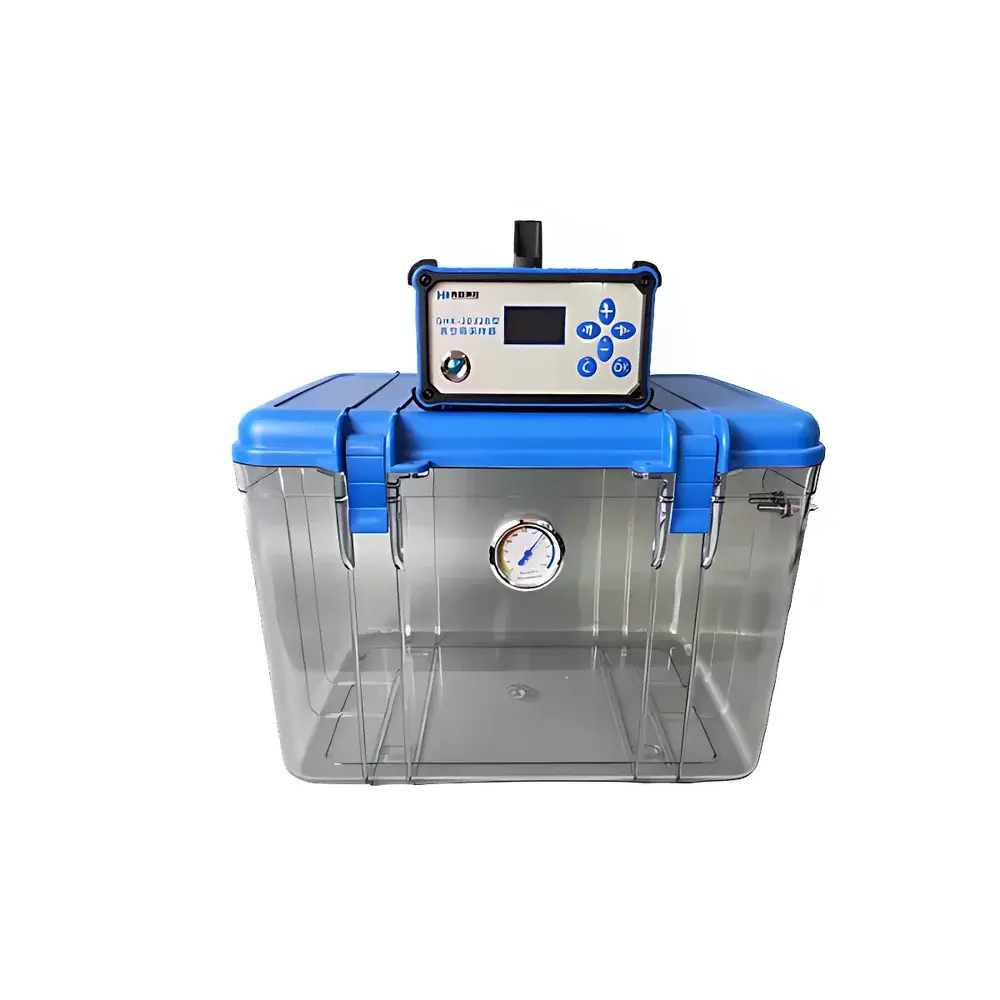
HUANKONG GHK-2032B Vacuum Chamber Gas Sampler
| Brand | HUANKONG |
|---|---|
| Origin | Shandong, China |
| Manufacturer Type | Manufacturer |
| Country of Origin | Domestic (China) |
| Model | GHK-2032B |
| Instrument Type | Single-Channel Passive Gas Sampler |
| Sampling Flow Rate | Up to 5.0 L/min |
| Standard Bag Capacity | 8 L (configurable from 1–10 L) |
| Power Supply | Rechargeable Internal Battery |
| Compliance Standards | HJ 732–2014, HJ 38–2017, HJ 604–2017, HJ 1006–2018, HJ/T 55–2017, HJ 1261–2022, HJ 1262–2022 |
| Bag Material Compatibility | Fluoropolymer Films (e.g., PVF) |
Overview
The HUANKONG GHK-2032B Vacuum Chamber Gas Sampler is an engineered field-deployable instrument designed for passive, contamination-free collection of ambient air and stack emissions in environmental compliance monitoring. It operates on the principle of vacuum-assisted passive sampling: a fluoropolymer gas bag—typically constructed from polyvinyl fluoride (PVF) or equivalent low-permeability, inert fluorinated film—is placed inside a sealed vacuum chamber; upon controlled release of the vacuum, ambient or ducted sample gas flows directly into the bag without mechanical compression, catalytic contact, or thermal degradation. This eliminates pump-induced artifacts such as adsorption loss, reactive surface interaction, or volatile compound fractionation—critical for preserving the integrity of trace-level VOCs, non-methane hydrocarbons (NMHC), halogenated volatiles, and odor-active compounds prior to laboratory analysis via GC-FID, GC-MS, or olfactometry.
Key Features
- Passive sampling architecture ensures zero inline flow resistance, eliminating pressure drop–induced bias and preventing chemical alteration of reactive analytes.
- High-capacity diaphragm sampling pump delivers up to 5.0 L/min flow rate with stable performance under variable backpressure conditions typical of full-stack or high-humidity sampling scenarios.
- Programmable sampling timer with auto-termination: users define duration (seconds to hours); system halts pump operation precisely at endpoint and initiates controlled venting of the vacuum chamber.
- Modular vacuum chamber design: controller unit is physically decoupled from the chamber, enabling interchangeability of chamber volumes (1 L to 10 L) while maintaining consistent vacuum control logic and pressure ramp profiles.
- Integrated bag conditioning mode: configurable manual purge cycles (1–5 rinses) using sample gas or certified zero air to remove residual contaminants from new or reused fluoropolymer bags prior to primary collection.
- Onboard rechargeable lithium-ion battery supports ≥8 hours of continuous operation at 3.0 L/min, verified per IEC 62133; battery status and remaining runtime are displayed in real time.
- Automated post-sampling depressurization sequence ensures safe, tool-free lid removal—eliminating risk of bag rupture or operator exposure during handling.
- Local data logging stores ≥1,000 sampling records including date/time stamp, set duration, actual flow profile (integrated), bag ID (user-entered), and chamber pressure decay curve.
Sample Compatibility & Compliance
The GHK-2032B is validated for use with fluoropolymer gas bags meeting ASTM D6159–22 specifications for permeation resistance and extractables performance. Its operational parameters align with Chinese national environmental monitoring standards governing both ambient and source emission testing—including HJ 732–2014 (VOC sampling via bag), HJ 38–2017 and HJ 604–2017 (NMHC quantification), HJ 1006–2018 (halogenated VOCs), and HJ 1261–2022 (benzene homologues). For odor assessment, it supports HJ 1262–2022-compliant three-point dynamic dilution bag preparation. While not certified to ISO/IEC 17025 or EPA Compendium Method TO-15, its passive design inherently satisfies GLP-aligned chain-of-custody requirements when paired with documented bag lot traceability and field blank protocols.
Software & Data Management
Data retrieval occurs via USB-C interface or optional Bluetooth 5.0 module (IEEE 802.15.1 compliant). The embedded firmware supports CSV export of all logged sessions, including timestamped vacuum decay curves and flow-integrated volume calculations. No proprietary software is required: exported files are natively readable in Excel, LabChart, or LIMS platforms. Audit trail functionality records user login events, parameter changes, and firmware updates—supporting basic 21 CFR Part 11 readiness when deployed with organizational electronic signature policies. Firmware updates are delivered via signed .bin files with SHA-256 checksum verification.
Applications
- Regulatory stack testing for NMHC, BTEX, chlorinated solvents, and fluorocarbons under provincial EPA-equivalent enforcement programs.
- Odor investigation at landfill boundaries, wastewater treatment plants, and rendering facilities per HJ 1262–2022 three-point olfactometry workflows.
- Indoor air quality (IAQ) screening in industrial hygiene assessments where thermal desorption artifact avoidance is critical.
- Method validation studies comparing bag-based vs. canister-based VOC recovery across temperature and humidity gradients.
- Mobile monitoring campaigns requiring rapid bag exchange and minimal power infrastructure—e.g., roadside fugitive emission surveys.
FAQ
What bag materials are compatible with the GHK-2032B?
PVF (Tedlar®), FEP, and PFA fluoropolymer films with thickness ≥25 µm and water vapor transmission rate <0.5 g·mm/m²·day (per ASTM E96) are recommended.
Does the instrument support active sampling with flow control?
No—it is strictly a passive vacuum-driven sampler; flow rate is determined by bag geometry, chamber vacuum level, and sample matrix viscosity—not regulated mass flow control.
Can sampling data be integrated into a centralized LIMS?
Yes, via exported CSV files containing ISO 8601 timestamps, unique session IDs, and metadata fields mapped to standard LIMS ingestion templates.
Is calibration required before each use?
No routine calibration is specified; however, annual verification of vacuum sensor accuracy (±1.5% FS) and pump flow consistency (±3% RSD at 5.0 L/min) is advised per internal QA procedures.
What maintenance intervals are recommended?
Diaphragm pump oil replacement every 12 months or 2,000 operating hours; O-ring inspection and fluoropolymer bag port cleaning after every 50 sampling cycles.







