
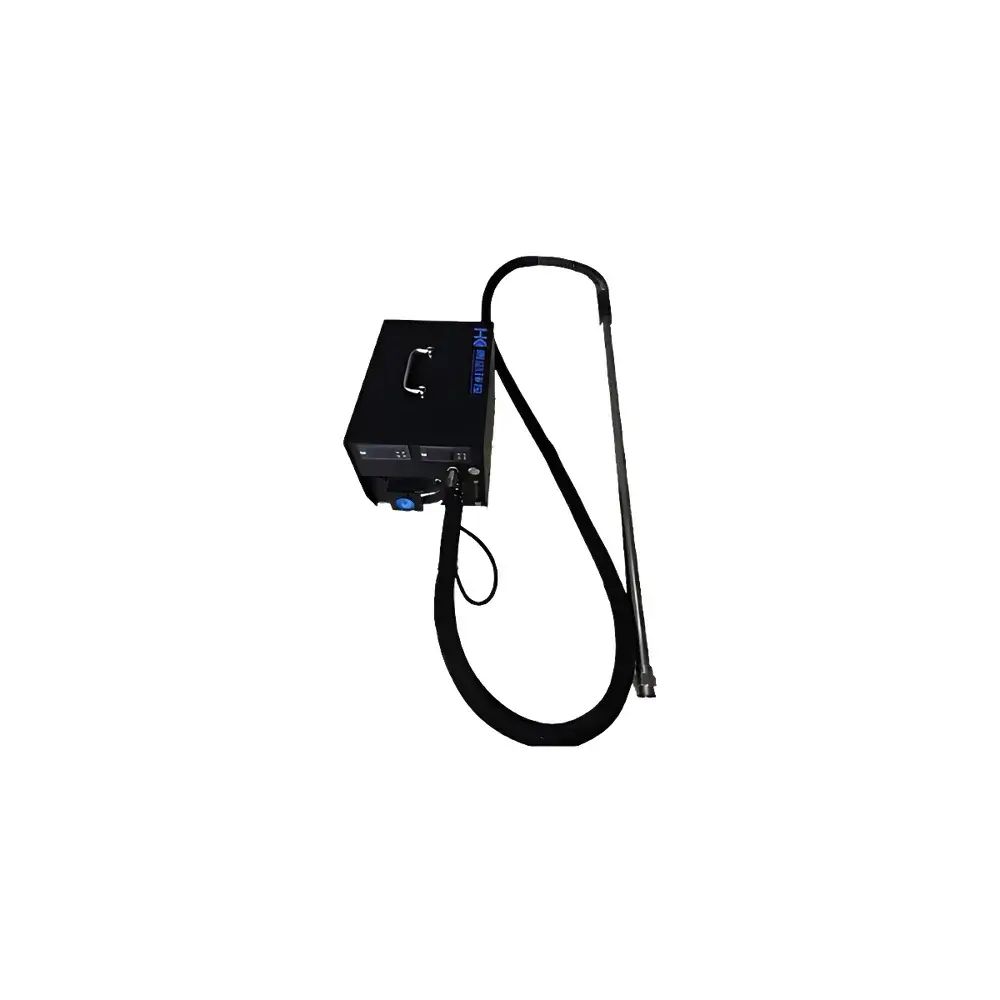
HUANKONG GHK-2901 Flue Gas Preconditioning System
| Brand | HUANKONG |
|---|---|
| Origin | Shandong, China |
| Manufacturer Type | Direct Manufacturer |
| Product Origin | Domestic (China) |
| Model | GHK-2901 |
| Instrument Type | Flue Gas Preconditioner |
| Sample Type | Flue Gas |
| Compliance Standard | HJ/T 47–1999 “Technical Specifications for Flue Gas Samplers” |
| Cooling Method | High-Power Compressor-Based Refrigeration |
| Minimum Refrigeration Temperature | –10 °C |
| Heating & Cooling Control | Dual-Screen PID Control |
| Sample Line Material | PTFE-Lined Tubing |
| Filtration | Dual-Stage — Sintered Metal + PTFE Membrane |
| Condensate Removal | External Peristaltic Pump with Visual Chamber |
| Electrical Safety | Low-Voltage DC for Heating/Refrigeration Circuits |
| Connection Interface | Quick-Connect Fittings for Gas and Power |
Overview
The HUANKONG GHK-2901 Flue Gas Preconditioning System is an engineered solution designed for real-time, in-line conditioning of hot, moist flue gas streams prior to instrumental analysis. It operates on the principle of thermally controlled condensation—using a high-efficiency compressor-based refrigeration module to rapidly cool sample gas to –10 °C, thereby precipitating water vapor while preserving the integrity of soluble gaseous analytes (e.g., SO₂, NOₓ, HCl, CO) and minimizing aqueous-phase partitioning losses. Unlike passive cooling or permeation dryers, this active preconditioning architecture ensures consistent dew point suppression under variable stack conditions (up to 200 °C inlet temperature, typical for coal- or biomass-fired boilers), directly supporting compliance with HJ/T 47–1999—the Chinese national standard governing performance requirements, calibration protocols, and operational validation criteria for flue gas sampling systems. Its purpose is not merely moisture removal, but systematic preservation of gas-phase composition fidelity across the full analytical chain—from probe tip to analyzer inlet.
Key Features
- High-capacity compressor refrigeration system delivering stable –10 °C cold trap operation with <5 min thermal stabilization time, enabling rapid response to transient moisture load changes.
- Full-length heated sample line (PTFE-lined, flexible, integrated with sampling probe) maintains gas temperature above dew point throughout transport, eliminating wall condensation and adsorptive loss of polar compounds.
- PTFE-lined internal flow path minimizes surface adsorption of reactive species (e.g., NH₃, Hg⁰, VOCs), ensuring representative sampling for regulatory-grade emission monitoring.
- Dual-stage filtration: front-end sintered stainless steel (5 µm nominal retention) followed by hydrophobic PTFE membrane (0.2 µm pore size), providing robust particulate protection without pressure drop-induced flow instability.
- Low-voltage DC power architecture (24 VDC) for both heating and refrigeration circuits—reducing electrical hazard risk in field-deployed industrial environments and supporting safe operation in Zone 2 hazardous areas when properly installed.
- Dual-screen PID controller with independent setpoint adjustment for heating and cooling zones, enabling precise thermal gradient management and reproducible conditioning profiles across seasonal ambient variations.
- Externally mounted peristaltic condensate pump with transparent fluid chamber allows real-time visual verification of liquid removal rate and facilitates rapid tubing replacement without system disassembly.
- Quick-connect gas and power interfaces (ISO-KF compatible for gas; M12 for power/data) reduce field setup time and improve repeatability during multi-point stack surveys or mobile monitoring campaigns.
Sample Compatibility & Compliance
The GHK-2901 is validated for continuous or intermittent sampling of flue gases from stationary combustion sources including coal-fired power plants, municipal waste incinerators, cement kilns, and industrial boilers. It accommodates gas matrices containing up to 20 % v/v water vapor, ≤500 mg/m³ total suspended particulates (TSP), and acidic components (SO₂ ≤ 5,000 ppm, NOₓ ≤ 2,000 ppm). All wetted materials—including PTFE tubing, sintered metal filter housing, and refrigerated condensate chamber—are chemically inert per ASTM D4293 and ISO 16000-3 specifications. The system meets structural and functional requirements defined in HJ/T 47–1999, including flow stability (<±2 % over 1 h), temperature control accuracy (±1.5 °C), and zero-gas drift <0.5 % FS/h. While not certified to EN 15267 or US EPA PS-11, its design principles align with the physical conditioning benchmarks referenced in ISO 12039 and VDI 3862 Part 2 for extractive CEMS preprocessing.
Software & Data Management
The GHK-2901 operates as a standalone hardware module with no embedded firmware or digital communication interface. Temperature setpoints, runtime status, and fault indicators are displayed via dual LED screens; no data logging, remote configuration, or network connectivity is provided. This analog control architecture ensures electromagnetic compatibility (EMC) in high-noise industrial settings and eliminates cybersecurity vulnerabilities associated with connected instrumentation. For integration into automated CEMS or QA/QC workflows, external analog output signals (4–20 mA) for refrigeration temperature and condensate level can be interfaced via optional I/O modules—supporting audit-ready traceability under GLP and ISO/IEC 17025 laboratory quality systems. All operational parameters remain manually recordable per HJ/T 47–1999 documentation requirements.
Applications
- Preconditioning flue gas for UV-DOAS, FTIR, and electrochemical analyzers in continuous emission monitoring systems (CEMS).
- Supporting reference method testing (e.g., HJ 57–2017 for SO₂, HJ 482–2009 for HCl) by delivering dry, particle-free sample streams compliant with method-defined moisture thresholds.
- Enabling accurate measurement of low-concentration pollutants (e.g., mercury, dioxins) where water interference causes spectral overlap or catalyst poisoning in pre-concentrator traps.
- Field deployment in stack testing campaigns requiring rapid setup, robustness against ambient temperature swings (–20 °C to +50 °C), and minimal maintenance between sampling events.
- Use in R&D laboratories evaluating sorbent efficiency, scrubber performance, or post-combustion capture technologies where gas composition stability across repeated runs is critical.
FAQ
Does the GHK-2901 support automatic calibration or diagnostic self-tests?
No. It is a manually operated, analog-conditioning device without embedded microprocessors, firmware, or self-test routines.
Can it be used with corrosive flue gases containing high concentrations of SO₃ or HF?
Yes—provided upstream corrosion-resistant probes (e.g., Hastelloy C-276 or ceramic-coated) are used; the GHK-2901’s PTFE and stainless-steel wetted parts resist moderate acid exposure, but long-term HF service requires custom material review.
Is the peristaltic pump rated for continuous 24/7 operation?
Yes—the pump motor and tubing are specified for >10,000 hours MTBF under nominal condensate load (≤10 mL/min), with replaceable tubing kits supplied per maintenance schedule.
What is the maximum allowable inlet gas temperature?
200 °C continuous; short-term excursions to 250 °C are permissible if duration remains <5 minutes and upstream dilution or quenching is applied.
Does the system include a built-in flow meter or flow controller?
No. Flow regulation must be performed upstream using a calibrated mass flow controller or critical orifice; the GHK-2901 maintains flow integrity but does not measure or adjust it.
Related Products







