
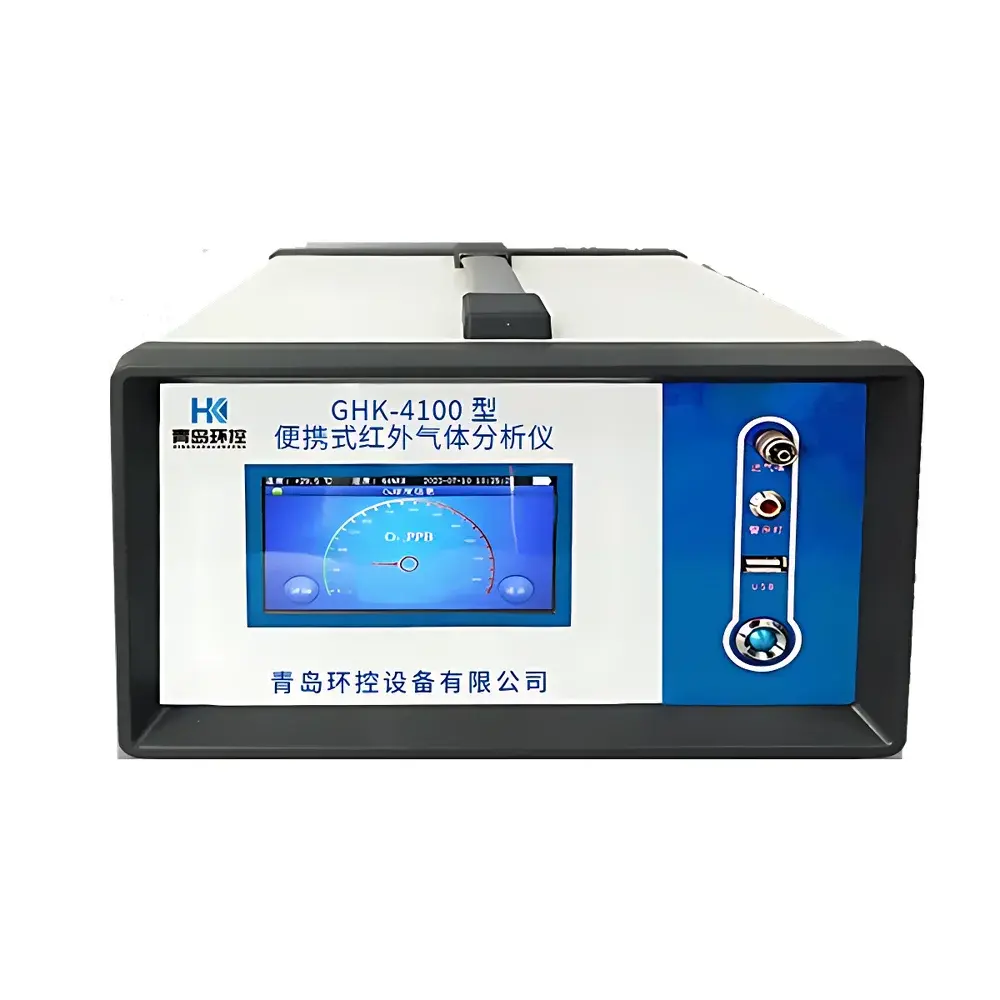
HUANKONG GHK-4100 Portable NDIR Multi-Gas Analyzer for CO and CO₂
| Brand | HUANKONG |
|---|---|
| Origin | Shandong, China |
| Manufacturer Type | Direct Manufacturer |
| Instrument Type | Portable |
| Detection Target | Multi-component Gases |
| Minimum Range | Customizable |
| Repeatability | ±1% F.S. |
| Resolution | 0.01 ppm (CO₂) / 1 ppm (CO) |
| Response Time | <15 s |
Overview
The HUANKONG GHK-4100 is a portable, dual-channel non-dispersive infrared (NDIR) gas analyzer engineered for high-accuracy, real-time measurement of carbon monoxide (CO) and carbon dioxide (CO₂) in ambient air, indoor environments, occupational settings, and field-based environmental monitoring applications. Based on the fundamental principle of selective infrared absorption—where each target gas exhibits characteristic absorption bands in the mid-infrared region—the GHK-4100 employs thermopile-based NDIR sensors with optical filters tuned to 4.26 µm (CO₂) and 4.67 µm (CO), ensuring minimal spectral overlap and low cross-sensitivity. Unlike electrochemical or metal-oxide semiconductor sensors, NDIR technology delivers long-term stability, negligible drift, and immunity to poisoning, enabling calibration intervals of up to 6 months under routine use. The instrument complies with key regulatory methodologies including HJ 965–2018 (ambient CO by NDIR), JJG 635–2011 (calibration verification for CO/CO₂ analyzers), GB/T 18204.2–2014 (public health chemical analysis), and GB/T 18883–2022 (indoor air quality standards). Its compact, ergonomic housing integrates thermal management and pressure-compensated flow control to maintain measurement integrity across variable ambient conditions.
Key Features
- True dual-gas NDIR detection: Simultaneous, independent quantification of CO and CO₂ using dedicated optical channels and temperature-stabilized detectors
- High-resolution display interface: 5-inch color TFT touchscreen supporting both digital numeric readout and analog-style gauge visualization
- Intelligent zero calibration: Dual-mode zeroing—catalytic conversion (for ambient air zero) and nitrogen purge—enabling field adaptability without external gas cylinders
- Integrated environmental compensation: Real-time correction algorithms for temperature (−10 °C to 50 °C) and relative humidity (0–95% RH, non-condensing) to minimize matrix-induced bias
- Automated valve sequencing: Built-in solenoid manifold for seamless switching between zero, span, and sample measurement phases—reducing operator error and improving reproducibility
- Configurable averaging modes: User-selectable 1-hour, 8-hour, and 24-hour moving average functions compliant with occupational exposure limit (OEL) assessment protocols (e.g., OSHA PEL, ACGIH TLV)
- Dual power architecture: Rechargeable lithium-ion battery (≥4 h continuous operation at 1.0 L/min flow) plus AC/DC adapter support for extended deployment
- Multi-unit reporting: On-device conversion among ppm, mg/m³, and % volume—automatically adjusted for molecular weight and standard temperature/pressure (STP)
- Acoustic-optical alarm system: Programmable threshold alerts with adjustable setpoints per gas channel, conforming to IEC 61000-4-2 ESD immunity requirements
Sample Compatibility & Compliance
The GHK-4100 is validated for direct sampling of ambient air, indoor air, workplace breathing zones, and stack effluent dilutions (when used with certified dilution systems). It meets performance criteria specified in GBZ/T 300.37–2017 (workplace toxicant analysis), GB/T 18204.23–2000 and GB/T 18204.24–2000 (public health CO/CO₂ methods), and GB 9801–1988 (ambient CO NDIR standard). While not intrinsically safe for Class I Div 1 hazardous locations, it operates within ATEX Zone 2/IECEx Zone 2 ambient temperature limits when deployed with optional explosion-proof enclosures. All firmware and data logging routines adhere to GLP-aligned traceability principles—including time-stamped event logs, user-accessible audit trails, and immutable storage of calibration history.
Software & Data Management
Data acquisition and post-processing are supported via embedded 8,000-entry flash memory (timestamped, GPS-tagged if optional module installed) and bidirectional communication interfaces: USB 2.0 (mass storage mode for CSV export), RS-232 (Modbus RTU protocol), and Bluetooth 5.0 (for wireless pairing with HUANKONG’s PC-based DataView Pro software). The software enables spectral baseline validation, linear/nonlinear calibration curve fitting (2–5 point), uncertainty estimation per ISO/IEC 17025 Annex A.3, and automated report generation aligned with CNAS-accredited laboratory templates. Firmware updates are performed via signed .bin files to ensure cryptographic integrity and prevent unauthorized modification.
Applications
- Ambient air quality monitoring networks (AQMS) requiring compliance-grade CO/CO₂ co-measurement
- Indoor air quality (IAQ) audits in schools, offices, hospitals, and residential buildings per GB/T 18883–2022
- Occupational hygiene surveys for CO exposure assessment in garages, boiler rooms, and confined spaces
- Greenhouse gas flux studies in agricultural and ecological field research
- Validation of HVAC system ventilation efficiency through CO₂ decay rate analysis
- Calibration verification of fixed-site continuous emission monitoring systems (CEMS)
FAQ
What gases can the GHK-4100 measure simultaneously?
The standard configuration measures CO and CO₂ concurrently. Optional sensor modules support CH₄, C₂H₆, C₂H₄, C₂H₅OH, CH₃Br, and SF₆—but only two gases may be active per measurement cycle due to optical path constraints.
Is the instrument suitable for regulatory reporting?
Yes—when operated per manufacturer-specified calibration and maintenance schedules, its performance satisfies the metrological requirements of HJ 965–2018 and JJG 635–2011 for ambient and workplace CO/CO₂ monitoring.
How is humidity interference mitigated?
A dedicated capacitive RH sensor feeds real-time humidity values into a physics-based compensation model that adjusts absorbance-to-concentration conversion coefficients, reducing typical humidity-induced error from >5% to <0.8% F.S. across 30–80% RH.
Can measurement data be exported to LIMS?
Yes—via USB mass storage (CSV) or RS-232 Modbus RTU, enabling direct ingestion into laboratory information management systems compliant with ASTM E1578 and ISO/IEC 17025 data integrity clauses.
What is the recommended calibration frequency?
Initial calibration before first use, followed by functional checks every 30 days and full recalibration every 180 days—or after exposure to concentrations exceeding 150% of full scale, sensor contamination, or mechanical shock.
Related Products







