
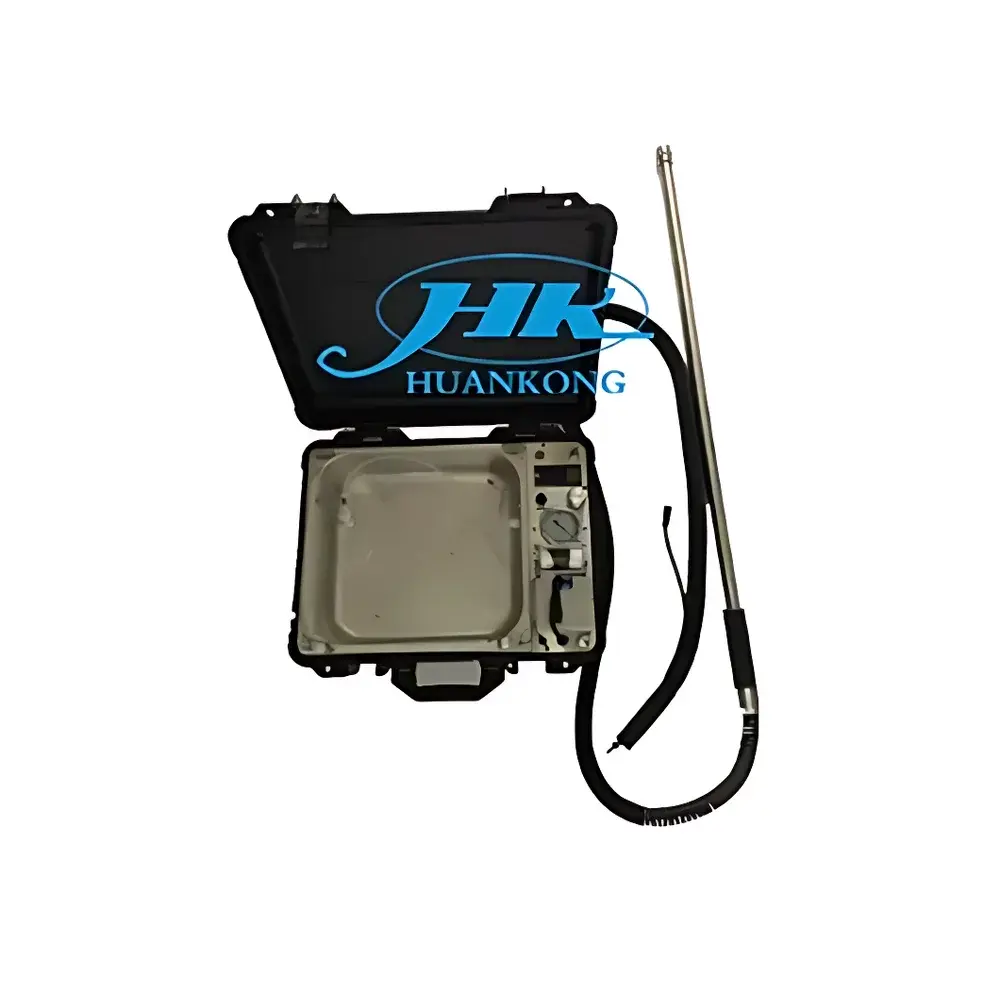
HUANKONG GHK2031 VOC Vacuum Chamber Bag Sampler for Emission Sources
| Brand | HUANKONG |
|---|---|
| Origin | Shandong, China |
| Manufacturer Type | Manufacturer |
| Product Category | Domestic |
| Model | GHK2031 |
| Instrument Type | Conventional Gas Sampler |
| Configuration | Single-Channel Gas Sampler |
| Flow Rate Range | ≥5 L/min |
| Vacuum Pressure | ≥30 kPa |
| Flow Stability | Better than ±2% |
| Flowmeter Accuracy | Better than ±1% |
| Operational Duration at Max Flow & Backpressure | ≥2 h |
Overview
The HUANKONG GHK2031 VOC Vacuum Chamber Bag Sampler is a field-deployable, passive gas sampling system engineered for regulatory-compliant collection of volatile organic compounds (VOCs) and non-methane hydrocarbons (NMHC) from stationary emission sources. It operates on the principle of vacuum-driven passive filling: a sealed fluoropolymer gas bag (e.g., Tedlar® or PVF film) is placed inside a rigid, airtight stainless-steel vacuum chamber; upon evacuation of the chamber, the pressure differential forces ambient stack or duct gas directly into the bag—without contact with pump internals, valves, or wetted metal surfaces. This design eliminates adsorption artifacts, catalytic degradation, and flow-induced fractionation commonly observed in active pump-based systems. The instrument complies strictly with HJ 732–2014 *Sampling of Volatile Organic Compounds from Stationary Sources Using Gas Bags*, and supports method validation under ISO 16000-6, EPA Method TO-14A/TO-15, and ASTM D6196–22 frameworks for ambient and source testing.
Key Features
- VOC-inert fluid path: Entire gas pathway—from heated sampling probe tip to bag inlet—is constructed exclusively from PTFE tubing and fluoropolymer fittings; zero metallic contact ensures minimal analyte loss for reactive species (e.g., aldehydes, terpenes, sulfur compounds).
- Integrated heated sampling probe: 1 m PTFE-sheathed probe with built-in 36 V AC/DC low-voltage heating element (max. 120 °C, adjustable in 0.1 °C increments); temperature accuracy ±2 °C; prevents condensation and wall deposition during high-humidity or low-temperature stack sampling.
- Robust vacuum chamber architecture: 304 stainless-steel enclosure rated IP54 for dust and splash resistance; accommodates gas bags up to 5 L capacity; includes analog vacuum gauge for real-time negative pressure monitoring (–30 kPa minimum), enabling leak verification pre- and post-sampling.
- Modular power system: Removable 29.6 V / 8.4 Ah lithium-ion battery pack (≥1000 charge cycles); provides ≥2 h continuous operation at full vacuum load; recharge time ≤6 h; integrated thermal management prevents overheat shutdown.
- Tool-free serviceability: Quick-connect pneumatic and electrical interfaces simplify field maintenance; detachable activated carbon scrubber allows optional pre-filtration for halogenated or acidic interferents; all consumables (bags, filters, O-rings) conform to USP Class VI and FDA 21 CFR Part 11 traceability requirements.
Sample Compatibility & Compliance
The GHK2031 is validated for sampling of gaseous emissions containing C2–C12 hydrocarbons, oxygenated VOCs (e.g., acetone, ethanol), chlorinated solvents (e.g., TCE, PCE), and aromatic compounds (e.g., benzene, toluene) at temperatures ≤150 °C. It meets structural and procedural requirements of HJ 732–2014, including bag material certification (PVF or FEP film per ASTM D5033), vacuum decay test protocols (<5 % pressure rise over 30 min), and documented chain-of-custody logging. All electronic components—including temperature controller, vacuum sensor, and battery management unit—support GLP/GMP audit trails when paired with optional external data loggers compliant with 21 CFR Part 11 Annex 11.
Software & Data Management
While the GHK2031 operates as a standalone hardware platform, its embedded microcontroller records timestamped operational metadata—including vacuum setpoint, achieved pressure, probe temperature, and runtime—into non-volatile memory. These logs export via USB-C to CSV format for integration into laboratory information management systems (LIMS). Optional firmware upgrade enables Bluetooth 5.0 connectivity for remote status monitoring and calibration certificate synchronization using HUANKONG’s certified calibration software suite (v3.2+), which maintains NIST-traceable calibration history and supports ISO/IEC 17025 documentation templates.
Applications
- Regulatory stack testing for chemical manufacturing, coating operations, and semiconductor fabrication facilities.
- Method development and validation for GC-FID, GC-MS, and PTR-MS analysis of unfiltered, non-diluted emission streams.
- Source apportionment studies requiring representative composite samples across variable load conditions.
- Leak detection and repair (LDAR) program support where bag sampling serves as primary capture method for fugitive emissions.
- QA/QC verification of continuous emission monitoring systems (CEMS) and portable FTIR analyzers.
FAQ
Does the GHK2031 require calibration before each use?
No—flow and vacuum sensors are factory-calibrated with NIST-traceable standards; annual recalibration is recommended per ISO/IEC 17025 and internal QA protocols.
Can the sampler be used for hydrogen sulfide (H2S) or ammonia (NH3) sampling?
Yes, provided the gas bag is certified for reactive species and sampling duration remains ≤30 minutes to minimize permeation losses; use of the optional activated carbon scrubber is advised for co-contaminant removal.
Is the heated probe compatible with wet-stack applications?
Yes—the PTFE-sheathed probe and 304 stainless-steel housing resist corrosion in saturated steam environments up to 100 % RH; however, condensate must be drained from the probe base prior to bag connection.
What gas bag specifications are required for compliance?
Bags must be made of PVF or FEP film (thickness ≥25 µm), certified per ASTM D5033 for VOC inertness, and pre-evacuated to <1 Pa residual pressure; lot-specific certification documents must accompany each batch.
How is sample integrity verified post-collection?
Via vacuum decay test (per HJ 732–2014 Section 7.4): bag pressure rise must not exceed 5 % of initial vacuum over 30 minutes at ambient temperature; recorded values are included in the instrument’s operational log.
Related Products







