
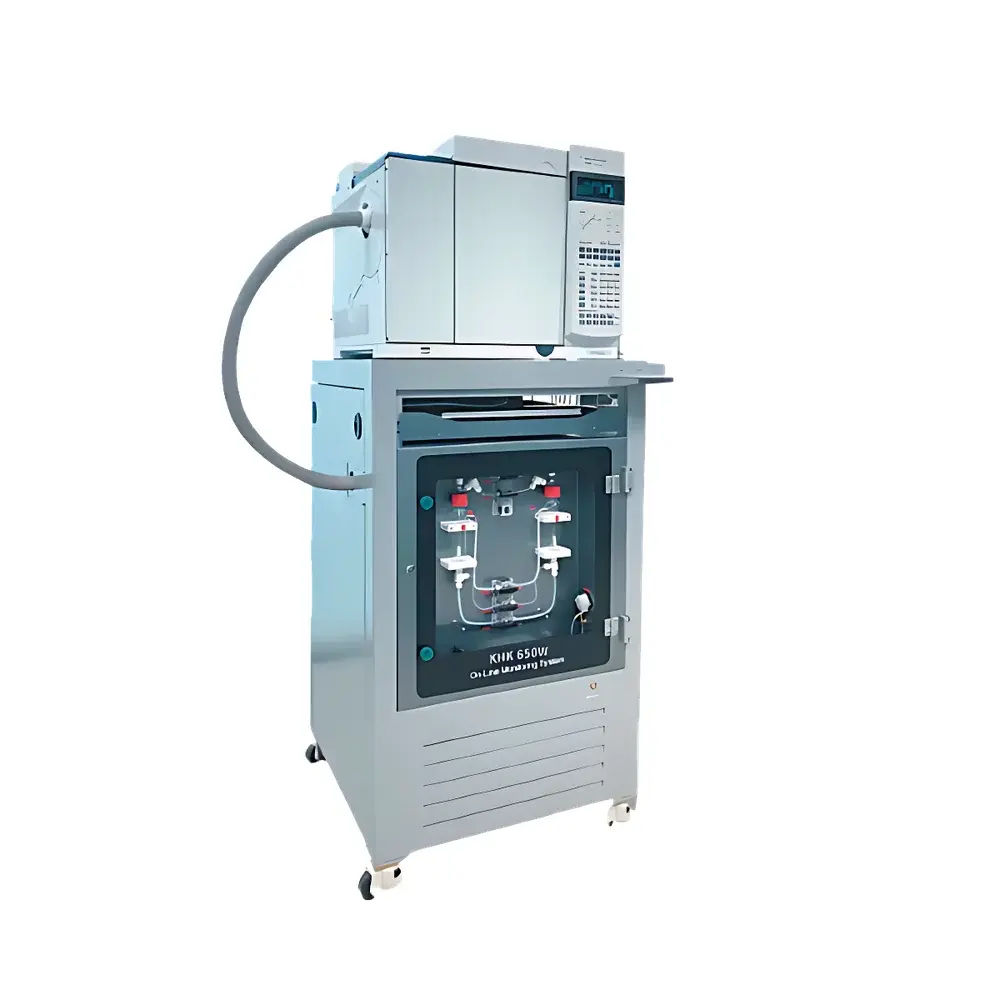
HUANKONG KHK650W Online VOCs Monitoring System for Water
| Brand | HUANKONG |
|---|---|
| Origin | Shandong, China |
| Manufacturer Type | Original Equipment Manufacturer (OEM) |
| Country of Origin | China |
| Model | KHK650W |
| Pricing | Available upon Request |
Overview
The HUANKONG KHK650W Online VOCs Monitoring System for Water is an automated, laboratory-grade analytical platform engineered for continuous, real-time quantification of volatile organic compounds (VOCs) in aqueous matrices. It operates in strict accordance with U.S. EPA Method 524.2—“Measurement of Purgeable Organic Compounds in Water by Capillary Column Gas Chromatography/Mass Spectrometry”—and supports full method compliance through integrated sample introduction, preconcentration, separation, and detection modules. The system employs two orthogonal sample preparation techniques—membrane-based liquid-phase microextraction (LPME) and purge-and-trap (P&T)—to accommodate variable matrix complexity, analyte volatility, and concentration ranges. VOCs are selectively extracted from water samples, concentrated onto sorbent traps, thermally desorbed, separated via high-resolution fused-silica capillary GC columns, and detected using configurable detectors including flame ionization detection (FID), electron capture detection (ECD), or mass spectrometric (MS) interfaces. This architecture ensures trace-level sensitivity (sub-pptr to low-ppt detection limits), high reproducibility (<5% RSD for replicate injections), and minimal interferences from humidity, salts, or particulates.
Key Features
- Dual-mode VOC extraction: Independent selection between hydrophobic microporous membrane extraction (for low-turbidity, low-salinity surface waters) and inert-gas purge-and-trap (for higher-concentration effluents or wastewater with suspended solids)
- Automated unattended operation: Fully programmable cycle timing, calibration verification, system diagnostics, and fault logging—enabling 7×24 deployment without manual intervention
- Modular detector compatibility: Field-upgradable detector options (FID, ECD, or GC-MS) to meet application-specific selectivity, regulatory reporting, or compound identification requirements
- Integrated moisture management: Membrane module excludes water vapor and inorganic ions, while P&T system incorporates dual-stage desiccant and cryogenic focusing to suppress humidity-induced baseline drift
- Robust architecture: IP65-rated enclosure, corrosion-resistant wetted materials (e.g., PTFE, quartz, electropolished stainless steel), and temperature-controlled GC oven (35–250 °C) for stable retention time alignment
- Regulatory-ready data handling: Audit-trail-enabled software compliant with FDA 21 CFR Part 11 principles, supporting electronic signatures, user access tiers, and raw data archiving
Sample Compatibility & Compliance
The KHK650W accommodates a broad range of aqueous environmental samples—including riverine and lacustrine surface waters, groundwater, industrial discharge effluents, municipal wastewater influents/effluents, and drinking water distribution systems. It is validated for target analytes per EPA 524.2, including BTEX (benzene, toluene, ethylbenzene, xylenes), chlorinated solvents (e.g., trichloroethylene, tetrachloroethylene), haloethers, and low-molecular-weight aliphatic hydrocarbons. System performance meets ISO 10301:2022 (Water quality — Determination of volatile organic compounds — Purge-and-trap gas chromatographic method) and supports GLP/GMP-aligned monitoring programs. All calibration standards, blanks, and QC checks follow EPA-recommended frequency (e.g., initial calibration verification, continuing calibration verification every 12 hours, laboratory control samples per batch).
Software & Data Management
The embedded HUANKONG Analytical Control Suite (HACS) v3.2 provides intuitive configuration of method parameters (purge time, trap desorption ramp, GC temperature program, detector settings), real-time chromatogram visualization, peak integration with retention time locking, and automatic report generation in PDF/CSV formats. Data integrity safeguards include timestamped raw signal files (.CDF), immutable audit logs tracking all user actions and instrument events, and optional integration with SCADA or LIMS via OPC UA or Modbus TCP. Remote diagnostics and firmware updates are supported over secure TLS-encrypted Ethernet or 4G LTE connections.
Applications
- Early-warning monitoring at drinking water intakes for accidental spills or upstream contamination events
- Compliance tracking of VOC discharges under NPDES permits or local environmental regulations
- Long-term trend analysis in watershed-scale ambient monitoring networks
- Process optimization and leak detection in petrochemical, pharmaceutical, and semiconductor manufacturing facilities
- Supporting remediation site assessments (e.g., plume migration studies at brownfield sites)
- Research applications requiring high-temporal-resolution VOC speciation in biogeochemical cycling studies
FAQ
Does the KHK650W require daily manual maintenance?
No. Scheduled maintenance intervals are defined per operational hours: trap replacement every 3,000 cycles, membrane module exchange every 6 months under typical surface water conditions, and GC column reconditioning annually. All consumables feature RFID-tagged inventory tracking within HACS.
Can the system operate in remote or off-grid locations?
Yes. It supports wide-input voltage (90–264 VAC, 50/60 Hz), optional solar-compatible DC power conversion, and internal UPS buffering for transient outages up to 15 minutes.
Is method validation documentation provided?
Yes. Each unit ships with a Factory Acceptance Test (FAT) report, Method Detection Limit (MDL) study summary per EPA 524.2, and a Site Acceptance Test (SAT) checklist aligned with ISO/IEC 17025 requirements.
How is data security ensured during transmission?
All network communications use TLS 1.2+ encryption; local storage employs AES-256 disk encryption; and user authentication follows NIST SP 800-63B Level 2 credentialing standards.
What is the minimum detectable concentration for benzene in drinking water?
Under standard EPA 524.2 operating conditions (10 mL sample, P&T mode, FID detection), the practical quantitation limit (PQL) is 0.05 µg/L, verified per EPA guidance on MDL determination.
Related Products







