
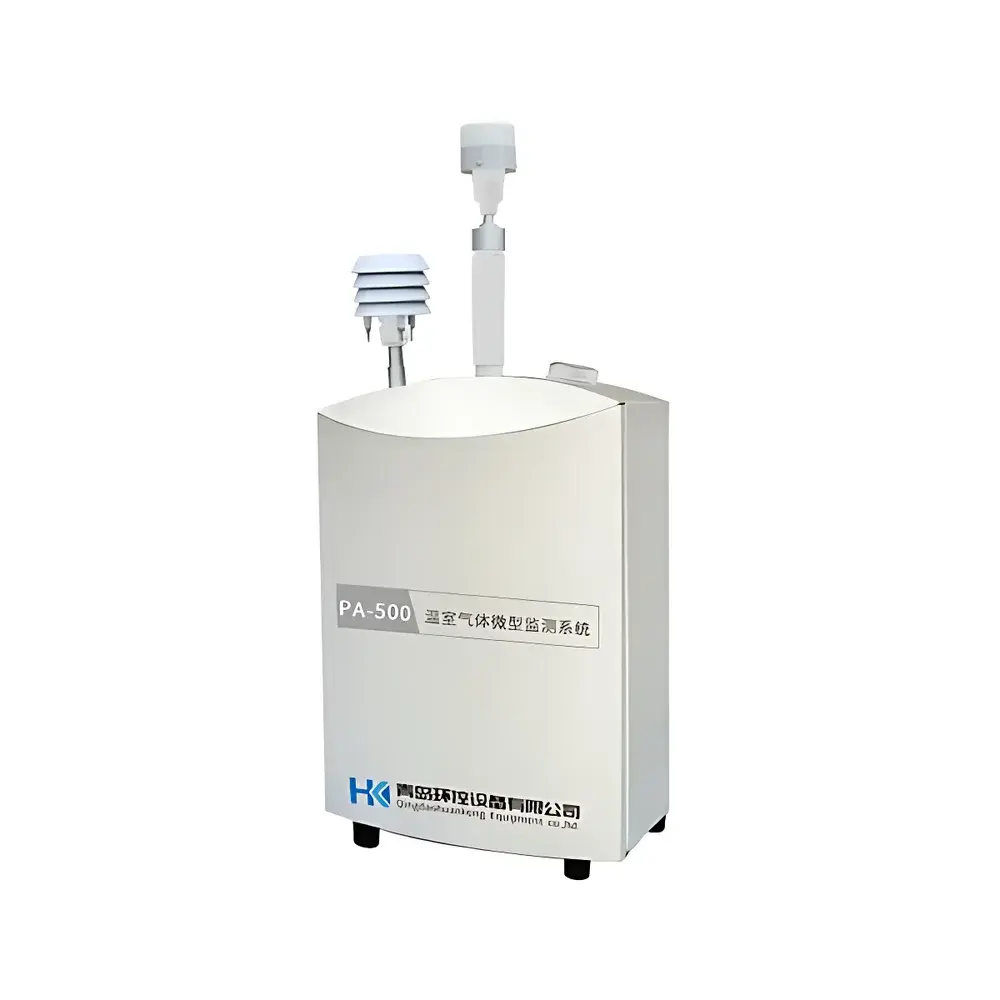
HUANKONG PA-500 Miniaturized Greenhouse Gas Monitoring System
| Brand | HUANKONG |
|---|---|
| Model | PA-500 |
| Origin | Shandong, China |
| Manufacturer Type | Direct Manufacturer |
| Detection Principle | Non-Dispersive Infrared (NDIR) |
| Measurable Gases | CO₂ (primary), expandable to PM₁₀, PM₂.₅, SO₂, NO, CO, O₃, VOCs, BTEX |
| Environmental Application Domain | Ambient Air Quality Monitoring, Industrial Boundary Monitoring, GHG Emission Verification |
| Compliance Context | Designed for alignment with ISO 14064-3 verification support, EPA Method TO-15 / Method 25A compatibility (via optional modules), and EU Directive 2008/50/EC ambient air reference equivalency |
Overview
The HUANKONG PA-500 Miniaturized Greenhouse Gas Monitoring System is an integrated, field-deployable ambient air quality analyzer engineered for continuous, unattended measurement of carbon dioxide (CO₂) using non-dispersive infrared (NDIR) spectroscopy—a physically robust, interference-resistant optical technique grounded in Beer–Lambert law absorption quantification at 4.26 µm. Unlike single-point sensors, the PA-500 employs a thermally stabilized NDIR cell with built-in temperature, pressure, and relative humidity compensation algorithms—ensuring traceable concentration output across variable environmental conditions without manual recalibration. Its modular architecture supports sequential or parallel integration of complementary sensing technologies—including electrochemical cells for NO, CO, and O₃; metal oxide semiconductor (MOS) or photoionization detector (PID) modules for VOCs and BTEX; and laser scattering-based particulate monitors for PM₁₀ and PM₂.₅—enabling multi-parameter co-location monitoring required for source apportionment, fugitive emission tracking, and urban background characterization.
Key Features
- Compact footprint (≤350 mm × 280 mm × 180 mm) optimized for rooftop installations, fence-line deployments, and mobile monitoring platforms.
- Stable mass flow control system (±1% full-scale repeatability) minimizing sampling artifacts during diurnal pressure and temperature fluctuations.
- Embedded environmental compensation engine applying real-time correction per ISO 4223-1:2021 guidelines for gas density and path-length variation.
- Low-power operation (<12 W average), supporting solar-battery hybrid power configurations for off-grid deployment up to 30 days autonomy.
- IP65-rated enclosure with corrosion-resistant aluminum alloy chassis, rated for continuous operation in -20 °C to +50 °C ambient range and 10–95% RH (non-condensing).
- Self-diagnostics including optical path integrity check, zero-span drift alert, and sensor health flagging per IEC 61508 SIL 2 functional safety principles.
Sample Compatibility & Compliance
The PA-500 draws representative ambient air via a heated stainless-steel inlet (maintained at 50 °C to suppress condensation and adsorption losses), followed by particle filtration (2.5 µm cut-off) and optional activated carbon scrubbing for VOC pre-treatment. All gas-phase measurements comply with EN 14625:2012 (O₃), EN 14626:2012 (CO), and EN 14627:2012 (NOₓ) performance criteria when configured with certified transducer modules. Particulate channels meet EN 12341:2014 reference equivalence requirements for PM₁₀/PM₂.₅. Data acquisition adheres to ISO 5725-2:2019 accuracy and precision protocols, with audit trails supporting GLP-compliant reporting. The system’s firmware architecture is designed to facilitate future validation against EPA 40 CFR Part 53 and EU QA/QC framework (2011/85/EU) requirements.
Software & Data Management
Data logging occurs at user-configurable intervals (1–60 min) with local storage (8 GB internal eMMC) and dual-path transmission: RS-485 Modbus RTU for SCADA integration and LTE-M/NB-IoT cellular uplink with TLS 1.2 encryption. The embedded web interface provides real-time calibration status, raw spectra visualization (for NDIR channel), and diagnostic logs exportable in CSV/JSON formats. Optional cloud platform (HUANKONG AirHub™) delivers automated QA/QC flagging—e.g., identifying CO₂ spikes coincident with wind-directional data from integrated meteorological module (wind speed/direction, temperature, humidity, atmospheric pressure)—and generates ISO 14064-3 Annex A-compliant uncertainty budgets per measurement channel.
Applications
- Urban and suburban ambient air quality networks requiring high spatial resolution CO₂ mapping alongside regulatory pollutants (SO₂, NO, O₃).
- Industrial boundary monitoring at chemical parks and refineries, where simultaneous detection of CO₂, VOCs, and BTEX supports fugitive emission identification per EPA Method 21 protocols.
- Greenhouse gas inventory verification under national MRV (Monitoring, Reporting, Verification) frameworks, including alignment with IPCC Tier 2 methodology for point-source proxy estimation.
- Research-grade microscale flux studies in peri-urban zones, leveraging synchronized meteorological inputs for inverse dispersion modeling.
- Compliance monitoring for LEED v4.1 and WELL Building Standard v2 indoor/outdoor air quality credits when deployed in campus or industrial park settings.
FAQ
What calibration standards are supported for CO₂ measurement?
The PA-500 accepts certified NIST-traceable CO₂ span gases (e.g., 400 ppm, 1000 ppm, 5000 ppm in synthetic air) and performs automatic zero calibration using catalytic scrubbers or synthetic nitrogen purge—fully documented in calibration log files.
Can the system operate without cellular connectivity?
Yes. All measurements are stored locally with timestamped metadata; data syncs automatically upon reconnection, preserving temporal continuity and eliminating gaps.
Is the VOC module capable of speciated benzene/toluene/ethylbenzene/xylene (BTEX) quantification?
The base PID module reports total VOC (as isobutylene-equivalent); optional GC-PID or GC-FID add-on modules enable speciated BTEX analysis with LODs ≤0.5 ppb per compound.
How is data integrity ensured during power interruption?
Non-volatile memory retains configuration and last 72 hours of data; UPS-compatible input allows graceful shutdown and resume without file corruption.
Does the system support remote firmware updates and parameter reconfiguration?
Yes—via authenticated HTTPS API endpoints compliant with IEC 62443-3-3 security level SL2, including role-based access control and cryptographic signature verification.







