
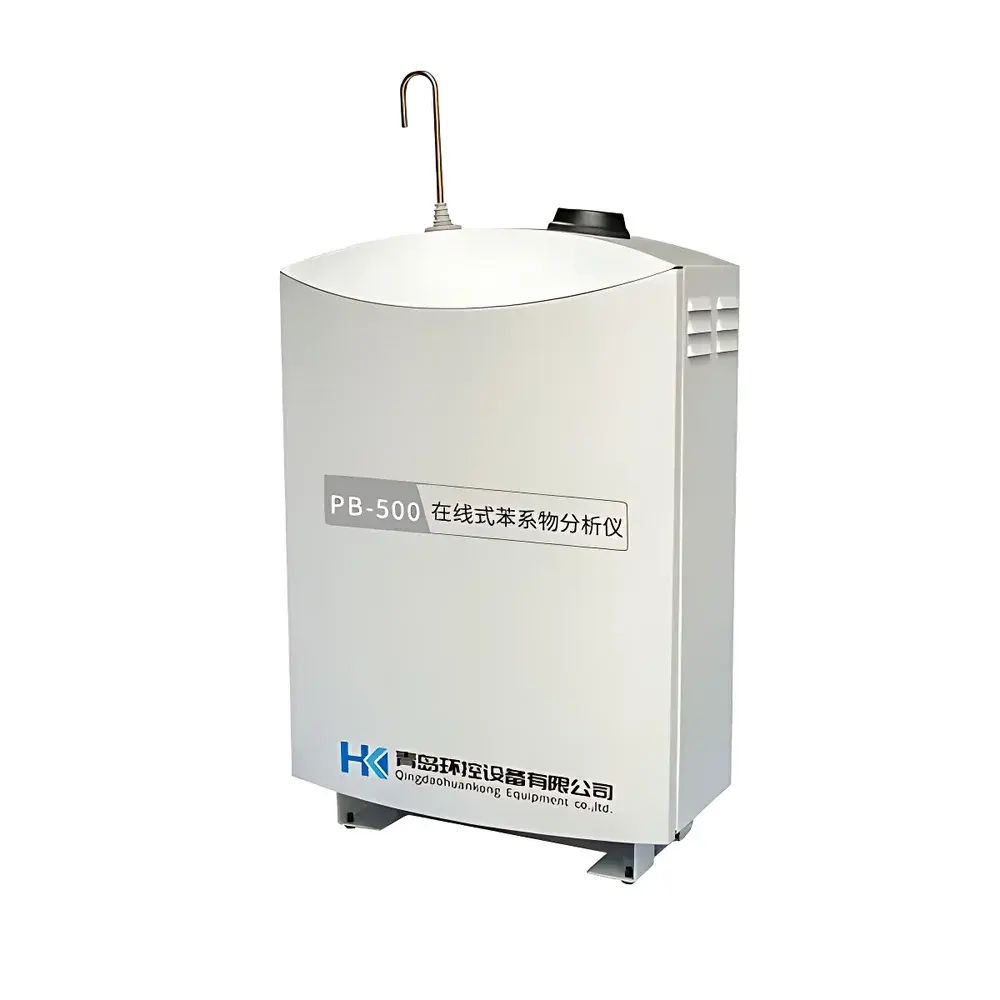
HUANKONG PB-500 Online Benzene Series Analyzer
| Brand | HUANKONG |
|---|---|
| Origin | Shandong, China |
| Manufacturer Type | Original Equipment Manufacturer (OEM) |
| Country of Origin | China |
| Model | PB-500 |
| Detection Principle | Gas Chromatography (GC) with Preconcentration and PID Detection |
| Instrument Type | Portable Online VOC Analyzer |
| Configuration | Single-Gas Targeted Analyzer (Benzene, Toluene, Xylenes) |
| Sampling Method | Probe-Based Direct Air Intake |
| Accuracy | ±2% of Full Scale |
| Response Time (T90) | < 900 s |
| Power Supply | Integrated 12 V DC |
| Maintenance Interval | Monthly Calibration Recommended |
| PID Lamp Lifetime | ≥12 months continuous operation |
| Operating Environment | Ambient or Enclosed Temperature-Controlled Enclosure |
Overview
The HUANKONG PB-500 Online Benzene Series Analyzer is a field-deployable, real-time gas chromatographic instrument engineered for continuous, unattended monitoring of benzene, toluene, and xylenes (BTX) in ambient air. It operates on a miniaturized gas chromatography platform integrated with solid-phase micro-preconcentration and photoionization detection (PID), eliminating dependence on external compressed carrier gas cylinders. This architecture enables autonomous operation in remote or infrastructure-limited locations while maintaining analytical rigor suitable for regulatory-grade environmental surveillance. The system implements a two-stage thermal desorption process: trace BTX compounds are selectively adsorbed onto an on-chip microfabricated preconcentrator at ambient temperature, then rapidly thermally desorbed into a microfluidic GC separation column. Separated analytes elute sequentially and are quantified by a low-power, long-life 10.6 eV PID sensor with linear response across the 0.1–10 ppmv dynamic range (calibrated for BTX). Designed for ISO 16000-6 and EPA TO-17 compliant sampling workflows, the PB-500 delivers repeatable retention time stability (<0.5% RSD) and quantitative reproducibility under variable humidity (10–90% RH) and temperature (−10 to +45 °C) conditions.
Key Features
- Carrier-gas-free GC architecture: Eliminates high-pressure gas cylinders, reducing operational risk, logistics overhead, and footprint—ideal for mobile deployment and fixed-site networks.
- MEMS-based micro-preconcentrator: On-die sorbent trap with programmable thermal desorption ensures selective enrichment of aromatic VOCs with minimal co-elution interference from aliphatics or moisture.
- Monolithic micro-GC column: Fused-silica capillary column (3 m × 0.25 mm ID) coated with 100% dimethylpolysiloxane phase, optimized for BTX resolution at sub-ambient oven temperatures (40–80 °C).
- High-stability 10.6 eV PID detector: UV lamp lifetime ≥10,000 hours; calibrated sensitivity of 0.05 ppmv for benzene (S/N ≥ 3); linear dynamic range spans three orders of magnitude.
- Integrated 12 V DC power management: Supports battery-backed or solar-charged operation; internal thermal regulation maintains column oven and detector temperature within ±0.3 °C.
- Modular signal processing unit: Optional RS-485/4–20 mA analog output and IEEE 802.11n wireless telemetry module enable seamless integration into SCADA, EMS, or cloud-based air quality platforms.
Sample Compatibility & Compliance
The PB-500 is validated for direct analysis of undiluted ambient air, indoor air, and stack-adjacent plume samples (via heated probe extension up to 2 m). It meets functional requirements of ISO 16017-1 (VOC measurement in indoor air), ASTM D5197 (determination of aromatic hydrocarbons), and EU Directive 2008/50/EC Annex IX (benzene limit value monitoring). While not certified as a Class I, Division 1 hazardous area device, its intrinsically safe design (IEC 60079-0:2017 compliant circuitry) permits use in non-explosive industrial perimeters. Data integrity adheres to GLP principles: onboard clock-synchronized timestamps, audit-trail-enabled calibration logs, and write-protected raw chromatogram storage (≥30 days at 1-min interval).
Software & Data Management
Firmware v3.2 includes embedded chromatogram acquisition engine with adaptive baseline correction and peak deconvolution algorithms for overlapping xylene isomers. The web-accessible interface (HTTPS-enabled) supports remote method configuration, real-time chromatogram visualization, and automated report generation (PDF/CSV). All calibration events—including zero/span checks, multi-point linearity verification, and lamp energy diagnostics—are recorded with user ID, timestamp, and deviation flags. Exported datasets comply with AQMesh and OpenAQ schema conventions and include metadata fields for location, temperature, pressure, and relative humidity (via optional onboard sensors). For regulated environments, optional 21 CFR Part 11-compliant software add-on provides electronic signatures, role-based access control, and immutable audit trails.
Applications
- Industrial fence-line monitoring: Continuous BTX tracking near petrochemical facilities, paint manufacturing plants, and printing operations to verify compliance with local emission thresholds.
- Urban air quality networks: Deployment in street canyons, underground parking structures, railway stations, and airport aprons where short-term benzene exposure poses occupational health risks.
- Indoor environmental assessment: Real-time evaluation of ventilation efficacy in hospitals, schools, and museums—particularly during renovation or solvent-based maintenance activities.
- Emergency response screening: Rapid deployment for post-spill or fire incident assessment, providing field-confirmed BTX concentration data within 15 minutes of startup.
- Research-grade exposure studies: Synchronized multi-node monitoring for epidemiological correlation of airborne BTX levels with biomarker data (e.g., urinary S-phenylmercapturic acid).
FAQ
Does the PB-500 require external carrier gas for GC separation?
No. It utilizes an integrated air-pumping system with electrochemical oxygen scrubbing to generate purified, pressurized air as the carrier medium—eliminating cylinder dependency.
Can the instrument differentiate between ortho-, meta-, and para-xylene?
Yes. Under standard operating conditions (65 °C isothermal oven), the micro-GC column achieves baseline resolution (Rs > 1.5) for all three isomers with retention times of 122 s, 128 s, and 134 s respectively.
What calibration standards are supported?
Certified permeation tube sources (NIST-traceable) for benzene, toluene, and mixed xylenes; optional dynamic dilution system enables automated multi-level calibration from 0.1 to 5 ppmv.
Is the system compatible with third-party data platforms?
Yes. Native Modbus TCP and MQTT protocols support integration with Siemens Desigo, Honeywell Experion, and AWS IoT Core without middleware.
How is humidity managed during sampling?
A Nafion™ membrane dryer is integrated upstream of the preconcentrator, maintaining sample dew point below −20 °C to prevent water breakthrough and column degradation.
Related Products







