
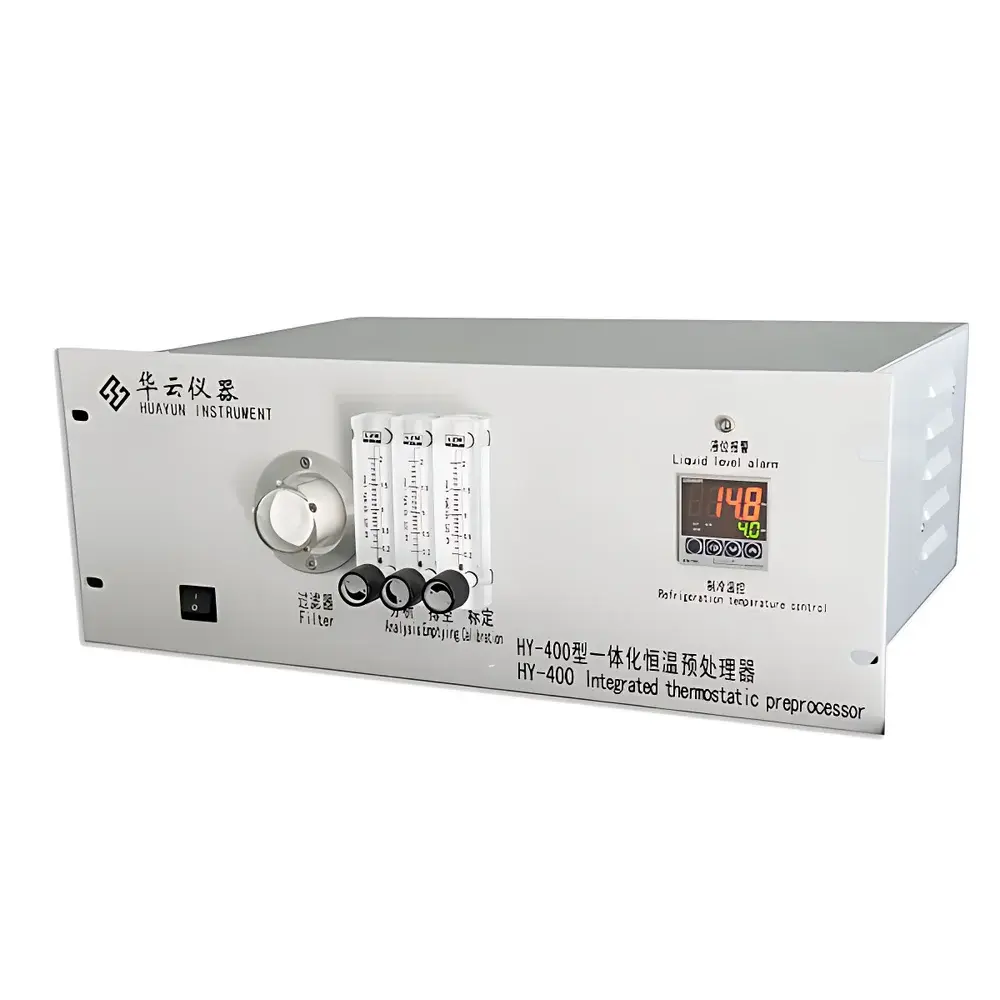
Huayun HY-400 Integrated Isothermal Sample Preconditioner
| Brand | Huayun Instruments |
|---|---|
| Origin | Beijing, China |
| Manufacturer Type | Direct Manufacturer |
| Country of Origin | China |
| Model | HY-400 (New) |
| Price | USD 5,600 (FOB Beijing) |
| Temperature Control Accuracy | ±0.1 °C |
| Setpoint Range | –20 °C to +10 °C (factory default: 4 °C) |
| Dimensions (W×H×D) | 484 × 178 × 320 mm |
| Gas Path Material | PTFE-lined stainless steel |
| Cooling Method | Staged refrigeration + condensate aggregation |
| Mounting | Panel-mount (19″ rack compatible) |
| Liquid Level Alarm Output | Dry contact relay (NO/NC configurable) |
| Integrated Pump Mounting | Yes (for sampling pump & peristaltic drain pump) |
Overview
The Huayun HY-400 Integrated Isothermal Sample Preconditioner is an engineered solution for continuous, stable conditioning of hot, humid, and particulate-laden sample gas streams in extractive gas analysis systems. Designed specifically for cold-dry extraction applications—such as CEMS (Continuous Emission Monitoring Systems), ambient air quality monitoring, industrial process gas analysis, and laboratory-grade emission testing—the HY-400 implements a closed-loop isothermal strategy based on staged thermoelectric and mechanical refrigeration, combined with passive condensate aggregation and precise thermal mass control. Unlike conventional chiller-based preconditioners that rely on dynamic airflow or ice-prone evaporator coils, the HY-400 employs static cold-source isothermality: the sample gas flows through a thermally stabilized PTFE-lined cavity maintained at a user-defined setpoint (–20 °C to +10 °C), enabling consistent dew point suppression without frost formation or flow restriction. This eliminates the risk of ice blockage, pressure drop instability, and measurement drift commonly associated with non-isothermal cooling stages.
Key Features
- Static cold-source isothermal architecture: Eliminates moving refrigerant components and ice accumulation; ensures long-term operational stability under variable inlet humidity and temperature conditions.
- Precision temperature regulation: Digital PID-controlled thermal management delivers ±0.1 °C setpoint accuracy across the full operating range; factory-calibrated at 4 °C with field-adjustable setpoints via front-panel interface.
- Integrated liquid separation chamber: Dual-stage vapor–liquid separation with gravity-assisted coalescence and reservoir-level sensing; prevents slug carryover during transient flow events.
- PTFE-lined gas path: Entire wetted surface—including heat exchange surfaces and flow channels—is lined with chemically inert polytetrafluoroethylene, ensuring compatibility with corrosive gases (e.g., SO₂, HCl, NOₓ, NH₃) and reducing adsorption artifacts.
- Fail-safe liquid level interlock: Built-in capacitive level sensor triggers dry-contact alarm output upon reaching critical condensate height; automatically interrupts sampling pump power via integrated relay interface to prevent analyzer flooding.
- Modular panel-mount design: 484 mm width conforms to standard 19″ rack cutout; includes pre-drilled mounting flanges and dedicated brackets for optional sampling and peristaltic drain pumps.
Sample Compatibility & Compliance
The HY-400 is validated for use with extractive analyzers requiring dry, particle-free, temperature-stabilized sample gas—including UV-DOAS, FTIR, NDIR, paramagnetic O₂, electrochemical sensors, and GC-based trace gas analyzers. It complies with key performance expectations outlined in EPA Method 3A, EN 15267-3 (QAL1), and ISO 12039 for gas conditioning subsystems. Its PTFE-wetted path meets ASTM D6348 requirements for low-adsorption sampling interfaces. The device supports GLP/GMP-aligned operation through configurable alarm logging (via external SCADA integration) and is suitable for installations requiring 21 CFR Part 11-compliant data integrity when paired with compliant supervisory software.
Software & Data Management
The HY-400 operates as a standalone hardware module with no embedded firmware or network stack. Temperature setpoint, real-time cavity temperature, and liquid level status are displayed on a local 3-digit LED interface. All alarm and status signals—including liquid level alert, overtemperature warning, and power fault—are provided as isolated 24 V DC dry-contact outputs (NO/NC) for integration into PLC-based control systems or DCS architectures. Optional analog output (4–20 mA) for cavity temperature is available upon request. Data logging, trend analysis, and remote configuration require external SCADA or historian platforms (e.g., Ignition, Siemens Desigo, or custom LabVIEW-based DAQ).
Applications
- Continuous Emission Monitoring Systems (CEMS) for coal-fired, biomass, and waste-to-energy plants.
- Stack gas analysis in cement, glass, and metallurgical industries where high moisture and alkali content challenge conventional dryers.
- Ambient air monitoring networks (e.g., AQMS) requiring stable 4 °C sample conditioning for ozone, NO₂, and VOC speciation.
- Calibration gas delivery systems where dew point consistency directly impacts span gas stability and analyzer zero drift.
- Research laboratories conducting kinetic studies of heterogeneous catalytic reactions requiring precisely conditioned feed gas streams.
FAQ
What is the maximum allowable inlet gas temperature and flow rate?
The HY-400 is rated for inlet gas temperatures up to 180 °C and volumetric flow rates between 0.5–2.0 L/min (standard conditions). Higher flows may reduce dew point depression efficiency; consult application engineering for custom thermal load assessment.
Does the unit include a built-in sampling pump or drain pump?
No. The HY-400 provides mechanical mounting provisions and electrical interfaces for user-supplied sampling and peristaltic drain pumps, but does not integrate them as standard equipment.
Can the temperature setpoint be changed remotely?
Not natively. Remote setpoint adjustment requires integration with an external controller (e.g., PLC or DCS) via 4–20 mA analog input option (available as factory-configurable add-on).
Is calibration documentation traceable to national standards included?
Yes. Each unit ships with a factory calibration certificate (NIST-traceable temperature reference) and verification report per ISO/IEC 17025 procedures, valid for 12 months from date of shipment.
What maintenance intervals are recommended?
Visual inspection and condensate reservoir emptying every 72 operational hours under high-humidity conditions; annual verification of temperature sensor linearity and relay function using certified references.
Related Products







