
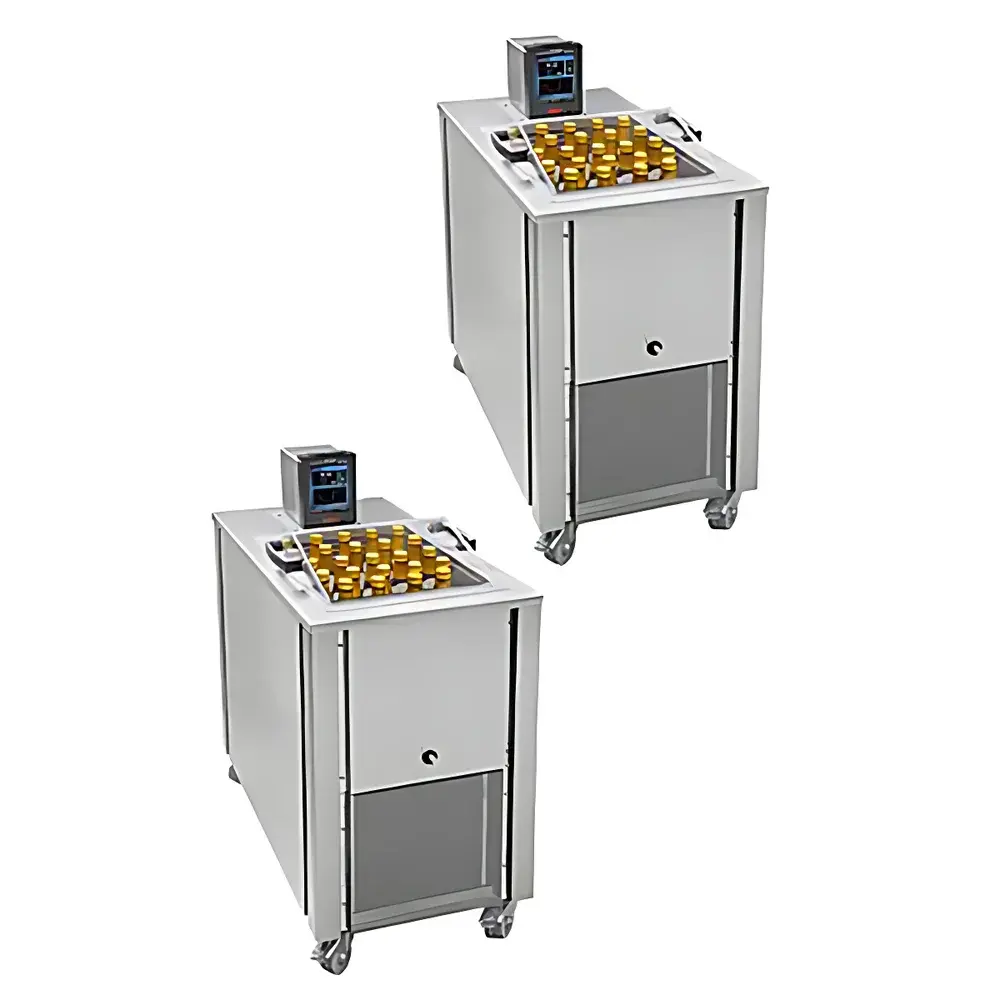
Huber BFT® Beer Aging Test Bath
| Brand | Huber |
|---|---|
| Origin | Germany |
| Model | BFT® |
| Temperature Range | –5 to 80 °C (typical operational range for beer aging: 0–60 °C) |
| Bath Opening Dimensions (W×D) | 350 × 410 mm |
| Bath Depth | 270 mm |
| Heating Power | 2.0 kW |
| Cooling Capacity at 20 °C | 1.2 kW |
| Overall Dimensions (W×D×H) | 460 × 710 × 911 mm |
| Construction | Full stainless steel (AISI 316L wetted parts) |
| Controller | Pilot ONE with 7″ color touchscreen, graph-based real-time temperature profiling, 11-language UI, programmable calendar/time/date scheduler, overtemperature & low-level safety cutoffs |
| Safety Class | DIN 12876-1 Class III / FL (suitable for flammable liquids) |
| Pump System | High-pressure circulation pump + absorption chiller circuit |
| Interfaces | RS232, integrated Pt100 Class A sensor (±0.1 °C accuracy) |
| Cooling Type | Available in water-cooled and air-cooled configurations |
Overview
The Huber BFT® Beer Aging Test Bath is a purpose-engineered thermal stability testing system designed specifically for accelerated aging studies of beer, wort, and related brewing intermediates under strictly controlled, programmable temperature conditions. Based on the principle of Arrhenius-driven chemical kinetics, the BFT® enables reproducible simulation of long-term storage effects—such as oxidative staling, flavor degradation, and colloidal instability—within compressed timeframes. Unlike generic recirculating chillers or immersion baths, the BFT® integrates precision temperature ramping, sustained thermal homogeneity (< ±0.05 °C stability over 24 h), and Class III/FL-certified construction for safe operation with ethanol-containing or low-flashpoint media. Its architecture complies with DIN 12876-1 requirements for laboratory equipment handling flammable liquids, making it suitable for QC labs operating under GMP-aligned brewing quality systems.
Key Features
- Full stainless steel (AISI 316L) bath vessel and circulation path—resistant to corrosion from acidic wort, hop oils, and cleaning agents (e.g., caustic soda, peracetic acid)
- Pilot ONE controller with 7-inch capacitive touchscreen: supports multi-segment temperature programming (up to 24-hour cyclic profiles between 0 °C and 60 °C), real-time graphical trace logging, and intuitive drag-and-drop curve editing
- Dual cooling configuration options: air-cooled for flexible benchtop deployment; water-cooled for high-ambient environments or continuous 24/7 operation
- Integrated safety architecture: independent overtemperature cutoff (hardware-limited), level-sensing probe with automatic pump shutdown, and Class III/FL certification per DIN 12876-1
- High-flow circulation system: pressure-optimized pump delivering ≥12 L/min at ≤2.5 bar, ensuring uniform thermal distribution across large-volume sample racks (e.g., 20 × 500-mL Erlenmeyer flasks)
- Comprehensive connectivity: RS232 serial interface for external SCADA integration; optional Ethernet/Modbus TCP upgrade for LIMS synchronization and remote monitoring
Sample Compatibility & Compliance
The BFT® accommodates standard brewing sample formats—including glass carboys (2–5 L), stainless steel kegs (1–10 L), and arrays of amber glass bottles (330 mL or 500 mL)—via customizable rack inserts. Its bath geometry (350 × 410 mm opening, 270 mm depth) allows vertical immersion of tall vessels without compromising thermal exchange efficiency. All wetted materials meet EU Regulation (EC) No. 1935/2004 for food contact, and surface finish complies with ISO 15528 for coating integrity verification. The system is routinely validated per ASTM E2876–22 (“Standard Guide for Thermal Stability Testing of Beverages”) and supports audit-ready documentation for breweries certified to ISO 22000, FSSC 22000, or BRCGS Brewing standards.
Software & Data Management
Temperature profiles, run logs, and alarm events are timestamped and stored locally on the Pilot ONE controller’s internal flash memory (≥10,000 entries). Data export is supported via USB stick (CSV format) or RS232 transmission to laboratory information management systems (LIMS). The controller firmware includes built-in electronic signature capability and audit trail functionality compliant with FDA 21 CFR Part 11 requirements when paired with Huber’s optional validation package (IQ/OQ documentation, calibration certificate traceable to DKD/DAkkS). User access levels (operator, supervisor, administrator) support role-based control and GLP-compliant workflow enforcement.
Applications
- Accelerated shelf-life prediction of lagers, ales, and craft beers under variable thermal stress (e.g., 0 → 20 → 40 → 0 °C cycles mimicking warehouse transit)
- Staling compound formation kinetics: quantification of trans-2-nonenal, furfural, and 2,3-pentanedione via GC-MS correlation with BFT®-induced aging duration
- Hop oil stability assessment during dry-hopping trials at elevated temperatures (35–45 °C)
- Yeast viability and flocculation behavior monitoring across aging gradients
- Validation of pasteurization equivalence (PU calculations) and cold-filtered beer stabilization protocols
FAQ
What temperature uniformity can be expected across the bath volume during a 48-hour aging cycle?
Typical spatial deviation is ≤ ±0.15 °C at 20 °C setpoint (measured per DIN 12876-2 using 9-point probe array); temporal stability remains within ±0.03 °C over 24 h.
Is the BFT® compatible with glycol/water mixtures as heat transfer fluid?
Yes—fluid compatibility includes 30% propylene glycol/water, ethanol/water (≤40% v/v), and deionized water; all seals and pumps are rated for these media per manufacturer specifications.
Can multiple BFT® units be synchronized for parallel aging experiments?
Via RS232 daisy-chaining or optional Huber SyncBox module, up to 8 units can share master timing, profile triggers, and centralized alarm reporting.
Does the system support IQ/OQ documentation for regulated brewery environments?
Yes—Huber provides full qualification kits including test protocols, acceptance criteria, and traceable calibration certificates aligned with ISO/IEC 17025 and Annex 15 of the EU GMP Guidelines.
What maintenance intervals are recommended for the absorption chiller circuit?
Annual inspection of desiccant cartridge and refrigerant charge; biannual cleaning of condenser coils (air-cooled) or plate heat exchanger (water-cooled); logbook templates included in firmware.



