
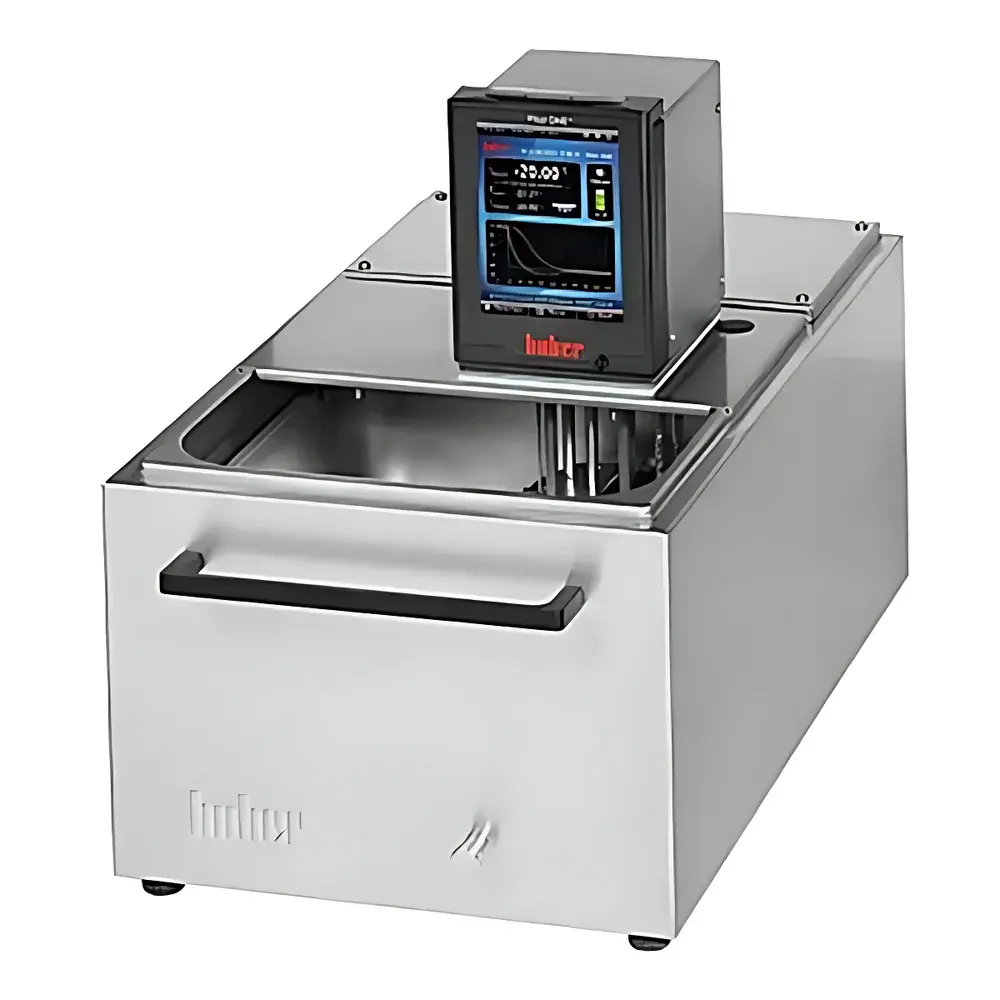
Huber CC-K Series Circulating Chillers & Heaters with Internal Temperature Control
| Brand | Huber |
|---|---|
| Origin | Germany |
| Model | CC-K Series |
| Temperature Range | -20 °C to +200 °C |
| Heating Power | 1.8–2.1 kW |
| Refrigeration Power | 0.12–0.35 kW (at specified setpoints) |
| Bath Volume | 10.5–23.5 L |
| Bath Opening Dimensions | 290 × 152 mm or 290 × 329 mm |
| External Pump Interface | Yes |
| Pressure Pump Flow Rate | 0.4–0.72 L/min @ 2–3.5 bar |
| Suction Pump Flow Rate | 0.12–0.27 L/min @ 0.16–0.2 bar |
| Overall Dimensions (W×D×H) | 350 × 555/560 × 430/615 mm |
| Construction | Full stainless-steel bath vessel |
| Safety Rating | DIN 12876 Class III / FL (flammable liquid compatible) |
| Controller | Pilot ONE touchscreen (7″), 11-language UI, RS232 interface, Pt100 sensor input, 2-point calibration, calendar-based scheduling, overtemperature & low-level protection |
Overview
The Huber CC-K Series is a high-performance line of externally controllable circulating chillers and heaters engineered for precise, stable thermal management in laboratory and pilot-scale applications. Based on closed-loop thermofluid circulation, these units combine Peltier-free compressor-based refrigeration with electric resistance heating and intelligent adaptive power modulation—enabling continuous operation across an exceptionally wide temperature range from –20 °C to +200 °C. Unlike conventional water baths, the CC-K systems maintain thermal homogeneity not only within the internal bath but also throughout external circuits via integrated pressure and suction pumps, making them suitable for both static immersion and dynamic flow-through configurations. The design adheres to DIN 12876 Class III / FL safety requirements, permitting safe use with flammable heat transfer media—including silicone oils and glycol–water mixtures—without compromising operational integrity or regulatory compliance.
Key Features
- Full stainless-steel bath construction ensures long-term corrosion resistance, chemical compatibility, and ease of cleaning under GLP/GMP conditions.
- Adaptive refrigeration control dynamically adjusts compressor output to match real-time thermal load—reducing energy consumption and minimizing waste heat generation.
- Pilot ONE controller with 7-inch capacitive touchscreen delivers intuitive navigation, multi-language support (11 languages), and embedded safety logic including dual independent overtemperature cutoffs and ultrasonic low-level detection.
- Integrated dual-pump architecture supports simultaneous high-pressure delivery (up to 3.5 bar) and high-suction lift (up to 0.27 L/min @ 0.2 bar), enabling reliable external loop circulation even with elevated backpressure or elevated reservoir placement.
- DIN 12876 Class III / FL certification confirms suitability for operation with flammable liquids—critical for applications involving organic solvents, synthetic oils, or high-temperature silicone media.
- RS232 serial interface enables direct integration into automated lab networks; Pt100 sensor inputs support external temperature feedback for cascade or master–slave control topologies.
- Calendar-based programming allows scheduled start/stop events with date- and time-stamped execution logs—essential for unattended overnight or weekend experiments requiring strict thermal protocol adherence.
Sample Compatibility & Compliance
The CC-K Series accommodates a broad spectrum of sample formats—from standard glassware (e.g., reaction flasks, jacketed reactors, viscometers) to custom-engineered fixtures requiring external thermal coupling. Its open-bath geometry (290 × 152 mm or 290 × 329 mm) permits direct immersion of vessels up to 200 mm depth, while optional external recirculation kits support jacketed equipment with flow rates up to 0.72 L/min. All models comply with European Machinery Directive 2006/42/EC, Low Voltage Directive 2014/35/EU, and Electromagnetic Compatibility Directive 2014/30/EU. Safety-critical functions—including temperature limit enforcement, fluid level monitoring, and pump dry-run prevention—are independently verified per EN 61000-6-2 and EN 61000-6-4. For regulated environments, the system’s deterministic control architecture and non-volatile event logging support audit readiness under FDA 21 CFR Part 11 and ISO/IEC 17025 frameworks.
Software & Data Management
While the Pilot ONE controller operates autonomously, its RS232 port provides full bidirectional communication with third-party SCADA, LIMS, or ELN platforms using ASCII-based command protocols. Logged parameters—including setpoint, actual bath temperature, refrigeration/heating status, pump RPM, and alarm timestamps—are timestamped to millisecond resolution and exportable as CSV. Optional Huber LabManager software (Windows-based) extends functionality with graphical trend analysis, multi-unit synchronization, remote firmware updates, and electronic signature-enabled report generation compliant with ALCOA+ data integrity principles. All calibration actions—including two-point Pt100 sensor adjustment—are digitally recorded with operator ID, date/time, and deviation values—supporting traceability requirements under ISO/IEC 17025 Clause 6.5 and USP .
Applications
- Controlled-rate cooling and heating of chemical reaction mixtures in jacketed glass reactors.
- Thermal conditioning of rheometers, viscometers, DSC cells, and UV-Vis spectrophotometer sample compartments.
- Stabilization of laser sources, photodetectors, and optical benches requiring sub-0.1 °C drift suppression.
- Accelerated aging studies per ASTM D5722 and ISO 188 for polymer, elastomer, and coating materials.
- Calibration of temperature-sensitive instrumentation including thermocouples, RTDs, and infrared sensors.
- Process validation support for pharmaceutical manufacturing steps governed by ICH Q5C and EU Annex 15.
FAQ
Can the CC-K Series operate with silicone oil at 200 °C?
Yes—its Class III / FL rating and stainless-steel wetted parts are validated for continuous use with methylphenyl silicone oils meeting DIN 51524 Part 2 specifications at full temperature range.
Is external recirculation mandatory for temperature uniformity?
No—the internal bath achieves ±0.03 °C spatial uniformity at steady state without external flow; recirculation is required only when transferring thermal energy to external devices.
Does the system support 21 CFR Part 11-compliant electronic records?
The hardware provides audit-trail-capable event logging; full Part 11 compliance requires implementation of Huber LabManager with configured user roles, electronic signatures, and secure database archiving.
What maintenance intervals are recommended?
Compressor oil and refrigerant charge require verification every 24 months under normal use; pump seals and bath gaskets should be inspected annually per Huber Service Bulletin SB-CC-K-2023-01.



