
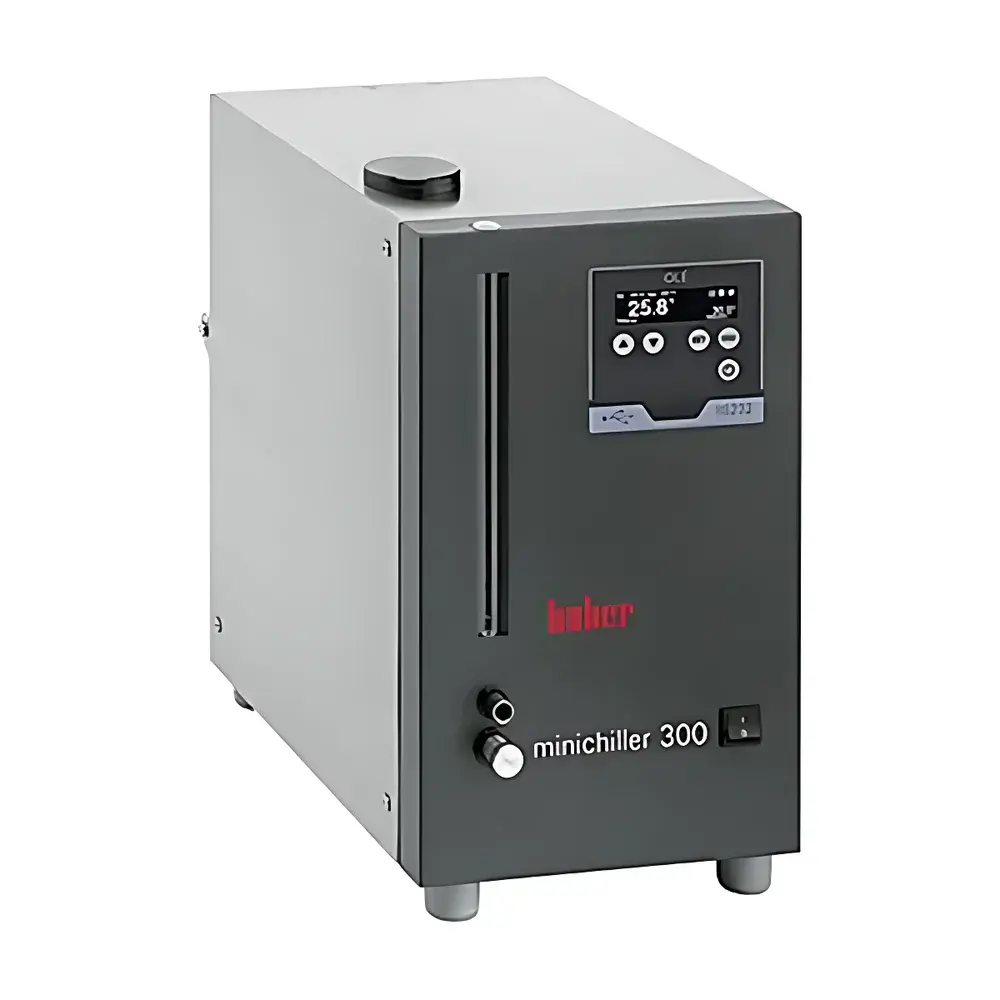
Huber Minichillers® with OLÉ Controller – Air-Cooled and Water-Cooled Circulating Chillers
| Brand | Huber |
|---|---|
| Origin | Germany |
| Model | Minichillers® |
| Temperature Range | −5 °C to +40 °C (up to +80 °C return fluid temperature) |
| Refrigeration Capacity | 0.25–1.2 kW @ specified setpoints |
| Pump Flow Rate | 10–18 L/min |
| Max. Pressure | 0.3–0.9 bar |
| Dimensions (W×D×H) | 225×360×380 mm to 280×511×424 mm |
| Construction | Stainless steel housing |
| Refrigerant | Natural R744 (CO₂) or R290 (propane), per model |
| Optional | Integrated 1 kW heater (extends range to +100 °C) |
| Interfaces | RS232, USB |
| Display | OLED touchscreen (OLÉ controller) |
| Compliance | CE, RoHS, EN 61000-6-3/6-4, EN 61000-3-2/3-3 |
Overview
The Huber Minichillers® series with OLÉ controller represents a class of compact, high-efficiency circulating chillers engineered for precise thermal management in demanding laboratory environments. Utilizing advanced thermodynamic design and natural refrigerants—primarily CO₂ (R744) or propane (R290)—these units deliver stable cooling performance across a wide operating envelope (−5 °C to +40 °C process fluid temperature, with fluid return temperatures up to +80 °C). Unlike conventional tap-water-based cooling systems, the Minichillers® operate as closed-loop recirculating units, eliminating dependency on municipal water supply and reducing laboratory water consumption by up to 48,000 liters per week—making them both operationally sustainable and economically justified within months of deployment. Their robust stainless-steel construction, integrated pressure- and flow-stabilized circulation pumps, and ambient resilience (continuous operation at ambient temperatures up to +40 °C) ensure long-term reliability in QC labs, synthetic chemistry workstations, analytical instrument cooling (e.g., HPLC column ovens, ICP-MS interfaces), and pilot-scale reaction calorimetry setups.
Key Features
- Compact footprint (as small as 225 × 360 × 380 mm) — optimized for benchtop integration without sacrificing performance
- OLÉ intelligent controller with intuitive OLED touchscreen interface, real-time parameter visualization, and multi-level menu navigation
- Natural refrigerant architecture (R744 or R290) compliant with F-Gas Regulation (EU No. 517/2014) and global sustainability mandates
- Stainless-steel fluid reservoir and wetted parts for chemical compatibility with water, water-glycol mixtures, silicone oils, and other common heat-transfer fluids
- Dual cooling configurations: air-cooled (standard) and water-cooled (‘w’ suffix models) for flexible installation in temperature-controlled or high-ambient spaces
- Integrated safety monitoring: dry-run protection, overtemperature cutoff, low-level alarm, pump fault detection, and refrigerant pressure supervision
- Optional 1 kW electric heater enables combined heating/cooling operation, extending operational range to +100 °C for applications requiring thermal ramping or isothermal hold above ambient
- Standard communication interfaces (RS232 and USB) support remote parameter logging, script-based control, and integration into LIMS or SCADA environments
Sample Compatibility & Compliance
The Minichillers® are designed for continuous-duty circulation of non-corrosive, non-viscous heat-transfer media—including deionized water, 30% aqueous glycol solutions, and low-volatility silicone oils (up to 50 cSt). All models comply with essential European directives: CE marking per Machinery Directive 2006/42/EC and Electromagnetic Compatibility Directive 2014/30/EU; RoHS 2011/65/EU for hazardous substance restriction; and EN 61000-6-3 (emissions) and EN 61000-6-4 (immunity). The OLÉ controller supports audit-ready operation through configurable event logging (start/stop, alarms, setpoint changes) and optional time-stamped data export—facilitating adherence to GLP and GMP documentation requirements. While not intrinsically rated for hazardous areas, units may be deployed in Zone 2 environments when installed per IEC 60079-14 guidelines.
Software & Data Management
The OLÉ controller firmware provides embedded data handling capabilities without external PC dependency. All operational parameters—including setpoint, actual bath temperature, pump speed, refrigerant pressure, and fluid level—are continuously logged to internal memory with timestamp resolution of ±1 second. Logged data can be exported via USB mass-storage mode in CSV format for post-processing in Excel or statistical analysis platforms (e.g., JMP, MATLAB). RS232 serial communication supports ASCII command protocol (SCPI-compatible), enabling integration with LabVIEW, Python-based automation frameworks, or enterprise lab infrastructure. Firmware updates are performed via USB stick, ensuring traceable version control and compliance with internal IT security policies. Audit trails include user-initiated actions (e.g., setpoint modification, manual pump override) and system-generated events (e.g., alarm activation, power cycle).
Applications
- Cooling of rotary evaporators, vacuum pumps, and condensers in organic synthesis labs
- Temperature stabilization of HPLC autosamplers, column ovens, and detector cells
- Thermal conditioning of spectroscopic cells (UV-Vis, FTIR) and laser sources
- Heat removal from plasma generators, RF amplifiers, and electrophoresis power supplies
- Process fluid temperature control in microreactors and flow chemistry systems
- Supporting ASTM D5276 (impact resistance), ISO 11357 (DSC calibration), and USP environmental monitoring workflows
FAQ
What natural refrigerants are used in the Minichillers® series?
All models utilize either carbon dioxide (R744) or propane (R290), selected based on cooling capacity and application-specific safety requirements. Both refrigerants exhibit zero ozone depletion potential (ODP = 0) and negligible global warming potential (GWP < 3).
Can the unit operate unattended for extended periods?
Yes—designed for 24/7 continuous operation under stable ambient conditions (≤ +40 °C). Built-in safeguards prevent dry running, overheating, and refrigerant overpressure, and all alarms trigger visual/audible alerts plus automatic shutdown where appropriate.
Is the OLÉ controller compatible with FDA 21 CFR Part 11?
While the base OLÉ firmware does not provide electronic signatures or role-based access control out-of-the-box, its event-logging architecture—combined with timestamped, immutable CSV exports—supports validation protocols required for Part 11 compliance when deployed within a validated IT environment and supported by procedural controls.
What maintenance intervals are recommended?
Annual inspection of refrigerant charge integrity, pump impeller wear, and fluid filter condition is advised. Reservoir cleaning and fluid replacement should occur every 6–12 months depending on usage intensity and heat-transfer medium. No routine oil changes are required—the compressors are hermetically sealed and lubricated for life.



