
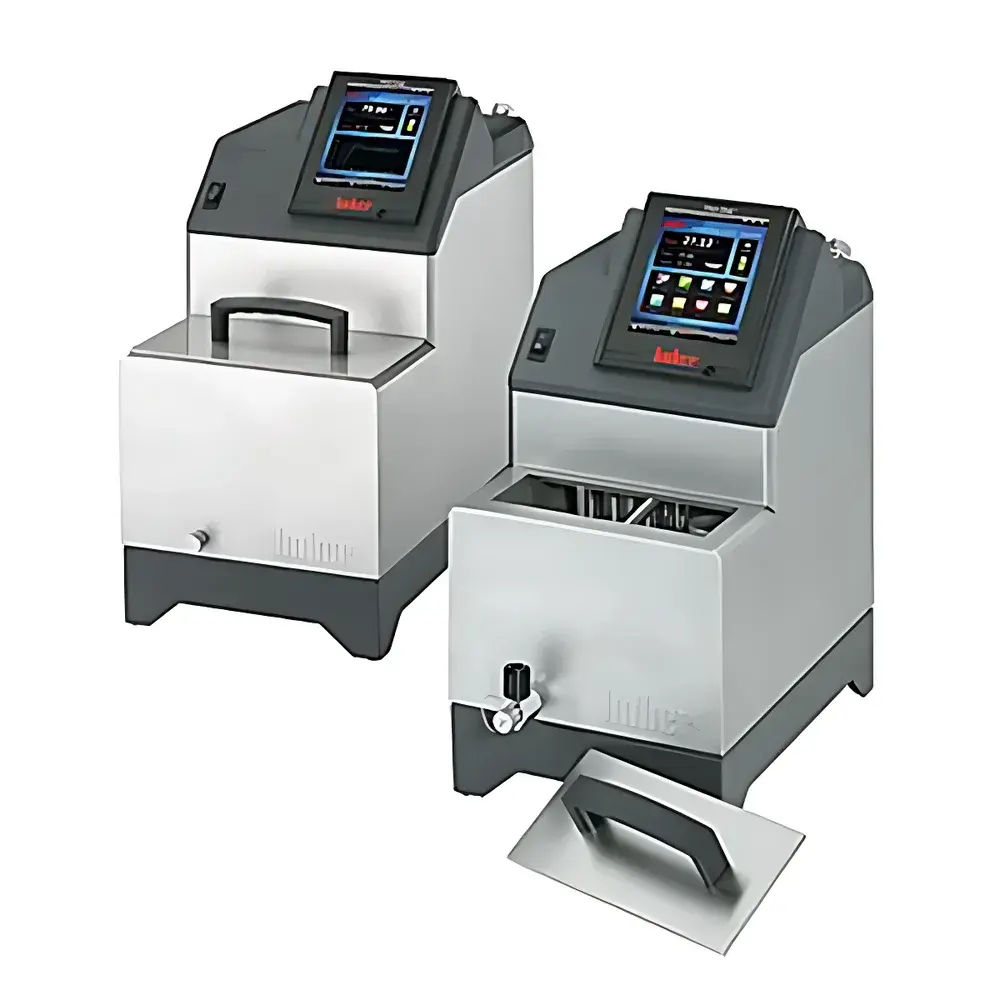
Huber Ministats® Heating and Cooling Circulators
| Brand | Huber |
|---|---|
| Origin | Germany |
| Model | Ministats® |
| Temperature Range | −25 °C to +200 °C (varies by model) |
| Heating Power | 0.9–2.1 kW |
| Refrigeration Power | 0.3–0.6 kW @ specified temperature |
| Pump Flow Rate (pressure/suction) | up to 5.5 L/min @ 2.8 bar / 0.125 L/min @ 0.35 bar |
| Bath Volume | 7–16 L |
| External Dimensions (W×D×H) | 225×370×429 mm to 300×465×516 mm |
| Temperature Stability | ±0.02 °C |
| Refrigerant | Natural (R744/R290 compliant) |
| Control Interface | Pilot ONE color TFT touchscreen with guided operation wizard |
| Analog I/O | NAMUR-compliant |
| Optional | Com.G@te module for Ethernet-based remote control and PLC/DCS integration |
| Certifications | CE, RoHS, compliant with ISO/IEC 17025 laboratory environment requirements |
| Application Mode | External open-bath circulation with adjustable pressure/suction delivery |
Overview
The Huber Ministats® series represents a class of compact, high-precision heating and cooling circulators engineered for external temperature control of analytical instruments, small-scale reactors, and process equipment in research and quality control laboratories. Operating on the principle of forced liquid circulation—using thermally stable silicone oil or water-glycol mixtures—the system maintains precise, dynamic thermal conditions via dual-mode (heating/cooling) thermodynamic regulation. Unlike conventional water baths or immersion chillers, Ministats® units integrate closed-loop refrigeration circuits with electric resistance heating, enabling seamless transition across wide temperature spans—from sub-zero cryogenic operation (−25 °C) to high-temperature stabilization (+200 °C)—without manual fluid exchange or auxiliary chiller pairing. This architecture supports both open-bath applications (e.g., jacketed viscometers, refractometers, photometers) and closed-loop jacketed reactor control, delivering consistent thermal inertia management critical for kinetic studies, calibration traceability, and method validation under GLP/GMP-aligned workflows.
Key Features
- Ultra-compact footprint: Designed for placement inside fume hoods or under benchtop instrumentation—minimum width of 225 mm enables integration into space-constrained analytical workstations.
- Natural refrigerant platform: Utilizes CO₂ (R744) or propane (R290) refrigerants, fully compliant with EU F-Gas Regulation (EU No 517/2014) and aligned with global sustainability mandates for low-GWP thermal management systems.
- Pilot ONE intelligent controller: 4.3″ color TFT display with multilingual GUI, step-by-step operational wizards, real-time trend logging, and password-protected parameter locking for audit-ready operation.
- Dual-pump architecture: Independently adjustable pressure and suction pumps allow fine-tuned flow modulation (0.1–5.5 L/min) and backpressure management—critical for protecting fragile glassware, microreactors, or capillary-based sensors from hydraulic shock.
- Integrated pressure sensing option: Optional pressure transducer enables closed-loop pump speed regulation, preventing over-pressurization during viscosity spikes or line blockage events—supports ASTM D2196 and ISO 3219 compliance in rheological testing environments.
- NAMUR analog interface (4–20 mA / 0–10 V) as standard; optional Com.G@te module provides Modbus TCP, OPC UA, and HTTP API connectivity for integration into LIMS, SCADA, or automated synthesis platforms.
Sample Compatibility & Compliance
Ministats® circulators are validated for use with externally mounted vessels ranging from 50 mL spectroscopic cuvettes to 5 L jacketed glass reactors. The system accommodates common bath media—including deionized water, 30% ethylene glycol/water, and silicone oils (e.g., DC200/50cs)—with material-wetted components constructed from stainless steel 316L, EPDM seals, and borosilicate glass-compatible fluid paths. All models meet CE marking requirements per Machinery Directive 2006/42/EC and Electromagnetic Compatibility Directive 2014/30/EU. For regulated environments, the Pilot ONE firmware supports 21 CFR Part 11–compliant electronic signatures and audit trail generation when paired with Huber’s certified validation package (IQ/OQ documentation available upon request). Units are routinely deployed in ISO/IEC 17025-accredited labs for temperature calibration of reference standards per ISO 17032 and ASTM E74.
Software & Data Management
Data acquisition and system supervision are supported via Huber’s proprietary Pilot ONE software suite, which runs on Windows-based host PCs. The software enables remote monitoring of setpoint tracking, real-time PID tuning, alarm event history export (CSV), and synchronized multi-channel logging (temperature, flow, pressure, power consumption). When equipped with Com.G@te, the unit becomes discoverable on industrial Ethernet networks and supports time-stamped data streaming to SQL databases or cloud historians (e.g., Ignition, Siemens Desigo CC). All communication protocols adhere to IEC 62443-3-3 security guidelines, including TLS 1.2 encryption and role-based access control. Raw sensor outputs (Pt1000, K-type thermocouple inputs) are linearized and compensated per ITS-90, ensuring metrological traceability to national standards bodies (e.g., PTB, NIST).
Applications
- Temperature control of optical instruments: spectrophotometers, polarimeters, and Abbe refractometers requiring ±0.02 °C stability over extended dwell periods.
- Rheometry support: thermal conditioning of rotational viscometers (e.g., Brookfield, Anton Paar) and capillary rheometers during shear-rate sweeps across variable thermal gradients.
- Reaction calorimetry: precise jacket temperature ramping for RC1e and EasyMax-style synthesis reactors during exothermic screening or crystallization optimization.
- Chromatography auxiliary cooling: pre-column and detector temperature stabilization in HPLC/UHPLC systems to improve peak resolution and retention time reproducibility.
- Material testing: thermal cycling of polymer samples in DMA fixtures or tensile test grips per ASTM D638 and ISO 527 protocols.
- Pharmaceutical QC: dissolution apparatus temperature maintenance per USP , and stability chamber qualification per ICH Q5C.
FAQ
What is the minimum recommended bath fluid volume for stable temperature control?
A minimum fill level of 80% of nominal bath capacity is required to ensure proper sensor immersion, pump priming, and thermal mass buffering—e.g., ≥12.8 L for the 16 L Ministat 240w model.
Can Ministats® units operate unattended for 72+ hours in GxP environments?
Yes—when configured with Com.G@te and Pilot ONE audit trail logging enabled, units support continuous operation with automatic alarm escalation (email/SNMP), power-fail recovery, and configurable hold-on-error behavior per FDA 21 CFR Part 11 Annex 11 expectations.
Is external pressure regulation supported without the optional pressure sensor?
No—pressure feedback and closed-loop pump speed adjustment require the factory-installed pressure transducer; manual flow restriction via needle valves is possible but not recommended for precision applications.
Are replacement calibration certificates available after initial commissioning?
Yes—Huber offers accredited recalibration services (DAkkS-certified where applicable) with full uncertainty budgets, traceable to PTB primary standards, valid for 12 months under normal operating conditions.



