
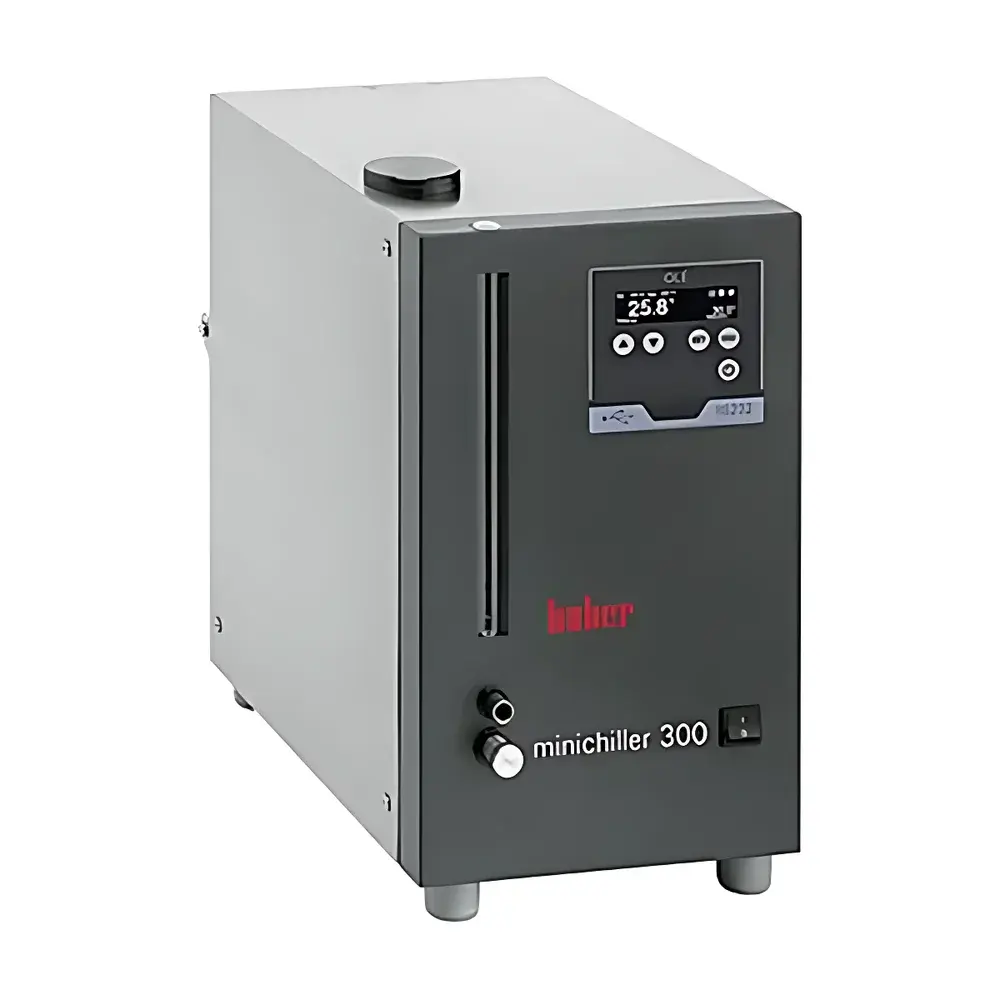
Huber TC® Immersion Chiller
| Brand | Huber |
|---|---|
| Origin | Germany |
| Model | TC® |
| Temperature Range | –45 °C to +100 °C |
| Refrigeration Capacity | 0.07–0.3 kW (varies by model) |
| External Dimensions (W×D×H) | 190×295×360 mm to 295×500×570 mm |
| Temperature Stability (TC®E models) | ±0.5 K |
| Sensor | Integrated Pt100 |
| Construction | Stainless Steel Housing |
| Optional Accessories | Flexible Stainless Steel Immersion Cooling Head, External Cooling Coil |
Overview
The Huber TC® Immersion Chiller is a compact, high-integrity temperature control solution engineered for precise, continuous cooling of external liquid baths, reactors, or jacketed vessels. Unlike conventional tap-water or dry-ice-based cooling methods, the TC® series employs a closed-loop refrigeration system circulating thermally stable heat-transfer oil—enabling reliable sub-ambient operation down to –45 °C without phase-change limitations or environmental hazards. Its design follows the principle of conductive heat exchange via direct immersion: a stainless-steel cooling element transfers thermal energy from the process fluid into the chiller’s refrigerant circuit, which is regulated by an electronically controlled expansion valve and a high-efficiency scroll compressor. This architecture ensures consistent thermal load management across variable ambient conditions and extended operational cycles—critical for applications requiring reproducible low-temperature environments in analytical, synthetic, or quality-control laboratories.
Key Features
- Stainless steel housing with ergonomic lifting handles and space-optimized footprint—designed for benchtop integration in ISO-classified labs or GMP-compliant cleanrooms.
- Pt100 resistance thermometer integrated directly into the immersion probe for real-time, traceable temperature feedback with Class B accuracy per IEC 60751.
- TC®E variants feature an LED display interface with local setpoint adjustment, status indicators, and alarm thresholds configurable via front-panel buttons—supporting standalone operation without external software.
- Modular accessory compatibility: optional flexible stainless steel immersion heads (for irregular vessel geometries) and external cooling coils (for retrofitting existing jacketed systems).
- Refrigerant system compliant with EU F-Gas Regulation (EU No. 517/2014); uses environmentally optimized R-513A—a low-GWP (GWP = 631), non-ozone-depleting alternative to R-134a.
- No consumables required; eliminates dependency on dry ice logistics, distilled water supply, or single-use coolant cartridges—reducing total cost of ownership and audit documentation burden.
Sample Compatibility & Compliance
The TC® series is compatible with common laboratory heat-transfer media including silicone oils (e.g., Dow Corning 200 Fluid), polyalphaolefins (PAOs), and aqueous glycol mixtures (up to 50% v/v). It is not intended for direct contact with corrosive solvents (e.g., concentrated acids, halogenated hydrocarbons) or volatile organic compounds exceeding flash point safety thresholds. All units are CE-marked and conform to EN 61000-6-2 (immunity) and EN 61000-6-4 (emissions). Electrical safety complies with EN 61010-1:2010 for Laboratory Equipment. When deployed in regulated environments (e.g., pharmaceutical QC labs), the TC®E models support GLP/GMP traceability through manual logbook entries; optional RS485 Modbus RTU interface enables integration with LIMS or SCADA systems for electronic record retention per FDA 21 CFR Part 11 requirements.
Software & Data Management
While the base TC® operates as a stand-alone unit, the TC®E variant supports serial communication via RS485 (Modbus RTU protocol) for remote monitoring and setpoint synchronization. No proprietary software is required—integration with third-party control platforms (e.g., LabVIEW, DeltaV, Ignition SCADA) is achieved using standard Modbus register mapping. Temperature logs can be exported as CSV files via connected PLCs or data acquisition modules. Firmware updates are performed via USB port using Huber-provided configuration utilities—validated and version-controlled per ICH Q9 risk management principles. Audit trails for parameter changes are maintained locally on the device for up to 30 days (circular buffer), satisfying basic ALCOA+ data integrity expectations for non-critical temperature control tasks.
Applications
- Cooling of rotary evaporators during low-boiling-point solvent removal (e.g., dichloromethane, ether), maintaining condenser temperatures below –20 °C to maximize recovery efficiency.
- Temperature stabilization of NMR sample probes during cryogenic experiments where bath homogeneity and drift <0.1 K/hour are essential.
- Supplemental chilling in combination with Huber heating circulators (e.g., Presto series) to extend dynamic temperature range in reaction calorimetry setups.
- Pre-cooling of HPLC mobile phase reservoirs to reduce baseline noise and improve retention time reproducibility in reversed-phase separations.
- Controlled crystallization studies requiring ramp-and-soak profiles between –30 °C and +40 °C with minimal overshoot and dwell stability within ±0.5 K.
FAQ
Can the TC® be used with flammable heat-transfer fluids?
No. Only non-flammable, thermally stable oils meeting DIN 51506 VDMA 24568 specifications are approved. Flammable fluids void warranty and violate EN 61010-1 safety certification.
Is external calibration required for the built-in Pt100 sensor?
Yes. While factory-calibrated, periodic verification against a NIST-traceable reference thermometer is recommended every 12 months per ISO/IEC 17025 Clause 6.5.2.
What maintenance intervals apply to the refrigeration system?
Compressor oil and filter-drier replacement is scheduled at 24,000 operating hours or 5 years—whichever occurs first—as specified in Huber Service Bulletin TC-2023-07.
Does the TC® support external PID control input?
Not natively. However, analog 0–10 V or 4–20 mA setpoint modulation is achievable via optional analog interface module (Order Code: TC-AI-01), sold separately.
Can multiple TC® units be daisy-chained for synchronized operation?
Yes—using Modbus RTU addressing, up to 31 units may share a single RS485 bus with independent setpoints and status reporting.



