
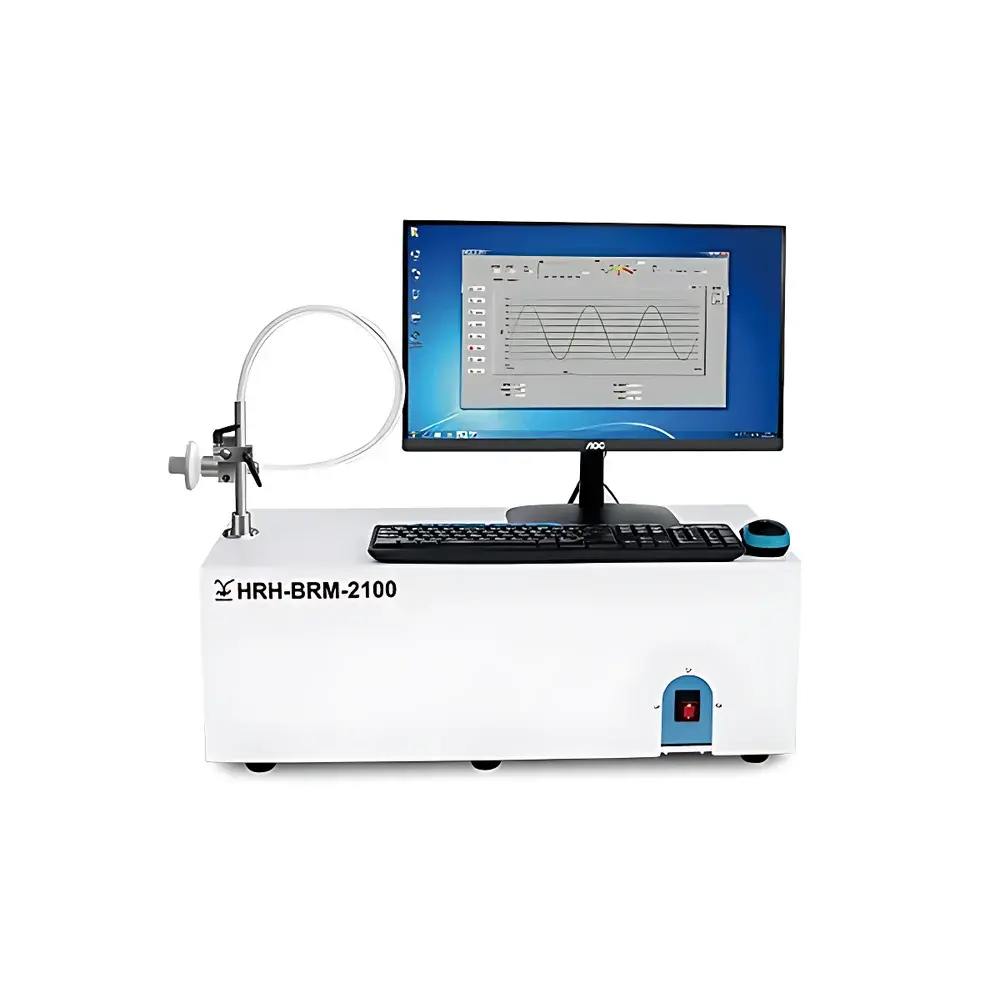
Huiron HRH-BRM-2100 Respiratory Simulator for Pharmaceutical Aerosol Delivery Testing
| Brand | Huiron |
|---|---|
| Model | HRH-BRM-2100 |
| Origin | Beijing, China |
| Tidal Volume Range | 0–1000 mL |
| Accuracy | ±5% of full scale or ±1 mL (whichever is greater) |
| Power Supply | 220 V, 50 Hz |
| Dimensions | 70 × 35 × 62 cm |
| Weight | 35 kg |
| Compliance | USP <601>, Ph. Eur. 2.9.43, ChP 2020 Vol. IV <0951> |
| Predefined Breathing Profiles | Adult / Pediatric / Infant / Neonatal |
| Customizable Parameters | Tidal Volume, Breathing Frequency, I:E Ratio, Flow Profile Shape, Cycle Count |
| Real-time Output | Flow Rate Curve, Tidal Volume Curve, Respiratory Parameter Summary |
Overview
The Huiron HRH-BRM-2100 Respiratory Simulator is an engineered precision platform designed specifically for the in vitro assessment of delivered dose and delivered dose uniformity (DDU) from pressurized metered-dose inhalers (pMDIs), soft-mist inhalers (SMIs), and nebulized liquid formulations. It operates on the principle of controlled pneumatic actuation synchronized with physiologically representative breathing patterns, enabling reproducible simulation of human respiratory mechanics during drug delivery testing. Unlike generic airflow controllers, the HRH-BRM-2100 implements dynamic flow profile generation—based on time-resolved flow rate algorithms—to replicate the inspiratory phase of real human respiration, including variable acceleration, peak flow timing, and expiratory hold characteristics. This capability ensures alignment with pharmacopoeial requirements for evaluating aerodynamic particle size distribution (APSD), fine particle fraction (FPF), and total emitted dose (TED) under standardized breathing conditions.
Key Features
- Pharmacopoeia-compliant breathing pattern generation per USP <601> “Inhalation and Nasal Drug Products – Performance Testing”, Ph. Eur. 2.9.43 “Aerodynamic Particle Size Distribution”, and ChP 2020 Vol. IV <0951> “Determination of Delivered Dose and Delivery Rate”.
- Four preloaded physiological breathing profiles: Standard Adult (500 mL tidal volume, 15 breaths/min, I:E = 1:2), Standard Pediatric (200 mL, 25 bpm, I:E = 1:1.5), Standard Infant (50 mL, 35 bpm, I:E = 1:1.2), and Standard Neonatal (15 mL, 40 bpm, I:E = 1:1).
- Full parameter customization: Adjustable tidal volume (0–1000 mL in 1 mL increments), breathing frequency (5–60 breaths/min), inspiratory-to-expiratory (I:E) ratio (1:1 to 1:4), inspiratory waveform shape (sinusoidal, linear ramp, or user-defined spline-based curve), and cycle count (1–999 cycles).
- Real-time graphical display of flow rate (L/min), cumulative tidal volume (mL), and respiratory cycle markers; all curves are timestamped and exportable in CSV format.
- Integrated hardware calibration traceability with documented uncertainty budgets compliant with ISO/IEC 17025 principles; factory calibration certificate provided with each unit.
Sample Compatibility & Compliance
The HRH-BRM-2100 interfaces seamlessly with standard impactors (e.g., Andersen Cascade Impactor, Next Generation Impactor), filter holders, and induction ports per ISO 27427 and USP <601>. Its pressure-tolerant inlet (rated up to 100 kPa gauge) accommodates both actuated and breath-actuated devices without flow restriction artifacts. All internal wetted surfaces are constructed from medical-grade stainless steel and chemically inert fluoropolymers to prevent adsorption or degradation of volatile or reactive compounds. The system meets essential requirements for GLP and GMP-regulated environments: audit trail-enabled operation logs, electronic signature support (via optional software module), and configuration control aligned with FDA 21 CFR Part 11 Annex 11 expectations.
Software & Data Management
The embedded control software features a deterministic real-time operating kernel, ensuring microsecond-level synchronization between valve actuation, flow sensor sampling (1 kHz update rate), and data logging. While the base interface is localized in Simplified Chinese for regional usability, firmware supports Unicode UTF-8 encoding—enabling future deployment of multilingual UI packs (English, German, Japanese). Raw sensor data—including differential pressure across the test article, mass flow rate, and temperature-compensated volume—are logged at ≥100 Hz and stored in structured binary archives with embedded metadata (operator ID, protocol version, environmental conditions). Export options include CSV, MATLAB .mat, and ASTM E1447-compliant XML for third-party statistical analysis and regulatory submission packages.
Applications
- In vitro characterization of pMDI and SMI performance across multiple breathing patterns to support QbD-based formulation development.
- Comparative evaluation of device resistance and plume geometry under varying inspiratory effort conditions.
- Validation of cascade impactor collection efficiency under pharmacopoeial test conditions.
- Stability testing of suspension-based inhalers where delivered dose consistency must be monitored over shelf life.
- Supporting ANDA, NDA, and MAA submissions with fully documented, instrument-qualified datasets meeting ICH Q5C and Q5D expectations.
FAQ
Does the HRH-BRM-2100 meet ISO 27427 requirements for inhaler testing?
Yes—the system’s flow accuracy, temporal resolution, and waveform fidelity satisfy Clause 6.2 (Breath Simulation Requirements) and Annex A (Verification Procedures) of ISO 27427:2013.
Can the simulator be integrated with third-party aerosol measurement systems?
Yes—standard analog (0–10 V, 4–20 mA) and digital (RS-485 Modbus RTU, USB CDC) I/O ports enable bidirectional communication with laser diffraction analyzers, light-scattering sensors, and gravimetric balance systems.
Is firmware upgrade capability available remotely?
Firmware updates are performed via secure USB key with SHA-256 signature verification; remote network connectivity is intentionally omitted to maintain air-gapped integrity in regulated laboratories.
What documentation is supplied for IQ/OQ qualification?
A complete qualification package—including URS, FDS, IQ/OQ protocols and executed reports, calibration certificates, and material traceability records—is provided with each shipment.
How is temperature and humidity compensated during testing?
An optional external environmental sensor module (sold separately) feeds ambient T/RH data into the control algorithm to dynamically adjust volumetric flow calculations per ISO 9300 standards.



