
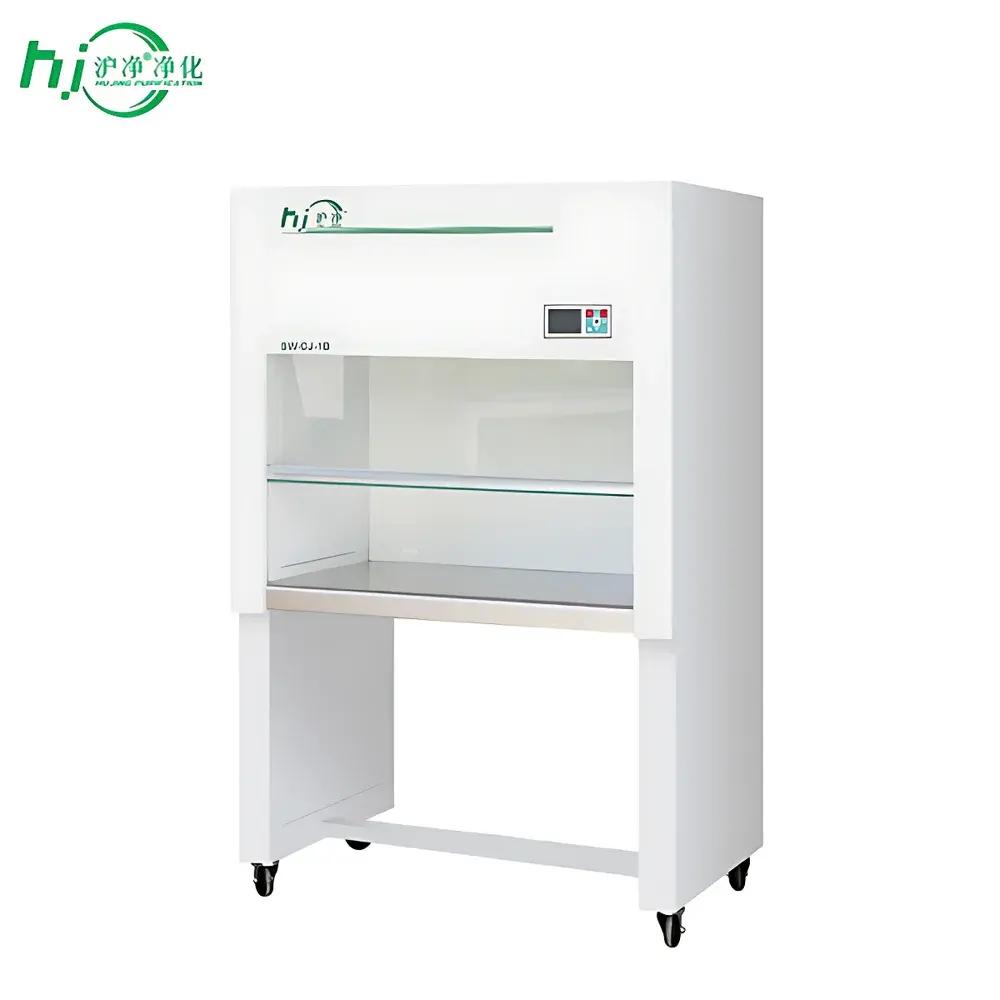
Hujing Full-Metal Single-Person Horizontal Laminar Flow Clean Bench SW-CJ-1B
| Brand | Hujing Purification (HJ) |
|---|---|
| Origin | Shanghai, China |
| Manufacturer Type | Direct Manufacturer |
| Product Category | Domestic |
| Model | SW-CJ-1B |
| Instrument Type | Horizontal Laminar Flow Clean Bench |
| Cleanliness Class | ISO Class 5 (equivalent to Federal Standard 209E Class 100 @ ≥0.5 µm) |
| Noise Level | ≤62 dB(A) |
| User Capacity | Single-user, single-front configuration |
| Airflow Pattern | Horizontal unidirectional laminar flow |
| Work Surface Material | SUS304 brushed stainless steel |
| Cabinet Material | Cold-rolled steel with electrostatic powder coating |
| Filtration System | Pre-filter + HEPA filter (H14, EN 1822 compliant) |
| Lighting | 12 W fluorescent lamp |
| UV Sterilization | 12 W germicidal UV lamp with safety interlock and timer function |
| Control Interface | Digital LCD controller |
| Average Face Velocity | 0.25–0.45 m/s |
| Vibration | ≤5 µm (peak-to-peak, XYZ axes) |
| Illuminance | ≥300 lx |
| Power Supply | AC 220 V / 50 Hz |
| Max Power Consumption | 490 W |
| Net Weight | 90 kg |
| Working Area Dimensions (W×D×H) | 880 × 510 × 580 mm |
| External Dimensions (W×D×H) | 1040 × 690 × 1600 mm |
Overview
The Hujing Full-Metal Single-Person Horizontal Laminar Flow Clean Bench SW-CJ-1B is an ISO Class 5-certified containment workstation engineered for non-hazardous microbiological, cell culture, and precision assembly applications requiring particle-free environments. Unlike vertical laminar flow hoods or biosafety cabinets, this clean bench operates on a horizontal airflow principle: air is drawn through a pre-filter, conditioned by a centrifugal blower, and then passed through a certified HEPA (H14, EN 1822) filter before being delivered across the work surface at a uniform, low-turbulence velocity of 0.25–0.45 m/s. This unidirectional horizontal flow establishes a protective barrier that sweeps airborne particulates—including viable microorganisms—away from the operator and out of the work zone, minimizing cross-contamination risks during aseptic procedures. Designed in strict accordance with Federal Standard 209E and aligned with ISO 14644-1 requirements for cleanroom performance, the SW-CJ-1B maintains ≤0.5 colony-forming units per 90-mm Petri dish per hour under standardized test conditions.
Key Features
- Full-metal construction: Cold-rolled steel cabinet with electrostatic powder coating ensures structural integrity, corrosion resistance, and long-term dimensional stability in laboratory environments.
- SUS304 brushed stainless steel work surface: Non-porous, chemically resistant, and compatible with common disinfectants including 70% ethanol and sodium hypochlorite solutions; facilitates rapid decontamination and traceability compliance.
- Integrated safety interlock system: UV germicidal lamp (12 W, 254 nm) automatically deactivates when the front sash is opened, preventing operator exposure to ultraviolet radiation.
- Digital LCD control panel: Enables precise monitoring and adjustment of operational parameters, including UV timer settings (0–60 min), lighting activation, and blower status indication.
- Optimized aerodynamic design: Vertically closed front edge and downward-flowing air curtain at the work surface perimeter reduce external air infiltration and enhance containment integrity during active use.
- Dual-stage filtration architecture: Washable aluminum pre-filter captures coarse particulates (>5 µm), significantly extending HEPA filter service life and reducing total cost of ownership over time.
Sample Compatibility & Compliance
The SW-CJ-1B supports routine handling of sterile media, tissue culture flasks, Petri dishes, microcentrifuge tubes, and small-scale electronic components. It is not suitable for work involving volatile organic solvents, radioactive materials, or pathogenic agents requiring biological containment (BSL-2 or higher). The unit complies with key international standards governing clean air devices, including ISO 14644-1 (airborne particle concentration), ISO 14644-3 (test methods), and IEST-RP-CC002.2 (HEPA filter testing). While not classified as medical equipment under FDA 21 CFR Part 820, its design supports GLP-compliant documentation practices when integrated into validated laboratory workflows.
Software & Data Management
This clean bench operates as a standalone mechanical system without embedded firmware or network connectivity. All operational parameters are monitored via analog/digital hardware controls; no software-based data logging, remote diagnostics, or audit trail functionality is included. Users are advised to maintain manual logbooks documenting daily UV sterilization cycles, filter replacement dates (recommended every 12–18 months depending on ambient particulate load), and periodic face velocity verification using calibrated anemometry—procedures consistent with ISO 14644-3 Annex B and EU GMP Annex 1 recommendations for clean area qualification.
Applications
- Aseptic transfer of microbial cultures and mammalian cell lines in academic and industrial research labs.
- Preparation of sterile pharmaceutical formulations, including ophthalmic solutions and parenteral drug intermediates.
- Assembly and inspection of high-precision optical and microelectromechanical systems (MEMS) where sub-5 µm particulate control is critical.
- Environmental sampling preparation, including membrane filtration and plate pour techniques for water quality analysis (e.g., EPA Method 1604).
- Quality control testing in food and beverage manufacturing facilities adhering to ISO 22000 hygiene requirements.
FAQ
Is the SW-CJ-1B certified for use with hazardous biological agents?
No. This is a clean bench—not a biosafety cabinet—and provides personnel and product protection only against environmental particulates, not aerosolized pathogens.
What HEPA filter standard does the unit meet?
It employs an H14-class HEPA filter per EN 1822-1:2019, with minimum efficiency of 99.995% at MPPS (Most Penetrating Particle Size) ~0.1–0.2 µm.
Can the unit be installed in a room without HVAC supply?
Yes. It is self-contained and recirculates filtered room air; however, ambient air quality must meet ISO Class 8 (100,000) or better to ensure stable Class 5 performance.
Does it support FDA 21 CFR Part 11 compliance?
No. As a non-data-generating mechanical device, it lacks electronic records, electronic signatures, or audit trail capabilities required under Part 11.
How often should the pre-filter be cleaned?
Weekly visual inspection and cleaning with isopropyl alcohol is recommended; frequency may increase in high-dust environments such as manufacturing pilot lines or animal facility anterooms.



