
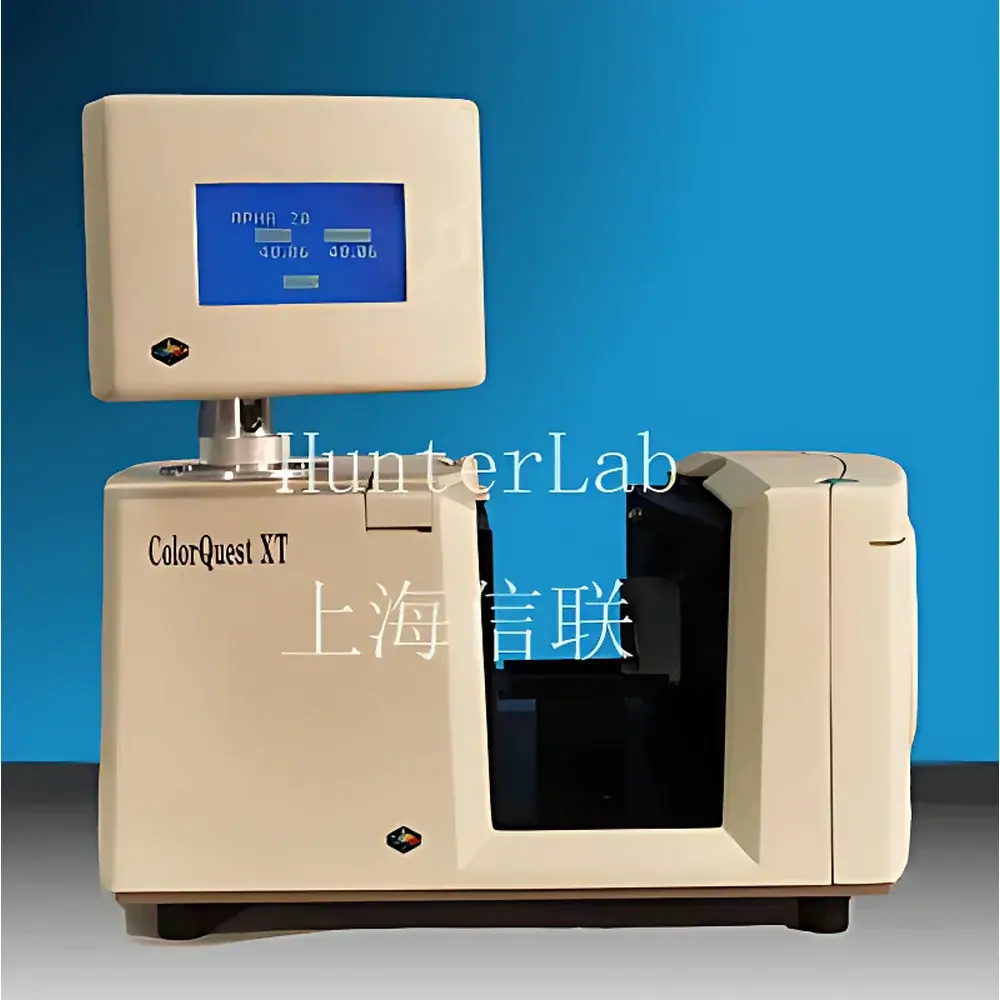
HunterLab ColorQuest XT Beer and Beverage Colorimeter
| Brand | HunterLab |
|---|---|
| Origin | USA |
| Model | ColorQuest XT |
| Product Type | Spectrophotometric Colorimeter |
| Instrument Type | Benchtop |
| Optical Geometry | d/8° Integrating Sphere |
| Light Source | Pulsed Xenon Lamp |
| Spectral Range | 400–700 nm |
| Repeatability | ΔE*ab ≤ 0.03 |
| Compliance | ASTM D1209 (APHA), ASTM D1500 (Gardner), ASTM D156 (Saybolt), ASBC, EBC, ISO 7784-2, CIE No. 15 |
Overview
The HunterLab ColorQuest XT Beer and Beverage Colorimeter is a benchtop spectrophotometric color measurement system engineered for high-precision transmission color analysis of transparent liquids and solids. Based on the CIE 1931 standard observer and utilizing a d/8° integrating sphere optical geometry with pulsed xenon illumination, the instrument delivers traceable, photometrically stable measurements across the visible spectrum (400–700 nm). Unlike filter-based colorimeters, the ColorQuest XT captures full spectral data at 10-nm intervals, enabling calculation of multiple color scales—including ASBC (American Society of Brewing Chemists), EBC (European Brewery Convention), APHA (Standard Methods 2120B), Gardner, Saybolt, and ASTM D1500—within a single measurement cycle. Its design eliminates subjective visual assessment in quality control workflows, supporting objective, quantitative color specification in regulated environments such as brewing, soft drink production, pharmaceutical excipient testing, and polymer clarity evaluation.
Key Features
- Optimized d/8° integrating sphere optics with diffuse illumination and hemispherical viewing, ensuring uniform light distribution and minimal sensitivity to sample positioning or surface irregularities.
- Pulsed xenon lamp with >1 million flash cycles lifetime—no warm-up time required, zero drift between measurements, and consistent spectral output across the full 400–700 nm range.
- High-resolution, backlit capacitive touchscreen display with multi-language interface (English, Chinese, Spanish, French), intuitive icon-driven navigation, and real-time pass/fail feedback against stored tolerances.
- Integrated calibration validation via built-in ceramic white tile and liquid cell verification standards; automatic diagnostic routines verify lamp energy, detector linearity, and sphere coating integrity before each measurement session.
- Robust mechanical architecture compliant with IEC 61000-4 electromagnetic compatibility standards and rated for continuous operation in ambient temperatures from 10–35°C and relative humidity up to 80% non-condensing.
Sample Compatibility & Compliance
The ColorQuest XT accommodates standard 10-, 20-, and 50-mm pathlength glass or quartz cuvettes, as well as custom flow cells for inline process monitoring integration. It supports both clear and slightly hazy transparent samples—including filtered beer wort, carbonated soft drinks, pharmaceutical syrups, edible oils, and optical-grade resins—without requiring dilution or filtration when turbidity remains below 1 NTU. All color scale calculations adhere to internationally recognized methods: ASBC Beer Color (SRM) per ASBC Methods of Analysis, EBC Color per EBC Analytica, APHA/Pt-Co per ASTM D1209, Gardner per ASTM D1500, and Saybolt per ASTM D156. The system is fully compatible with GLP/GMP documentation requirements, including audit trail generation, user access levels, and electronic signature support when paired with validated software configurations.
Software & Data Management
The instrument operates natively via its embedded firmware or connects seamlessly to HunterLab’s Universal Software platform (v7.0+), which runs on Windows 10/11 and supports 21 CFR Part 11-compliant configuration. Universal Software provides customizable report templates, statistical process control (SPC) charting, batch trending, multi-instrument fleet management, and automated export to LIMS or ERP systems via CSV, XML, or direct ODBC connection. All raw spectral data, metadata (operator ID, timestamp, instrument serial number, calibration history), and derived color values are stored with SHA-256 hashing for data integrity verification. Software validation packages—including IQ/OQ documentation, test scripts, and change control logs—are available upon request for regulated users.
Applications
- Brewing QA/QC: Real-time SRM tracking during wort boiling, fermentation, and final filtration; correlation of color shift with Maillard reaction progression and hop utilization efficiency.
- Soft Drink Manufacturing: Monitoring caramel color consistency in colas, detecting oxidation-induced browning in citrus-based beverages, and verifying batch-to-batch hue uniformity in flavored waters.
- Pharmaceutical Excipients: Quantifying yellowness index (YI) in purified water, assessing color stability of parenteral solutions under accelerated aging conditions per ICH Q1A(R2).
- Chemical & Polymer Industries: Measuring APHA color in solvents (e.g., acetone, IPA), evaluating clarity degradation in polycarbonate sheets, and validating optical grade specifications for LED lens materials.
- Academic & Method Development Labs: Serving as a reference spectrophotometer for developing novel color indices, validating alternative measurement geometries, and cross-calibrating handheld devices.
FAQ
Does the ColorQuest XT require annual recalibration by a certified service provider?
No—HunterLab recommends performance verification using NIST-traceable standards at least daily or per shift. Full factory recalibration is advised every 12 months or after physical shock, lamp replacement, or optical component servicing.
Can the instrument measure opaque or translucent samples?
No—the ColorQuest XT is optimized exclusively for transmission mode. For reflectance or haze measurements, HunterLab recommends the MiniScan EZ or UltraScan VIS platforms.
Is spectral data export supported in vendor-neutral formats?
Yes—raw reflectance/transmittance spectra are exportable as ASCII text (.txt) or CSV files containing wavelength (nm) and %T/%R columns, fully compatible with third-party analysis tools such as MATLAB, Python (NumPy/Pandas), or R.
What is the minimum detectable color difference (ΔE*ab) under routine operating conditions?
Instrument repeatability is specified at ΔE*ab ≤ 0.03 for white tile measurements; typical process-relevant detection limits for beer color shifts range from ΔE*ab = 0.15–0.25 depending on matrix viscosity and cuvette cleanliness.
How does the system handle temperature-sensitive samples like unpasteurized beer?
The instrument includes optional Peltier-controlled sample compartment (accessory part #CQT-TEMP), maintaining cuvette temperature within ±0.2°C across 5–40°C, critical for enzymatic color development studies.




