
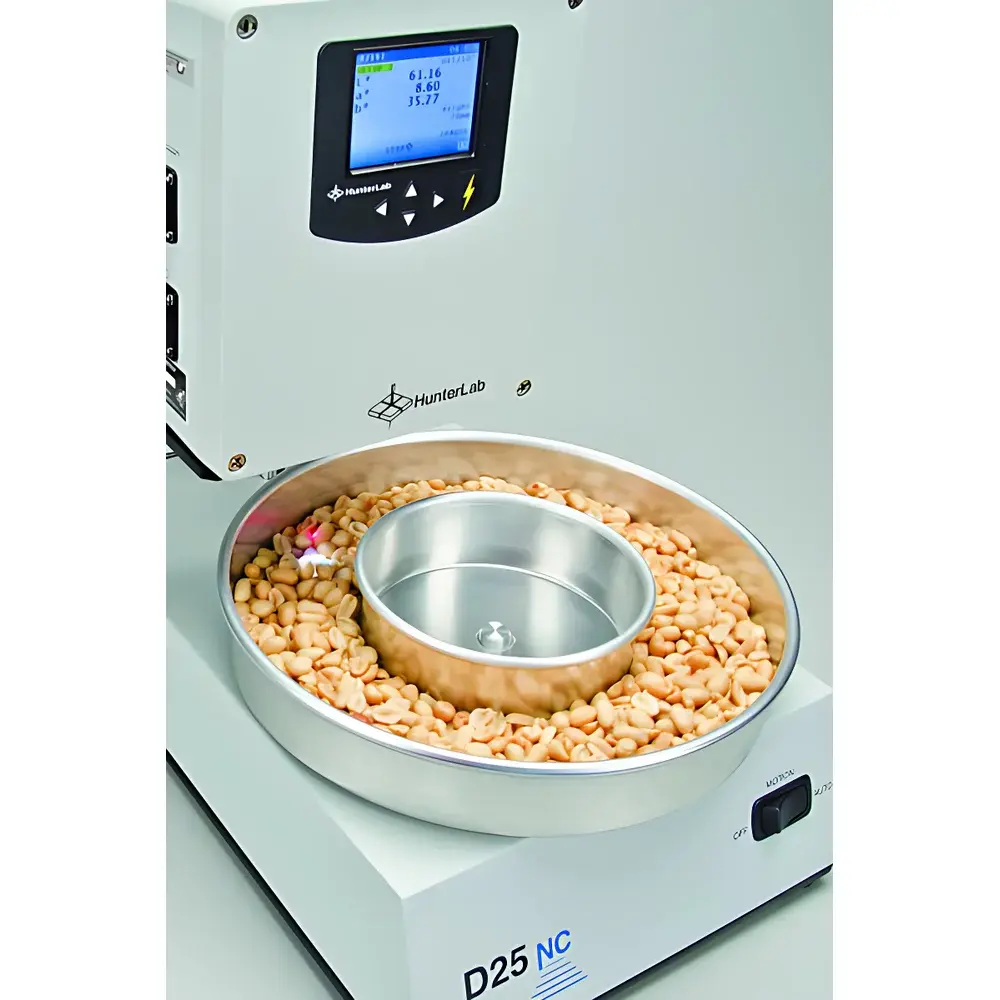
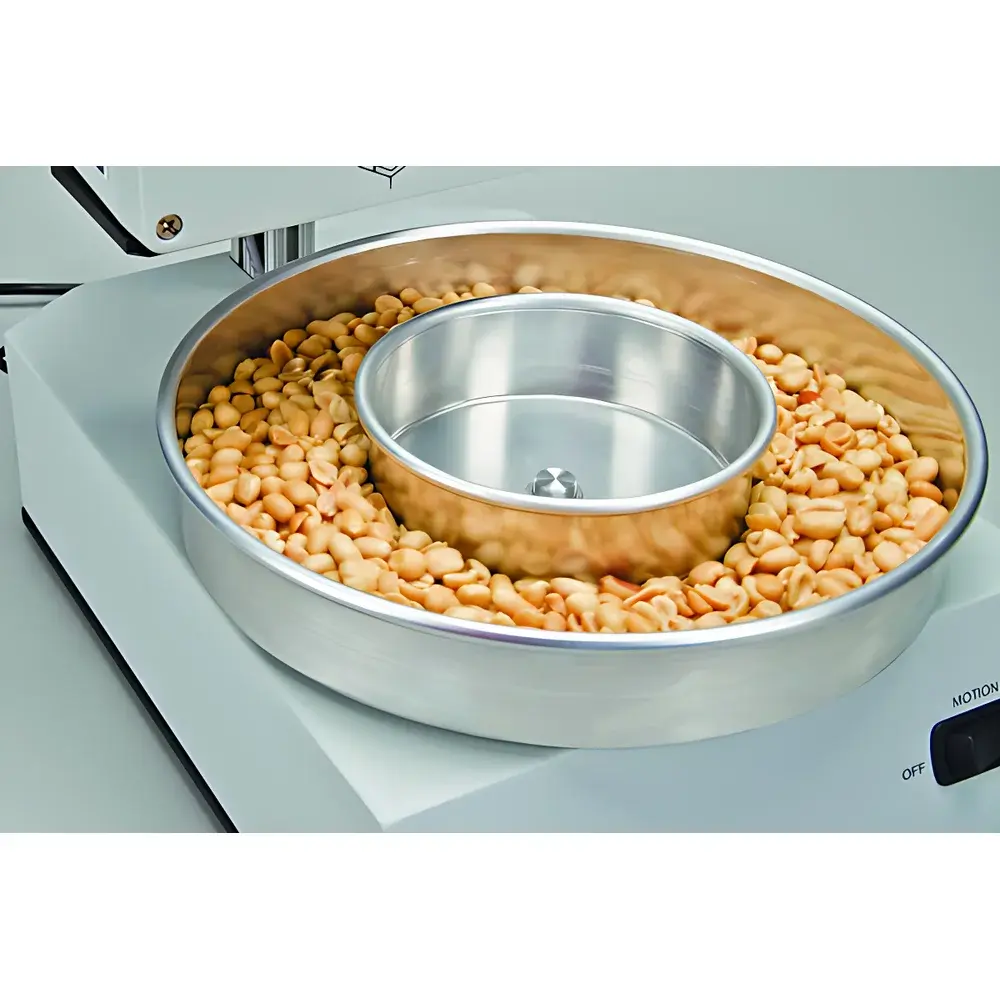
HunterLab D25-NC Non-Contact Spectrophotometer
| Brand | HunterLab |
|---|---|
| Origin | USA |
| Model | D25-NC |
| Product Type | Color Difference Meter |
| Instrument Type | Benchtop |
| Optical Geometry | 0/45° Integrating Sphere |
| Light Source | Full-Spectrum LED (Cool, Energy-Efficient) |
| Spectral Range | 400 nm – 700 nm |
| Repeatability | ΔE* < 0.05 |
Overview
The HunterLab D25-NC Non-Contact Spectrophotometer is a benchtop color measurement system engineered for precision, reproducibility, and operational robustness in industrial and laboratory environments where sample geometry, surface texture, or handling constraints preclude conventional contact-based measurement. Utilizing a fixed 0/45° optical geometry with an integrating sphere detector, the D25-NC captures reflectance spectra across the visible spectrum (400–700 nm) without physical contact—eliminating pressure-induced spectral distortion, surface abrasion, or operator-dependent positioning errors. Its non-contact architecture is fundamentally rooted in photometric principles compliant with CIE 15:2018 and ASTM E308-22, ensuring traceable, metrologically sound color data aligned with international colorimetric standards. Designed as the evolutionary successor to HunterLab’s original spectrophotometer platform—first introduced in 1963—the D25-NC integrates six decades of empirical calibration science, optical engineering refinement, and industrial field validation into a single-purpose instrument optimized for heterogeneous, irregular, or fragile materials.
Key Features
- Non-contact measurement at a fixed 12 mm working distance—ensures consistent illumination and detection geometry independent of sample height variation
- Large-area sampling aperture (129 cm²) with motorized 360° rotation during acquisition—enables spatial averaging across macroscopically non-uniform surfaces
- High-speed spectral capture: up to 5 measurements per second, with 25 discrete readings per full rotation for statistically robust mean color calculation
- Dedicated sample-height compensation algorithm—maintains optical path integrity and colorimetric accuracy even when samples deviate ±5 mm from nominal plane
- Full-spectrum LED light source with stable spectral power distribution (SPD), rated for >50,000 hours lifetime and zero warm-up delay
- Integrated USB host interface supporting direct connection to keyboards, barcode scanners, thermal printers, and host PCs—no external hub required
- Onboard memory stores up to 250 user-configurable methods and 2,000 sample records with full metadata (date/time, operator ID, method name, L*a*b*, ΔE*, spectral data)
- Tool-free modular design: optical head, sample stage, and electronics bay disassemble in under 60 seconds for cleaning, recalibration verification, or routine maintenance
Sample Compatibility & Compliance
The D25-NC is validated for use with granular, particulate, textured, curved, or thermally sensitive materials—including extruded polymer pellets, roasted coffee beans, ground spices, animal feed pellets, breakfast cereals, baked goods, shredded cheese, crushed stone aggregates, and recycled plastic flakes. Its non-contact operation eliminates cross-contamination risk and avoids compression artifacts common in contact probes. The instrument complies with ISO 11664-4:2019 (CIE colorimetry), ASTM D2244-22 (calculation of color differences), and supports audit-ready workflows aligned with GLP and GMP requirements. While not FDA 21 CFR Part 11–certified out-of-the-box, its data export formats (CSV, XML, SPC) and integration with EasyMatch QC software enable full electronic record retention, user access controls, and change history tracking suitable for regulated quality systems.
Software & Data Management
The D25-NC operates autonomously via its embedded touchscreen interface or connects seamlessly to HunterLab’s EasyMatch QC software (v5.0+). EasyMatch QC provides method-driven workflows, statistical process control (SPC) charting, multi-instrument fleet management, and customizable reporting templates compliant with internal QA protocols. All spectral data are stored in vendor-neutral .qtx format, preserving raw reflectance curves for retrospective analysis. Software-defined tolerances support pass/fail logic based on CIEDE2000, CMC(l:c), or custom ΔE* thresholds. Audit trail functionality logs all user actions—including method edits, calibration events, and result overrides—with timestamps and operator identifiers.
Applications
The D25-NC delivers reliable color consistency assessment in high-variability production environments: monitoring batch-to-batch uniformity of extruded plastic components; quantifying roast degree and bean homogeneity in coffee processing; verifying pigment dispersion in recycled PET flake; assessing browning index in fried potato products (e.g., French fries, chips); evaluating grain maturity and contamination in cereal milling; controlling hue consistency in powdered food ingredients (spices, dairy powders, nutritional blends); and validating color stability in decorative surfacing materials (laminates, engineered stone). Its ability to average over large surface areas makes it particularly suited for quality release testing of bulk commodities where representative sampling is otherwise statistically challenging.
FAQ
Does the D25-NC require annual factory recalibration?
No—HunterLab recommends biannual verification using NIST-traceable ceramic tile standards; full recalibration is only necessary if verification fails or after major hardware service.
Can the D25-NC measure transparent or translucent samples?
No—it is designed exclusively for opaque, diffusely reflecting surfaces. Translucent or backlit materials require transmission-capable instrumentation such as the UltraScan VIS.
Is spectral data export supported in industry-standard formats?
Yes—raw 10-nm interval reflectance data export is available in CSV and XML, fully compatible with third-party analytics platforms including MATLAB, Python (NumPy/Pandas), and JMP.
What environmental conditions are recommended for optimal performance?
Operate within 15–30°C ambient temperature, ≤80% non-condensing humidity, and minimal ambient UV exposure; avoid direct sunlight on the optical port.
How does the D25-NC handle highly glossy or metallic surfaces?
The 0/45° geometry inherently suppresses specular reflectance; however, for mirror-like finishes, HunterLab recommends supplemental measurement using the Agera or MiniScan EZ with gloss-compensated modes.





