
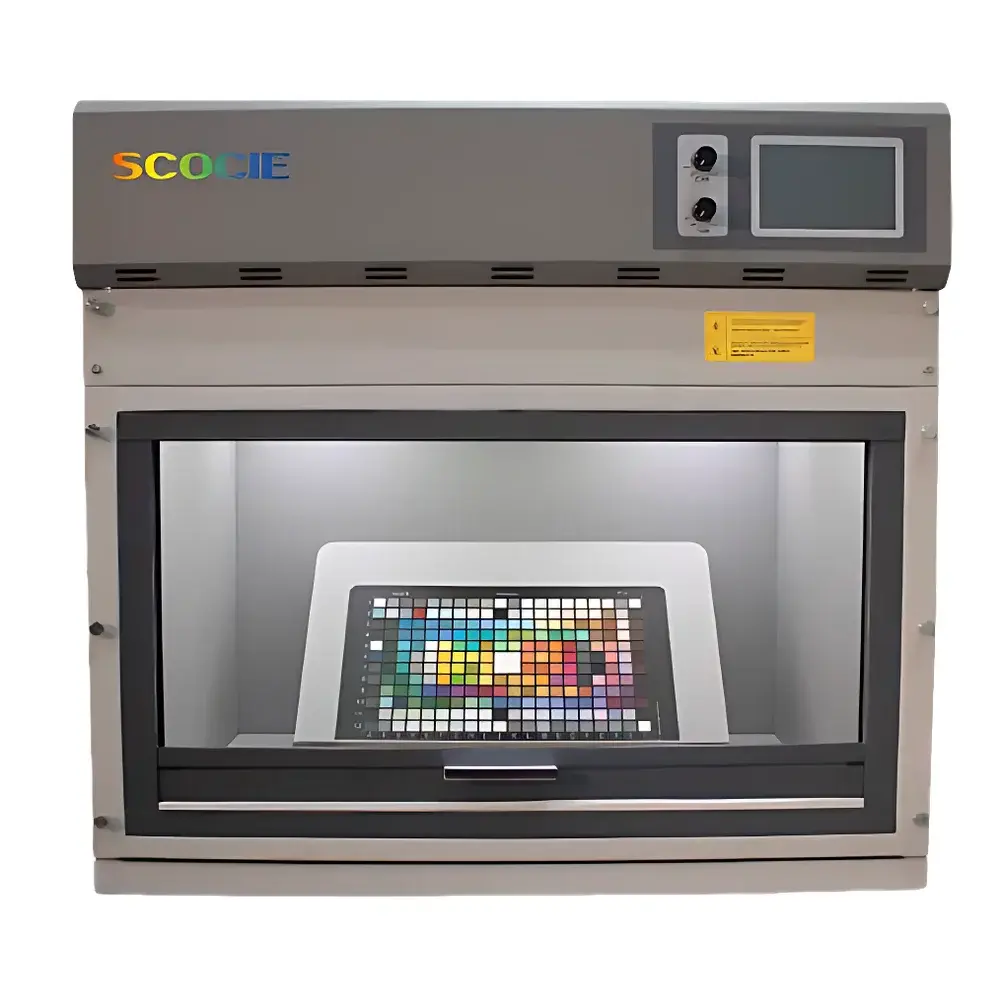
HunterLab FastnessGrade Colorfastness Testing Instrument
| Brand | HunterLab |
|---|---|
| Origin | Shanghai, China |
| Model | FastnessGrade Colorfastness Testing Instrument |
| Product Type | Spectrophotometric Color Measurement System |
| Instrument Form Factor | Benchtop |
| Optical Geometry | 0/45° Integrating Sphere |
| Light Source | LED Array |
| Spectral Range | 350–700 nm |
| Repeatability (ΔE*ab) | ≤0.03 |
| Compliance | ASTM D2244, ISO 105-A02, ISO 105-A03, ISO 105-A04, ISO 105-B02, ISO 105-X12, AATCC Test Method 8, AATCC TM16, AATCC TM20, GB/T 3920, GB/T 8427, GB/T 4802.1 |
Overview
The HunterLab FastnessGrade Colorfastness Testing Instrument is a benchtop spectrophotometric imaging system engineered for objective, quantitative assessment of textile and material colorfastness properties. Unlike conventional visual evaluation under standard illuminants or single-point spectrophotometry, the FastnessGrade integrates high-fidelity RGB imaging with calibrated 0/45° geometry spectrophotometry to capture spatial chromatic variation across entire test specimens. Its measurement principle combines spectral reflectance acquisition (350–700 nm) with multi-region image analysis, enabling simultaneous evaluation of color change (ΔE*ab), staining transfer, surface texture degradation, and pilling morphology against standardized reference scales. Designed for compliance-driven environments—including textile QC labs, dye house R&D, and contract testing facilities—the instrument supports full traceability, audit-ready data export, and alignment with globally recognized fastness test standards.
Key Features
- Integrated dual-mode operation: spectrophotometric color measurement + high-resolution RGB imaging for spatially resolved fastness analysis
- Calibrated 0/45° optical geometry with integrated LED array illumination (CIE Illuminant D65, A, F2, and custom spectra) ensuring consistent, stable, and flicker-free lighting conditions
- Automated digital grading engine compliant with ISO 105-A02 (gray scale for color change), ISO 105-A03 (gray scale for staining), ISO 105-B02 (blue wool scale for lightfastness), and AATCC TM16 protocols
- Multi-sample imaging capability: up to eight specimens analyzed per acquisition cycle without repositioning—reducing throughput time by >60% versus sequential single-sample methods
- Embedded standard illuminant simulation: accurate reproduction of CIE D65, A, F2, F7, F11, and UV-enhanced spectra for visual assessment consistency across global supply chains
- Robust architecture with NIST-traceable calibration validation, thermal drift compensation, and automated self-diagnostic routines
Sample Compatibility & Compliance
The FastnessGrade accommodates flat, flexible, and moderately textured substrates including woven/knitted textiles, nonwovens, leather, paper, and coated films (max. thickness: 5 mm; max. sample area: 120 × 120 mm). It supports all major colorfastness test formats: wash fastness (ISO 105-C06), rub fastness (ISO 105-X12, AATCC TM8), lightfastness (ISO 105-B02, AATCC TM16), perspiration fastness (ISO 105-E04), and pilling resistance (ISO 12945-1, GB/T 4802.1). Data outputs comply with GLP/GMP documentation requirements, including full audit trails, user authentication logs, and electronic signatures per FDA 21 CFR Part 11 when configured with optional software modules. All spectral measurements are referenced to NIST SRM 2020 and validated per ASTM E308 and CIE 15:2018.
Software & Data Management
The FastnessGrade operates via HunterLab’s proprietary EasyMatch QC software, featuring a validated workflow engine for ISO/AATCC-compliant reporting. The software provides real-time image overlay of test samples against digital gray scales and blue wool references, automatic ΔE*ab mapping, and statistical process control (SPC) charting for batch-level trend analysis. Raw spectral data, annotated images, and grade reports are exportable in CSV, PDF/A-2, XML, and industry-standard .qtx formats. Network-enabled deployment supports centralized database archiving, remote calibration monitoring, and role-based access control. Optional IQ/OQ/PQ documentation packages are available for regulated industries requiring formal instrument qualification.
Applications
- Textile and apparel manufacturing: automated grading of wash, rub, light, and perspiration fastness per ISO 105 and AATCC standards
- Dye development labs: rapid iteration of dye formulations using quantitative staining transfer metrics and spectral shift analysis
- Printing and packaging: evaluation of ink adhesion, bleed resistance, and UV fluorescence response under controlled illuminants
- Food and agricultural QA: objective assessment of surface color uniformity in baked goods, fruits, and processed meats—correlating L*a*b* values with sensory maturity indices
- Coatings and plastics: quantification of photochemical degradation, chalking, and gloss-color interaction under accelerated aging protocols
- Academic research: reproducible spectral baseline establishment for novel pigment systems, nanocomposite colorants, and bio-based dyes
FAQ
Does the FastnessGrade replace trained human graders entirely?
No—it augments and standardizes grading. While it eliminates inter-observer variability and enables remote collaboration, final sign-off in regulated environments may still require qualified personnel review per internal SOPs.
Can the system be validated for ISO/IEC 17025 accreditation?
Yes. The instrument includes documented uncertainty budgets, traceable calibration certificates, and software validation templates aligned with ILAC G8:2009 and ISO/IEC 17025:2017 Annex A.3 requirements.
Is UV measurement capability included as standard?
Yes. The LED array includes a dedicated UV channel (365 nm peak) with adjustable intensity, supporting fluorescent whitening agent (FWA) quantification per ISO 105-X16 and AATCC TM113.
What sample preparation is required beyond standard fastness testing?
None. Specimens are mounted identically to conventional test methods—no special mounting fixtures, coatings, or pretreatment are needed.
How is data security managed in networked deployments?
Data encryption (AES-256), TLS 1.2+ communication, Windows Active Directory integration, and configurable audit log retention policies ensure compliance with GDPR, HIPAA, and corporate IT governance frameworks.




