
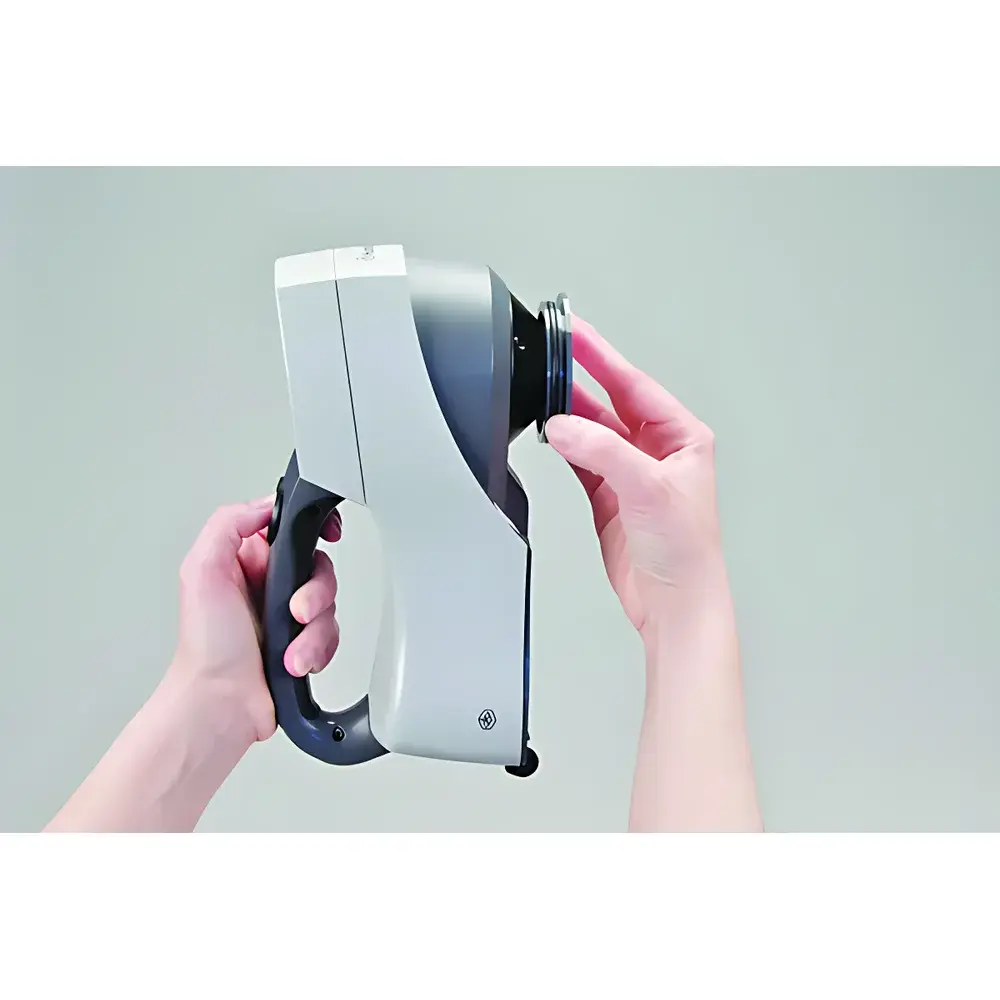
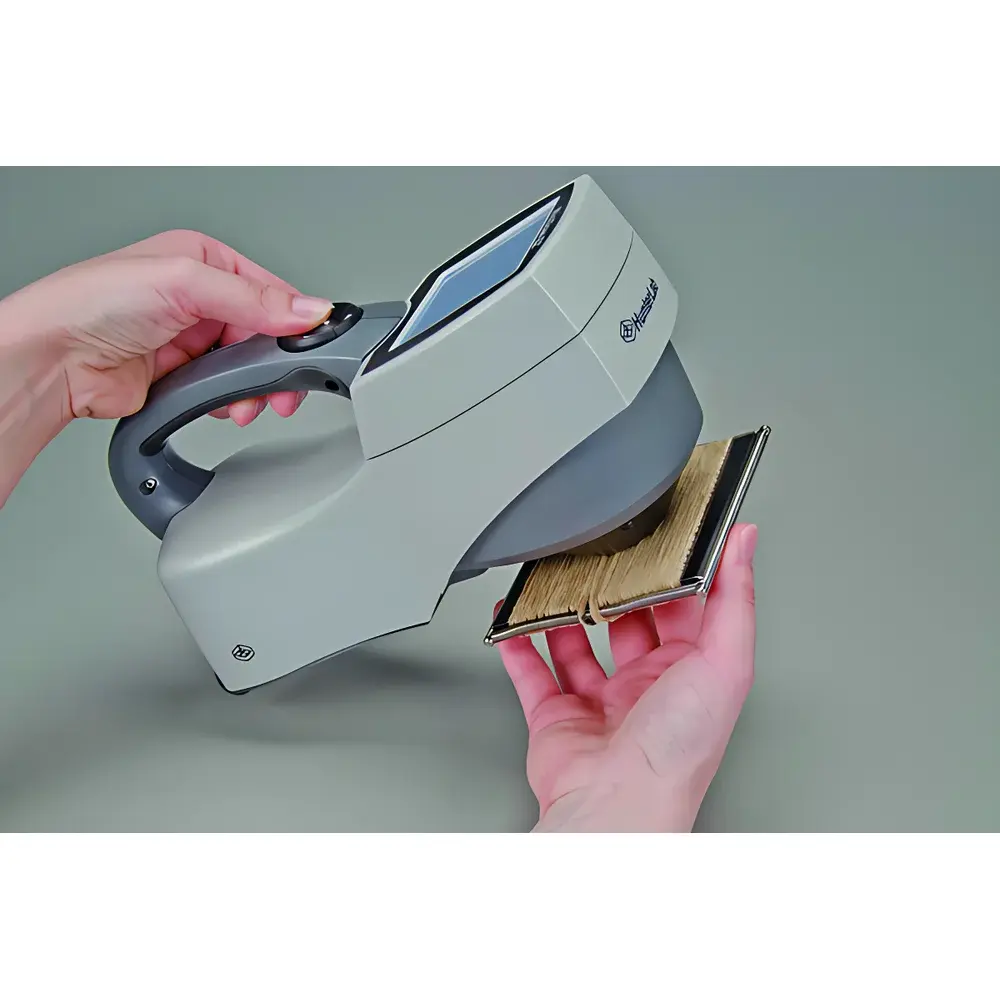
HunterLab MiniScan EZ Portable Colorimeter for Carbon Black Tint Strength Measurement
| Brand | HunterLab |
|---|---|
| Origin | USA |
| Model | MiniScan EZ Carbon Black Colorimeter |
| Type | Portable |
| Optical Geometry | d/8° Integrating Sphere |
| Light Source | Pulsed Xenon Lamp |
| Spectral Range | 400–700 nm |
| Repeatability | ΔE*ab ≤ 0.05 (average, CIE Lab scale) |
| Compliance | ASTM D2805, ISO 11664-4, ISO 11664-6, USP <1061>, FDA 21 CFR Part 11 (software-enabled audit trail) |
Overview
The HunterLab MiniScan EZ Portable Colorimeter is a precision optical measurement instrument engineered specifically for quantitative color evaluation and tint strength assessment of carbon black–pigmented materials—such as rubber compounds, inks, plastics, and masterbatches. It operates on the principle of diffuse reflectance spectroscopy using a d/8° integrating sphere geometry, which ensures high angular acceptance and minimizes directional bias in measurements. The pulsed xenon lamp provides stable, full-spectrum illumination across the visible range (400–700 nm), enabling accurate CIE L*a*b*, ΔE*ab, and related color difference metrics compliant with ISO 11664-4 and ASTM D2805 for carbon black dispersion quality and relative tinting strength. Unlike general-purpose colorimeters, the MiniScan EZ integrates proprietary wavelength calibration verification via dual-reference (white + green tile) validation—ensuring long-term photometric stability and eliminating drift-induced errors critical for QC/QA in high-volume manufacturing environments.
Key Features
- True portable architecture: Weighs under 600 g with integrated ergonomic handle for one-handed operation in production lines, warehouses, or loading docks.
- Dual-reference calibration system: Factory-calibrated white tile plus dedicated green ceramic reference tile for real-time monitoring of spectral response drift—unique to MiniScan EZ and essential for maintaining traceability in carbon black applications.
- Flexible aperture options: Interchangeable 8 mm and 4 mm ports support both bulk material sampling (e.g., rubber sheets) and small-area targets (e.g., ink drawdowns).
- Universal optical configuration: d/8° geometry with specular component included (SCI) or excluded (SCE) modes—enabling consistent evaluation of textured, glossy, or matte carbon black surfaces per ISO 27677 and ASTM E308.
- Power flexibility: Operates on rechargeable Li-ion battery (up to 10,000 measurements per charge) or AC adapter—no dependency on fixed infrastructure during shift-based production audits.
- Ruggedized industrial design: IP54-rated enclosure with scratch-resistant sapphire window and shock-absorbing housing—validated for continuous use in factory-floor conditions.
Sample Compatibility & Compliance
The MiniScan EZ accommodates solid, semi-solid, and film-based samples common in carbon black formulation workflows—including vulcanized rubber slabs, extruded plastic pellets, coated metal panels, printed films, and laboratory-prepared drawdowns. Its 8 mm port meets ASTM D2805 requirements for minimum sample area in tint strength testing, while its 4 mm option enables localized assessment of pigment dispersion heterogeneity. Instrument compliance extends to ISO 11664-6 (colorimetric observers), ISO 13655 (M1/M2 illumination standards), and supports GLP/GMP documentation through optional software modules with 21 CFR Part 11–compliant electronic signatures and audit trails. All calibrations are NIST-traceable and certified per ISO/IEC 17025–accredited procedures.
Software & Data Management
The MiniScan EZ interfaces seamlessly with HunterLab’s EasyMatch QC software (Windows-based), enabling automated pass/fail tolerancing, statistical process control (SPC) charting, batch trending, and comparative analysis against master standards. For carbon black users, dedicated “Tint Strength Mode” calculates relative tinting value (RTV) and deviation from reference black standards using CIELAB ΔE*ab, ΔL*, Δa*, and Δb* deltas. Data export supports CSV, XML, and PDF formats; instrument firmware updates are delivered via USB or network connection. Optional cloud synchronization allows centralized database management across global R&D and manufacturing sites, with role-based access control and version-locked method templates to ensure inter-laboratory reproducibility.
Applications
- Quantitative tint strength evaluation of carbon black masterbatches per ASTM D2805 and ISO 3668.
- In-line color consistency verification for rubber extrusion, tire tread compounding, and conveyor-belt coating processes.
- QC release testing of automotive interior plastics, where gloss-independent color match is required across varying surface finishes.
- Raw material incoming inspection of carbon black grades (e.g., N110, N220, N330) against supplier certificates.
- Dispersion uniformity mapping on cured elastomer sections using grid-based measurement protocols.
- Regulatory documentation for FDA-regulated medical device components requiring documented color stability over shelf life.
FAQ
Does the MiniScan EZ support measurement of carbon black in liquid dispersions?
No—the MiniScan EZ is designed exclusively for opaque, solid, or semi-solid samples. Liquid carbon black dispersions require transmission-mode spectrophotometry (e.g., HunterLab UltraScan VIS) or specialized turbidity-corrected instruments.
How often must the green tile be recalibrated?
The green ceramic reference tile is factory-stabilized and requires no user recalibration. Annual verification against HunterLab’s NIST-traceable reference set is recommended for GMP environments.
Can the MiniScan EZ store measurement data internally without a computer?
Yes—it retains up to 2,000 measurements with timestamp, operator ID, and sample ID fields directly on-device memory.
Is the d/8° geometry compliant with ISO 7724-1 for industrial color matching?
Yes—the MiniScan EZ implements d/8° geometry with diffuser and baffle system fully aligned with ISO 7724-1, ISO 11664-4, and CIE Publication 15:2004 specifications.
What is the typical measurement uncertainty for ΔE*ab on carbon black samples?
Under controlled ambient conditions (23 °C ± 2 °C, 50% RH ± 5%), the expanded uncertainty (k = 2) for ΔE*ab is ≤ 0.08 for repeat measurements on homogeneous carbon black rubber slabs per ISO/IEC 17025 validation reports.





