
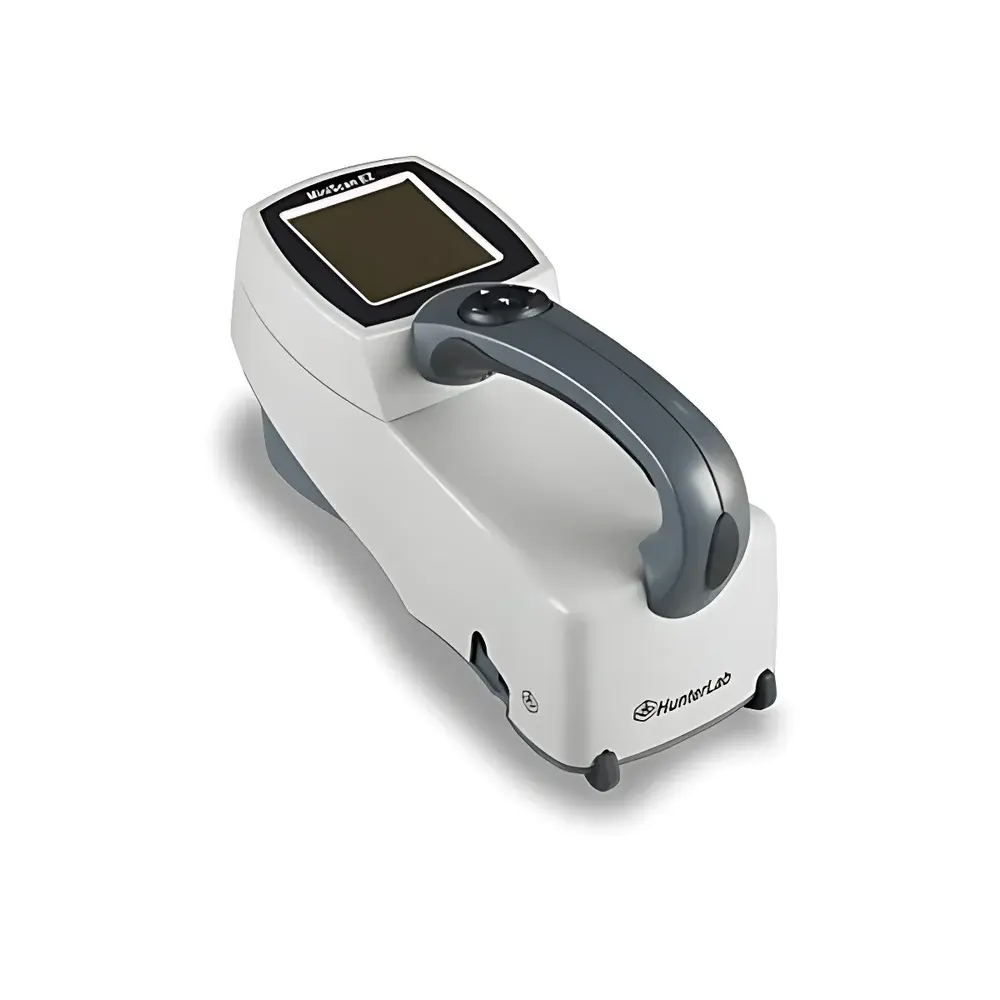
HunterLab MiniScan EZ Portable Spectrophotometer
| Brand | HunterLab |
|---|---|
| Origin | USA |
| Model | MiniScan EZ |
| Product Type | Spectrophotometric Colorimeter |
| Instrument Type | Portable |
| Optical Geometry | d/8° integrating sphere |
| Light Source | Pulsed Xenon Lamp |
| Spectral Range | 400 nm – 700 nm |
| Repeatability | ΔE* < 0.05 (CIE L*a*b* on white tile) |
| Weight (with batteries) | 1.0 kg (2.25 lbs) |
| Display | Rotatable LCD matrix screen (0°, 90°, 180°, 270°) |
| Measurement Apertures | Large and small ports available for both 45°/0° and d/8° optical configurations |
| Wavelength Interval | 10 nm |
| Data Output | Color values (L*a*b*, L*C*h), color differences (ΔE*ab, ΔE*cmc, ΔE*94, ΔE*00), spectral reflectance curves, spectral difference plots |
| Software Compatibility | EasyMatch QC (≥100 user-defined methods) |
| Calibration | Built-in wavelength verification tool |
| Compliance | Designed to support GLP/GMP workflows with audit-trail-capable software integration |
Overview
The HunterLab MiniScan EZ is a handheld spectrophotometric colorimeter engineered for precision, portability, and operational robustness in industrial quality control environments. Utilizing a d/8° integrating sphere optical geometry with pulsed xenon illumination, it delivers stable, repeatable spectral reflectance measurements across the visible spectrum (400–700 nm at 10 nm intervals). This configuration ensures diffuse illumination and hemispherical viewing—minimizing directional bias from surface texture, gloss, or orientation—making it suitable for heterogeneous, textured, or non-uniform samples such as extruded plastics, painted panels, woven textiles, and food products. Unlike tristimulus meters, the MiniScan EZ captures full spectral data, enabling post-acquisition calculation of multiple color spaces (CIE L*a*b*, L*C*h, Yxy), color difference formulas (ΔE*ab, ΔE*cmc, ΔE*94, ΔE*00), and compliance with ASTM D2244, ISO 11664, and CIE Publication 15 standards. Its design reflects over six decades of HunterLab’s applied expertise in color science, emphasizing traceable calibration, long-term stability, and field-deployable reliability.
Key Features
- True portable form factor: Weighs only 1.0 kg (2.25 lbs) with batteries—optimized for extended use with minimal operator fatigue.
- Ergonomic single-hand operation: Intuitive tactile keypad layout supports glove-compatible use in production or warehouse settings.
- Rotatable high-contrast LCD display: Four fixed orientation angles (0°, 90°, 180°, 270°) ensure optimal readability under variable lighting and mounting conditions.
- Dual optical system support: Compatible with both d/8° and 45°/0° measurement geometries via interchangeable apertures—enabling method alignment with industry-specific requirements (e.g., ASTM D313 for paper, ISO 2813 for coatings).
- On-device pass/fail evaluation: Configurable tolerances (user-defined or auto-calculated) generate immediate visual and audible pass/fail feedback without external software.
- Integrated wavelength verification tool: Ensures spectral accuracy drift remains within specification over time—critical for regulatory audits and inter-instrument correlation.
- High repeatability performance: ΔE* < 0.05 in CIE L*a*b* on certified white tile—validated per ASTM E308 and ISO 13655 procedures.
Sample Compatibility & Compliance
The MiniScan EZ accommodates a broad range of physical sample types—including opaque solids (ceramics, metal finishes, plastic parts), translucent materials (bottles, films, gels), textured surfaces (carpets, fabrics, leather), and food specimens (meat patties, fish fillets, baked goods). Its large and small aperture options allow precise targeting of heterogeneous areas or confined features. The instrument meets essential metrological requirements for routine QC in regulated industries: spectral data acquisition supports FDA 21 CFR Part 11–compliant electronic records when paired with EasyMatch QC software (with audit trail, user access controls, and electronic signatures enabled). It is routinely deployed in facilities operating under ISO 9001, IATF 16949, and GMP frameworks where color consistency directly impacts product release criteria.
Software & Data Management
The MiniScan EZ interfaces seamlessly with HunterLab’s EasyMatch QC software—a validated platform supporting ≥100 customizable test methods, statistical process control (SPC) charting, batch averaging, and multi-instrument network synchronization. All spectral and colorimetric data are stored with full metadata (timestamp, operator ID, standard reference, measurement geometry, aperture size). Export formats include CSV, XML, and PDF reports compatible with LIMS and ERP systems. Data integrity safeguards include automatic version-controlled calibration logs, encrypted local storage, and configurable backup protocols. Firmware updates are delivered via USB or Ethernet, ensuring continued alignment with evolving color standards and cybersecurity best practices.
Applications
- Pigmented plastics & polymer extrusions: Monitoring batch-to-batch consistency in automotive interior trim, medical tubing, and consumer packaging.
- Coatings & architectural finishes: Verifying color match of façade paints, powder coatings, and anodized aluminum before installation.
- Food & agriculture: Quantifying surface color changes in meat, seafood, and produce—correlating with freshness, cooking degree, or oxidation status.
- Textiles & nonwovens: Controlling dye lot uniformity across woven, knitted, and spunbond materials under varying lighting conditions.
- Printing & packaging: Validating spot color fidelity on corrugated board, flexible films, and label stock against brand-critical standards.
- Ceramics & tiles: Assessing glaze consistency across kiln batches and detecting subtle firing-related chromatic shifts.
FAQ
What optical geometry does the MiniScan EZ use by default?
The standard configuration employs d/8° geometry with a pulsed xenon lamp and integrating sphere—conforming to ISO 7724 and ASTM E308 for diffuse/total reflectance measurement.
Can the MiniScan EZ measure transparent or translucent materials?
Yes—when used with the optional transmission stand and appropriate aperture, it measures transmittance and color of clear films, bottles, and gels per ASTM D1003 and ISO 14782.
Is spectral data export supported?
Yes—full 400–700 nm reflectance spectra at 10 nm intervals can be exported in ASCII or CSV format for third-party analysis or spectral modeling.
How is calibration maintained in field use?
Instrument calibration is verified using the included wavelength calibration tile; full recalibration is performed at HunterLab-certified service centers using NIST-traceable standards.
Does the MiniScan EZ comply with FDA 21 CFR Part 11?
The hardware itself is not Part 11–certified, but when operated with EasyMatch QC (configured with audit trail, electronic signatures, and role-based access), it supports compliant data governance in pharmaceutical and food manufacturing environments.




