
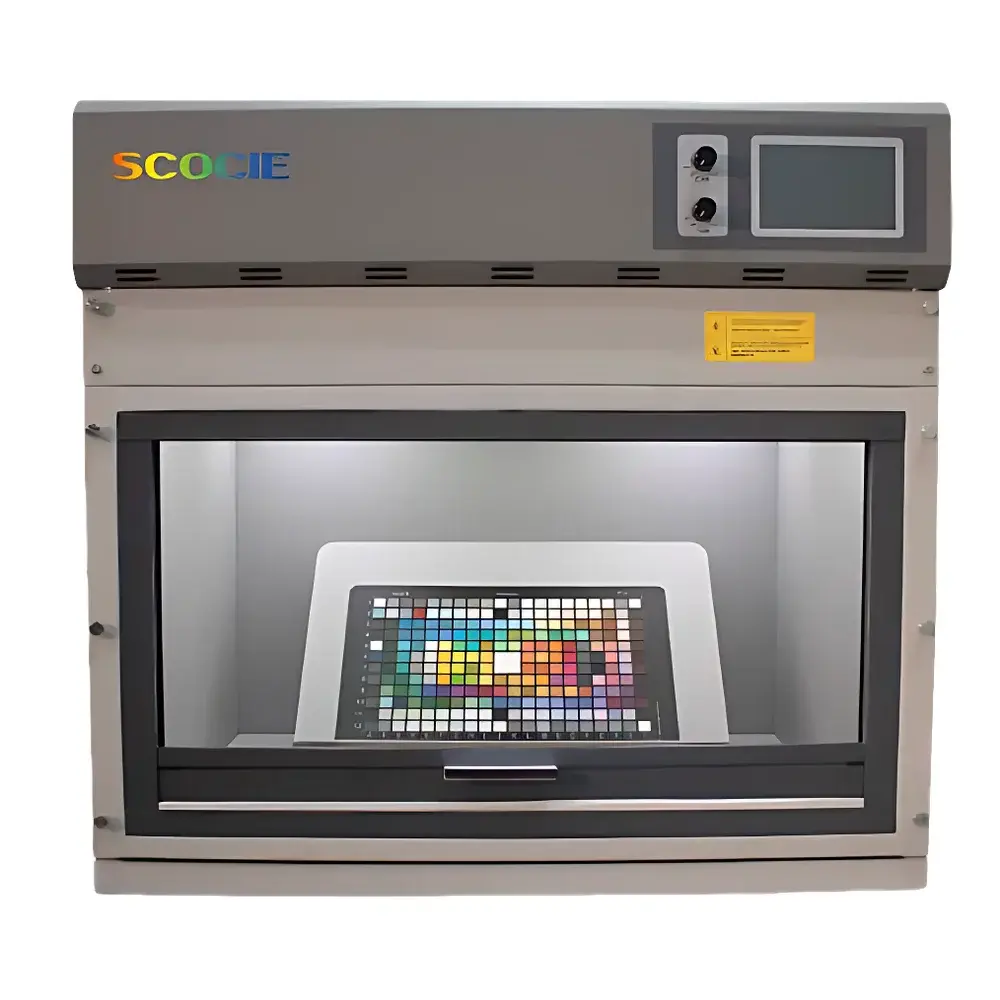
HunterLab SCOCIE FastnessGrade Digital Colorfastness Analyzer
| Brand | HunterLab |
|---|---|
| Origin | Shanghai, China |
| Model | FastnessGrade |
| Product Type | Spectrophotometric Color Difference Meter |
| Instrument Form Factor | Benchtop |
| Optical Geometry | 0°/45° Integrating Sphere |
| Light Source | LED Array |
| Spectral Range | 350–700 nm |
| Repeatability (ΔE*ab) | ≤0.03 |
| Compliance | ASTM D2244, ISO 105-A02, ISO 105-A03, ISO 105-A04, ISO 105-B02, ISO 105-X12, AATCC Test Method 8, AATCC TM16, AATCC TM20, GB/T 3920, GB/T 8427 |
Overview
The HunterLab SCOCIE FastnessGrade Digital Colorfastness Analyzer is a benchtop spectrophotometric imaging system engineered for objective, repeatable, and standardized evaluation of textile colorfastness properties. Unlike conventional visual assessment under standard illuminants or single-point reflectance measurement, the FastnessGrade integrates high-fidelity RGB imaging with calibrated 0°/45° optical geometry and full-spectrum LED illumination (350–700 nm) to capture spatial color distribution across entire test specimens. Its core measurement principle relies on quantitative spectral reflectance analysis combined with multi-region image registration and comparative algorithmic grading against certified reference standards—including multi-fiber adjacent fabrics, blue wool standards (ISO 105-B02), and grayscale scales (ISO 105-A02/A03). This enables traceable, operator-independent classification of color change (ΔE*ab, ΔL*, Δa*, Δb*), staining transfer, pilling morphology, and abrasion-induced surface degradation—each aligned to internationally recognized rating scales.
Key Features
- Integrated dual-function platform: Combines spectrophotometric color difference analysis (ΔE*ab ≤ 0.03 repeatability) with high-resolution digital imaging for spatially resolved colorfastness grading.
- Standardized 0°/45° optical configuration with large-area integrating sphere ensures uniform illumination and minimizes directional bias—critical for textured, napped, or uneven substrates.
- Full-spectrum LED array (350–700 nm) provides stable, flicker-free, and UV-free illumination compliant with CIE illuminant D65, A, F2, and F7 spectral power distributions.
- Automated grading engine supports all major textile colorfastness test protocols: wash fastness (ISO 105-C06, AATCC TM61), rub fastness (dry/wet, ISO 105-X12, AATCC TM8), lightfastness (ISO 105-B02, AATCC TM16), and pilling resistance (ISO 12945-1, AATCC TM152).
- Multi-sample imaging mode allows simultaneous acquisition and parallel grading of up to six specimens per cycle—reducing throughput time by >60% versus sequential manual evaluation.
- Embedded GLP-compliant audit trail: All image captures, calibration logs, user actions, and grading decisions are timestamped, user-logged, and exportable in CSV/PDF format for regulatory review.
Sample Compatibility & Compliance
The FastnessGrade accommodates rigid and flexible substrates up to 200 × 200 mm, including woven/knitted textiles, nonwovens, leather, coated papers, and printed films. Its imaging field-of-view and depth-of-field optimization ensure accurate grading of low-contrast staining, micro-pilling, and edge-diffused abrasion zones. The system conforms to ASTM D2244 (instrumental color difference calculation), ISO 105-A02 (gray scale for color change), ISO 105-A03 (gray scale for staining), ISO 105-B02 (blue wool scale for lightfastness), and AATCC TM16 (lightfastness testing). Data outputs meet requirements for ISO/IEC 17025-accredited laboratories and support FDA 21 CFR Part 11–compliant electronic records when deployed with validated network authentication and role-based access control.
Software & Data Management
FastnessGrade operates via proprietary Windows-based software featuring ISO/ASTM-aligned grading modules, customizable report templates (PDF/Excel), and DICOM-compatible image archiving. Spectral data is stored in CIE XYZ, L*a*b*, and sRGB formats; image metadata includes EXIF tags for illuminant ID, integration time, white calibration timestamp, and operator credentials. Raw images and processed grading matrices are exportable for third-party statistical process control (SPC) integration (e.g., JMP, Minitab). Software supports automated synchronization with LIMS platforms via HL7 or RESTful API, enabling real-time quality gate enforcement at production line checkpoints.
Applications
The FastnessGrade serves as a primary colorfastness evaluation tool in textile R&D labs, dye house QC departments, and brand compliance testing facilities. It is routinely deployed for: validating dye migration resistance in activewear laminates; quantifying UV stabilizer efficacy in outdoor awning fabrics; benchmarking ink adhesion durability in packaging flexography; assessing pigment bleed in food-grade silicone molds; and monitoring batch-to-batch consistency in automotive interior trims. Beyond textiles, its spectral imaging capability supports maturity grading of horticultural produce (e.g., tomato lycopene index), browning assessment in baked goods (Maillard reaction kinetics), and fluorescence quantification of optical brighteners in detergents—each traceable to NIST-traceable reflectance standards.
FAQ
Does FastnessGrade require annual recalibration by an external service provider?
No. The system features on-board self-calibration using integrated ceramic white tile and black trap references. Full spectral validation against NIST SRM 2020 is recommended every 12 months or after 10,000 measurement cycles.
Can the instrument grade samples tested under non-standard conditions (e.g., custom wash cycles or extended UV exposure)?
Yes. Users may define custom reference libraries and tolerance thresholds within the software—provided the test methodology remains documented and internally validated per ISO/IEC 17025 Clause 7.2.2.
Is remote operation supported for distributed laboratory networks?
Yes. The software supports secure remote desktop access and centralized database hosting via Microsoft SQL Server. All remote sessions comply with TLS 1.2+ encryption and enforce two-factor authentication.
What file formats are generated for audit documentation?
Each test session exports a ZIP archive containing: (1) raw TIFF images with embedded EXIF metadata, (2) CSV files with spectral reflectance values (10-nm intervals), (3) PDF reports with grading rationale and pass/fail flags per ISO clause, and (4) XML-formatted audit logs compliant with 21 CFR Part 11 Subpart B.
How does FastnessGrade handle specular highlights on glossy or coated substrates?
The 0°/45° geometry inherently suppresses specular reflection. For highly reflective surfaces, optional matte spray application or polarized illumination mode (available as add-on module) further eliminates glare-induced grading error.






