
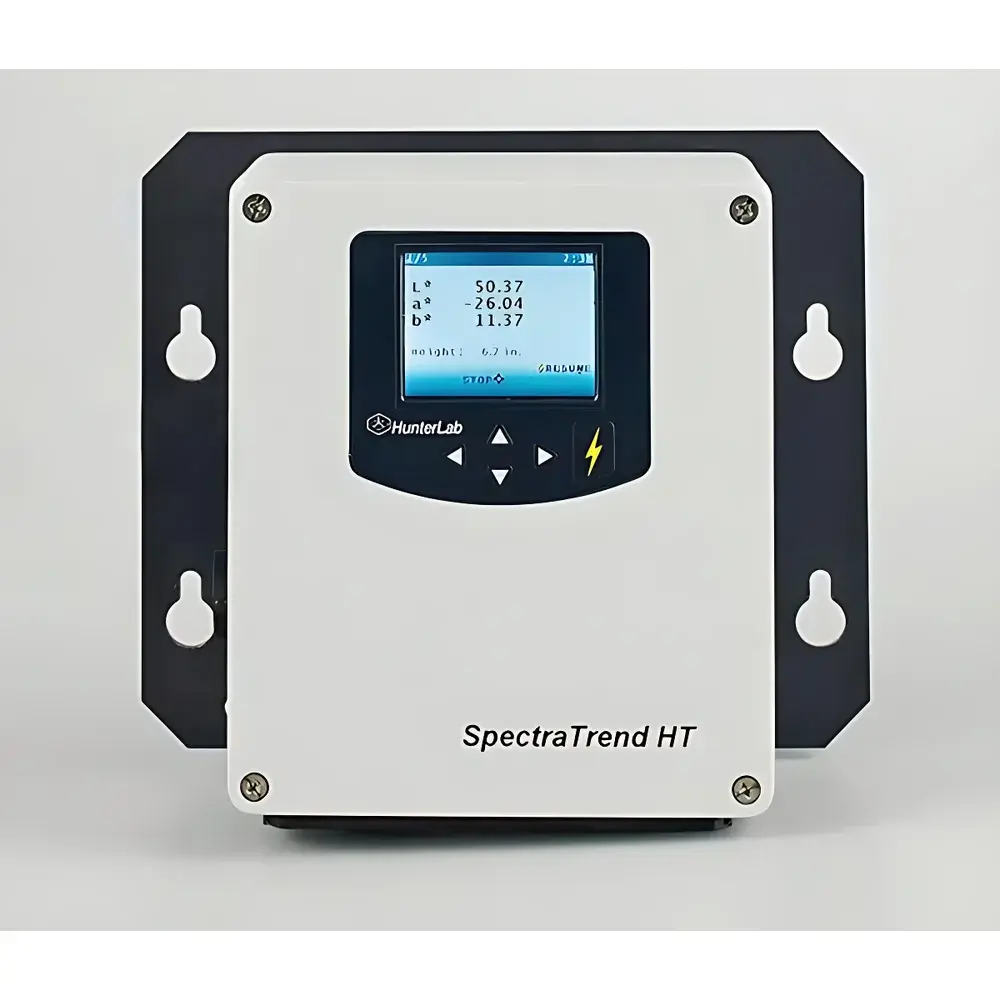
HunterLab SpectraTrend HT In-Line Polyester Chip Color Measurement System
| Brand | HunterLab |
|---|---|
| Origin | USA |
| Manufacturer Type | Authorized Distributor |
| Product Category | Imported Instrument |
| Model | SpectraTrend HT In-Line Colorimeter for Polyester Chips |
| Product Type | Spectrophotometric Color Measuring Instrument |
| Instrument Type | In-Line |
| Optical Geometry | 0/45° Integrating Sphere |
| Light Source | Full-Spectrum Balanced Solid-State LED System |
| Spectral Range | 400 nm – 700 nm |
| Repeatability | ΔE*ab ≤ 0.03 |
Overview
The HunterLab SpectraTrend HT is an industrial-grade, in-line spectrophotometric color measurement system engineered specifically for continuous, non-contact color and height monitoring of polyester chips during extrusion, drying, and conveying processes. Operating on the principle of diffuse reflectance spectroscopy under standardized 0/45° optical geometry, it delivers laboratory-grade colorimetric data—traceable to CIE 1931 XYZ and CIELAB (L*, a*, b*) color spaces—in real time. Unlike benchtop or manual spot-check instruments, the SpectraTrend HT integrates directly into production lines, enabling closed-loop process control and supporting Quality by Design (QbD) frameworks such as Process Analytical Technology (PAT), Lean Six Sigma, and DMAIC. Its solid-state LED illumination provides stable, flicker-free, full-spectrum output across the visible range (400–700 nm) with 10 nm spectral bandwidth, ensuring high photometric stability over >50,000 hours of operation.
Key Features
- Non-contact, high-speed measurement at up to 5 Hz—enabling real-time tracking of color shifts during transient process conditions.
- Simultaneous dual-parameter acquisition: CIELAB color coordinates + physical sample height (0–100 mm detection range), with automatic height-based color compensation.
- NEMA 4 / IP56-rated rugged enclosure for reliable operation in humid, dusty, or temperature-variable industrial environments typical of PET chip processing facilities.
- Full-width auto-translating probe carriage with integrated acoustic-optical alarm and mechanical probe retraction—ensuring operator safety and preventing sensor damage during maintenance or line stoppages.
- Self-calibrating architecture with user-definable calibration intervals; eliminates reliance on manual recalibration and associated downtime or human error.
- Ethernet-native communication (RJ45) compliant with standard TCP/IP protocols—enabling seamless integration with PLCs, SCADA systems, MES, and centralized quality databases without legacy serial port dependencies.
Sample Compatibility & Compliance
The SpectraTrend HT is validated for use with granular, semi-crystalline polymer materials—including PET, PBT, and PLA chips—across bulk densities from 0.7–1.4 g/cm³ and particle size distributions ranging from 2–8 mm. Its optical design compensates for surface irregularities, variable feed rates, and conveyor belt background interference via dynamic height sensing and spectral background subtraction algorithms. The system conforms to ISO 11664 (CIE colorimetry standards), ASTM D2244 (standard practice for calculation of color tolerances), and supports FDA 21 CFR Part 11 compliance when deployed with HunterLab EasyMatch QC software configured for audit-trail-enabled workflows. It meets GLP/GMP documentation requirements for color-critical manufacturing in regulated polymer supply chains.
Software & Data Management
HunterLab EasyMatch QC v5.x serves as the embedded and network-accessible platform for instrument configuration, real-time visualization, statistical process control (SPC), and report generation. It displays synchronized L*, a*, b*, ΔE*ab, and height values per measurement cycle, with configurable pass/fail thresholds based on user-defined color tolerances (e.g., CMC(2:1), ΔE00). Trend charts, spectral overlays, batch-level deviation heatmaps, and customizable Excel-exportable reports are generated automatically. Role-based access control (RBAC) enforces data integrity and operational accountability. Raw spectral data (31-point reflectance per nm) is stored in vendor-neutral .csv and .jdx formats, ensuring long-term archival compatibility and third-party analytics interoperability.
Applications
Primary deployment includes real-time color consistency verification in PET chip production lines—covering melt-phase color drift, thermal degradation monitoring, additive dispersion uniformity, and post-drying yellowing assessment. Secondary applications extend to other free-flowing particulates and sheeted thermoplastics: polyolefin pellets, nylon chips, recycled HDPE flakes, extruded profiles, and coated films. The system supports cross-facility correlation studies between production-line measurements and off-line lab results (e.g., against HunterLab UltraScan VIS or MiniScan EZ), achieving inter-instrument agreement within ΔE*ab ≤ 0.15 under controlled ambient conditions.
FAQ
How does the SpectraTrend HT handle varying chip bed heights during conveyance?
It employs triangulated LED-photodiode height sensing to dynamically adjust color normalization parameters in real time—compensating for optical path length variations without requiring fixed-focus mechanics.
Can the system interface with Siemens or Rockwell PLCs?
Yes—via Modbus TCP or OPC UA protocols over standard Ethernet; preconfigured driver templates are available for S7-1200/1500 and ControlLogix platforms.
Is spectral data export supported for external multivariate analysis (e.g., PLS regression)?
Yes—full 31-channel reflectance spectra (400–700 nm @ 10 nm intervals) are exportable in ASCII format for chemometric modeling in MATLAB, Python (scikit-learn), or Unscrambler.
What maintenance is required beyond scheduled calibration?
None—solid-state optics require no lamp replacement; only periodic lens cleaning (using isopropyl alcohol and lint-free wipes) and verification against NIST-traceable ceramic tiles every 6 months.
Does the system support multi-point color mapping across wide conveyors?
Yes—up to four SpectraTrend HT units can be synchronized via master-slave timing over Ethernet to generate spatial color profiles across 1.2 m conveyor widths.




