
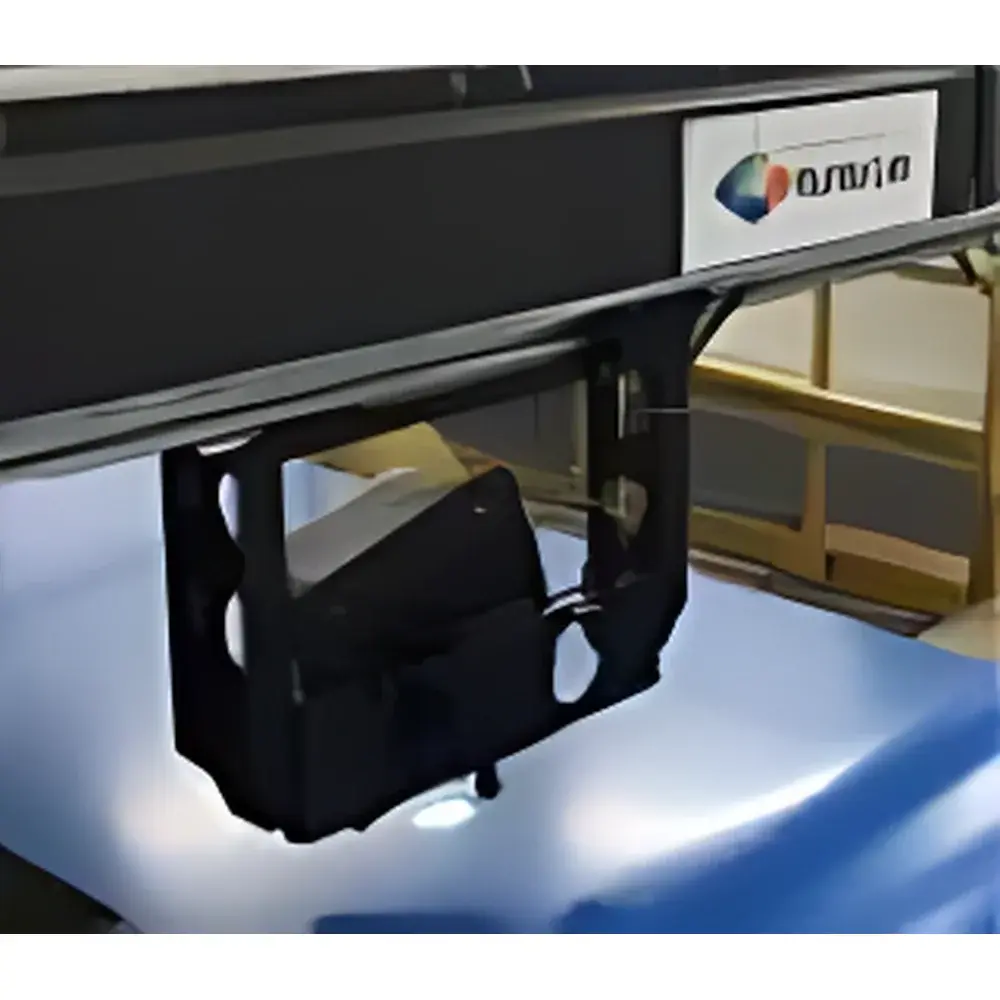
HunterLab SpectraTrend HT In-Line Spectrophotometer
| Brand | HunterLab |
|---|---|
| Origin | USA |
| Manufacturer Type | Authorized Distributor |
| Product Category | Imported Instrument |
| Model | SpectraTrend HT |
| Product Type | Spectrophotometric Color Measurement System |
| Instrument Type | In-Line |
| Optical Geometry | 0/45° Integrating Sphere |
| Light Source | Full-Spectrum Balanced Solid-State LED Array |
| Spectral Range | 400–700 nm |
| Repeatability | ΔE*ab ≤ 0.03 (under controlled conditions) |
Overview
The HunterLab SpectraTrend HT is an industrial-grade in-line spectrophotometer engineered for continuous, non-contact color and height measurement of textiles during high-speed manufacturing processes. Operating on the principle of diffuse reflectance spectroscopy under standardized 0/45° geometry, it captures full-spectrum data across the visible range (400–700 nm) to compute CIE-compliant colorimetric values—including L*a*b*, ΔE*ab, and spectral reflectance curves—with metrological traceability to NIST-calibrated standards. Unlike benchtop colorimeters, the SpectraTrend HT integrates directly into production lines—mounted above conveyor systems or roller frames—to deliver real-time, spatially resolved color uniformity assessment without interrupting throughput. Its solid-state LED illumination ensures spectral stability over time, eliminating lamp aging drift common in xenon-based systems, while the integrating sphere design minimizes directional sensitivity and enhances robustness against surface texture variations typical in woven, knitted, or dyed fabric substrates.
Key Features
- Non-contact, high-speed acquisition at up to 5 measurements per second—enabling full-width scanning across moving textile webs at line speeds exceeding 100 m/min.
- Integrated height-sensing capability via dual-channel optical detection, allowing simultaneous capture of color and topographical profile data for compensation of fabric pile height, nap direction, or tension-induced surface distortion.
- Full-width automatic traverse mechanism with programmable lateral positioning—ensuring consistent coverage across variable web widths without manual repositioning.
- Auto-probe avoidance logic with audible and visual alarm feedback prevents mechanical interference during maintenance or operator intervention.
- NEMA 4 / IP56-rated enclosure—certified for operation in humid, dusty, or chemically exposed textile mill environments including dye houses and finishing lines.
- Configurable auto-calibration intervals (e.g., hourly, per shift, or per batch), reducing reliance on manual recalibration and minimizing human error and occupational exposure risks.
Sample Compatibility & Compliance
The SpectraTrend HT is validated for use across diverse textile formats—including spun yarns, woven fabrics, nonwovens, and printed rolls—regardless of fiber composition (cotton, polyester, nylon, blends) or surface finish (glossy, matte, brushed, embossed). Its 0/45° optical configuration conforms to ASTM D2244, ISO 11664-4, and CIE Publication 15:2004 for instrumental colorimetry. Data integrity meets GLP/GMP-aligned requirements through built-in audit trail logging, user access controls, and timestamped event records—including calibration events, alarm triggers, and out-of-specification (OOS) color deviation flags. While not FDA-certified as a medical device, its firmware architecture supports 21 CFR Part 11 compliance when deployed with validated enterprise software platforms.
Software & Data Management
The instrument operates natively with HunterLab’s Universal Software Suite (v5.0+), providing centralized configuration, real-time dashboard visualization, and SPC-based trend analysis. Raw spectral data and computed color metrics are exported in CSV, XML, or ASTM E2983-compliant formats for integration with MES, LIMS, or ERP systems via OPC UA or RESTful API. Historical measurement archives support retrospective analysis of batch-to-batch consistency, dye lot correlation, and root-cause investigation of chromatic deviations. All calibration references are digitally signed and version-controlled; spectral baseline validation reports include spectral noise floor, signal-to-noise ratio (SNR), and wavelength accuracy verification per ISO 17025 internal quality protocols.
Applications
- Real-time monitoring of dye bath consistency and shade matching during continuous pad-dry-cure processing.
- Automated detection of color banding, streaking, or fading across wide-format printing and digital inkjet textile applications.
- Quantitative validation of colorfastness after washing, light exposure, or crocking tests by comparing pre- and post-treatment spectral signatures.
- Correlation of in-line measurements with lab-based QC results using identical CIE illuminants (D65, A, F2) and observers (CIE 1931 2° or 1964 10°).
- Height-compensated color grading of textured fabrics such as terry cloth, velvet, or bouclé—where conventional colorimeters yield inconsistent readings due to varying surface elevation.
FAQ
How does the SpectraTrend HT handle irregular web movement or speed fluctuations?
It employs dynamic exposure time adjustment and height-synchronized sampling to maintain spectral fidelity across ±15% speed variation—no external encoder input required.
Can it replace laboratory spectrophotometers for final release testing?
It is designed for process control and early anomaly detection—not regulatory release testing—but achieves <0.1 ΔE*ab correlation with HunterLab LabScan XE and UltraScan VIS under matched measurement conditions.
Is spectral data export compliant with ASTM E308 or ISO/CIE color conversion standards?
Yes—raw 10-nm interval reflectance data is provided alongside CIE XYZ, L*a*b*, and CMYK conversions calculated per CIE 15:2004 and ASTM E308-22 Annex A1.
What maintenance is required beyond scheduled calibration?
Annual verification of optical path cleanliness and LED spectral output stability; no consumables or lamp replacements are needed due to solid-state illumination.
Does it support custom tolerance zones for multi-point color evaluation?
Yes—users define polygonal or ellipsoidal acceptance regions in L*a*b* or L*C*h* space, with configurable pass/fail logic per measurement location.




