
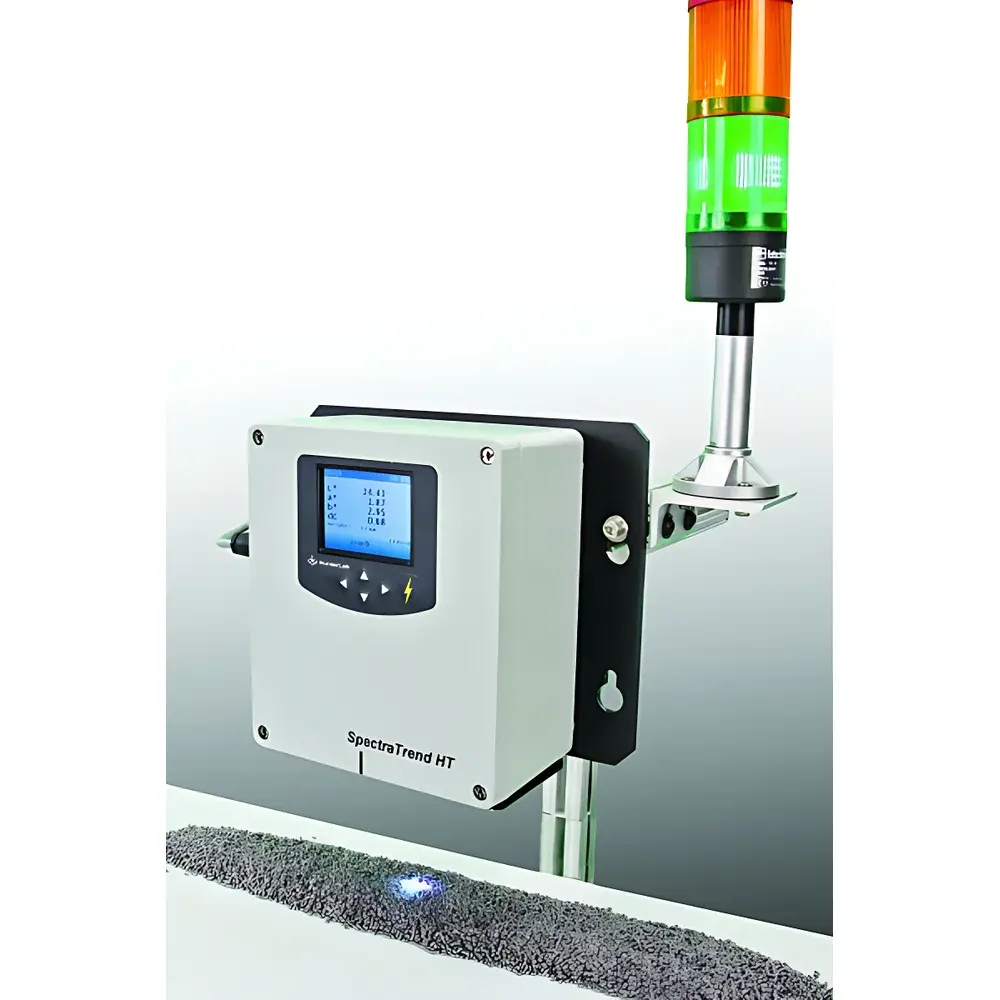
HunterLab SpectraTrend-HT Online Leather Color Measurement System
| Brand | HunterLab |
|---|---|
| Origin | USA |
| Manufacturer Type | Authorized Distributor |
| Origin Category | Imported |
| Model | SpectraTrend-HT |
| Product Type | Online Color Difference Meter |
| Instrument Type | In-line |
| Optical Geometry | 0/45° Integrating Sphere |
| Light Source | Full-spectrum, Balanced Solid-State LED Array |
| Spectral Range | 400 nm – 700 nm |
| Repeatability | ΔE* < 0.30 (CIE L*a*b* scale) |
| Spectral Bandwidth | 10 nm |
| Measurement Distance | Up to 4 in (100 mm) |
| IP Rating | NEMA 4 / IP56 |
| Data Interface | Standard Ethernet (No RS-232/COM required) |
| Software | HunterLab EasyMatch QC v5.x or later |
Overview
The HunterLab SpectraTrend-HT Online Leather Color Measurement System is an industrial-grade, non-contact spectrophotometric sensor engineered for real-time, in-line color and surface height monitoring of leather, synthetic hides, and flexible sheet materials during continuous production. Operating on the CIE 1931 standard observer model and calibrated to CIE L*a*b*, CIE L*C*h, and ΔE* metrics, the SpectraTrend-HT employs a precision 0/45° optical geometry with an integrating sphere to eliminate directional reflectance artifacts common in textured, anisotropic surfaces such as grain-finished leathers. Its solid-state LED illumination delivers photometrically stable, full-visible-spectrum excitation (400–700 nm) with 10 nm spectral bandwidth—ensuring high-fidelity spectral acquisition compliant with ASTM D2244, ISO 11664-4, and ISO 105-J03 for textile and leather color evaluation. Designed for integration into tanning lines, finishing conveyors, and automated cutting stations, the system supports Process Analytical Technology (PAT) frameworks and aligns with FDA Guidance for Industry on PAT and ICH Q8(R2), enabling objective, quantitative process control without manual sampling.
Key Features
- Simultaneous dual-parameter measurement: Real-time color (CIE L*a*b*, ΔE*, Yellowness Index, Whiteness Index) and surface height (±0.1 mm resolution) in a single acquisition cycle.
- High-speed acquisition: Up to 5 measurements per second, synchronized to line speed via encoder input or programmable trigger logic.
- Height-compensated color correction: Automatic optical path length adjustment compensates for vertical displacement (up to ±25 mm), mitigating measurement drift caused by belt vibration, material curl, or uneven thickness.
- Ruggedized industrial enclosure: NEMA 4 / IP56-rated housing with stainless-steel mounting flange and thermal management for operation in humid, dusty, or temperature-variable tannery environments (10–40 °C).
- Factory-calibrated traceability: Each unit ships with NIST-traceable calibration certificate and onboard reference tile verification routine per ASTM E308 and ISO 13655.
- No moving parts or consumables: Solid-state LED source rated for >50,000 hours; no lamp replacement, filter wheels, or mechanical shutters required.
Sample Compatibility & Compliance
The SpectraTrend-HT is validated for use on wet-blue, crust, finished, and embossed leathers—including bovine, ovine, and synthetic alternatives—as well as coated textiles and PVC-based substrates. Its 0/45° geometry minimizes specular interference from glossy finishes while preserving sensitivity to subtle chromatic shifts induced by dye lot variation, pH drift in dye baths, or uneven fatliquor distribution. The system meets regulatory requirements for quality-critical manufacturing: data audit trails comply with FDA 21 CFR Part 11 (when used with validated EasyMatch QC configuration), and measurement protocols support ISO 9001:2015, ISO/IEC 17025:2017, and GMP Annex 11 documentation standards. Height measurement functionality satisfies ISO 25178-2 surface topography reporting needs for dimensional consistency validation.
Software & Data Management
Integrated with HunterLab EasyMatch QC software (v5.10+), the SpectraTrend-HT supports centralized network deployment via standard TCP/IP Ethernet—eliminating legacy serial dependencies and enabling multi-sensor aggregation on a single server. The software provides real-time SPC dashboards with X-bar/R charts, trend analysis (CUSUM/EWMA), and automated pass/fail classification against user-defined tolerances (e.g., ΔE* ≤ 1.0 for Grade A leather). Raw spectral data (31-point reflectance at 10 nm intervals) and processed metrics are exportable in CSV, XML, or SQL formats. Custom report templates accommodate enterprise MES/SCADA integration, and optional OPC UA server module enables direct PLC communication (Siemens S7, Allen-Bradley ControlLogix, Rockwell CompactLogix).
Applications
- Real-time color deviation detection during drum dyeing, spray finishing, and roller coating processes.
- Automated batch release verification prior to cutting or grading—reducing manual QC labor by >70%.
- Root cause analysis of chromatic drift linked to chemical feed rate, temperature excursions, or exhaustion kinetics.
- Correlation of surface height variance with tensile strength, grain uniformity, or moisture content in finished hides.
- Supporting Six Sigma DMAIC initiatives through statistically robust color process capability indices (Cp/Cpk) and multivariate correlation modeling.
FAQ
What calibration standards are supported?
NIST-traceable ceramic tiles (LAV, DAV) and customer-specific master samples; field recalibration requires only one-touch verification via EasyMatch QC.
Can the SpectraTrend-HT operate in high-humidity tannery environments?
Yes—its IP56-rated enclosure and condensation-resistant optics are validated for continuous operation at up to 95% RH non-condensing.
Is height measurement traceable to metrological standards?
Surface height output is referenced to internal laser triangulation baseline and certified per ISO 10360-8; uncertainty budget available upon request.
How is data security maintained in networked deployments?
EasyMatch QC supports role-based access control (RBAC), TLS 1.2 encrypted data transmission, and configurable local database encryption (AES-256).
Does the system support custom spectral weighting functions?
Yes—users may define application-specific color difference equations (e.g., CMC(l:c), DIN99d) or import proprietary reflectance weighting curves via XML schema.





