
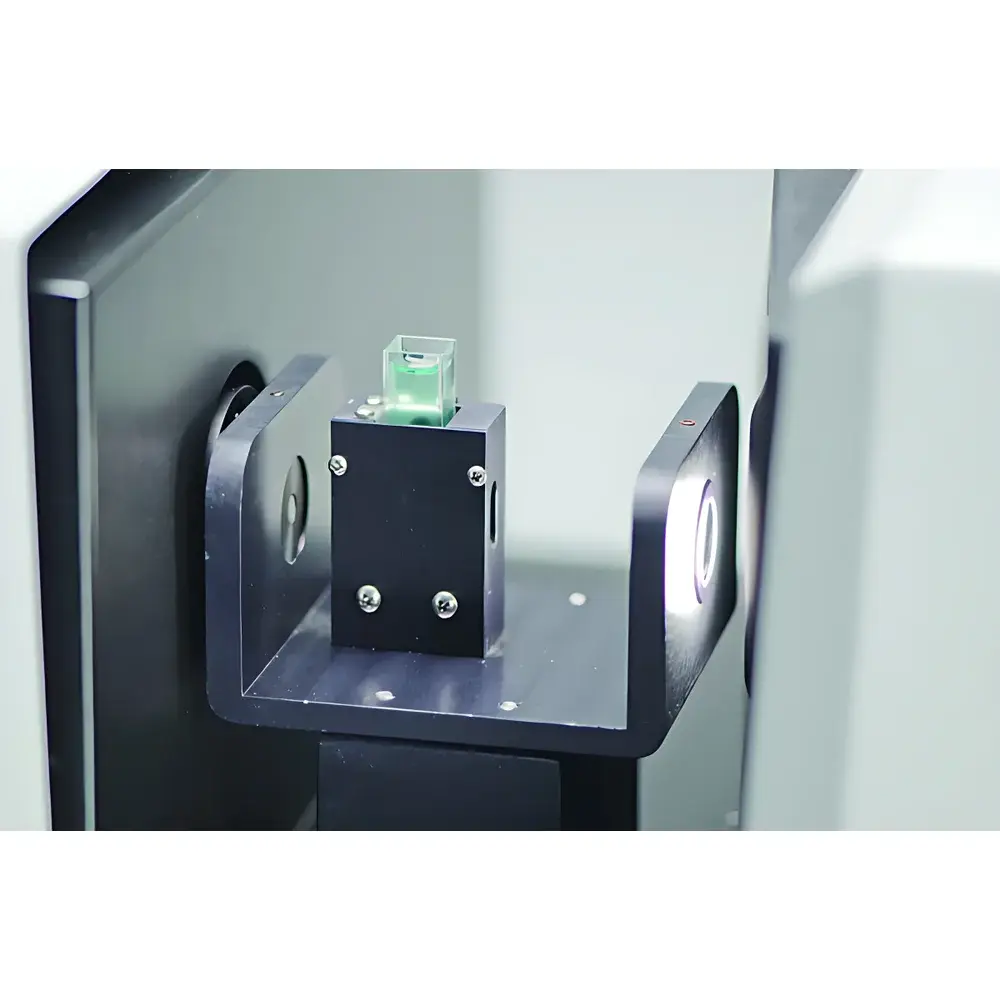
HunterLab UltraScan PRO Automotive Interior & Exterior Color Measurement Spectrophotometer
| Brand | HunterLab |
|---|---|
| Origin | USA |
| Manufacturer Type | Authorized Distributor |
| Product Origin | Imported |
| Model | UltraScan PRO Automotive Interior & Exterior Color Difference Meter |
| Product Category | Color Difference Meter |
| Instrument Type | Benchtop |
| Optical Geometry | d/8° Integrating Sphere |
| Light Source | Pulsed Xenon Lamp |
| Spectral Range | 350–1050 nm |
| Spectral Interval (Acquisition) | 2 nm |
| Reporting Interval | 5 nm |
| Optical Bandwidth | 5 nm |
| Repeatability | ≤ 0.03 ΔE*ab (Mean, CIE Lab, White Tile) |
| Detector | 512-Element Silicon Photodiode Array |
| UV Calibration | D65 with Fluorescence Correction |
| Reflectance Measurement Areas | LAV (25 mm), SAV (13 mm), XSAV (7 mm) |
| Minimum Liquid Volume | 0.4 mL |
| UV Transmission Capability | Down to 350 nm |
| Compliance | CIE No. 15, ASTM E308, ASTM D2244, ASTM E2539, USP <1061>, ISO 7724, ISO 11664, GLP/GMP-Ready Data Integrity Features |
Overview
The HunterLab UltraScan PRO Automotive Interior & Exterior Color Measurement Spectrophotometer is a high-precision, benchtop dual-beam spectrophotometer engineered for rigorous color quality control and R&D applications in automotive OEMs, Tier-1 suppliers, and materials development laboratories. It operates on the fundamental principle of diffuse/8° (d/8°) sphere geometry with pulsed xenon illumination—enabling accurate, repeatable measurement of reflectance, transmittance, haze, and spectral power distribution across the full 350–1050 nm range. Its optical architecture incorporates a high-stability integrating sphere coated with proprietary Spectralon®-grade material, optimized for uniform light diffusion and minimal inter-reflection error. The instrument employs a precision 5 nm effective bandwidth diffraction grating and a 512-element silicon photodiode array detector, delivering high signal-to-noise ratio spectral data at 2 nm acquisition resolution (reported at 5 nm intervals). Unlike continuous-source instruments, its pulsed xenon lamp generates no thermal load on samples, eliminates warm-up drift, and minimizes ambient light interference—critical for production-floor deployment and long-term calibration stability.
Key Features
- Dual-beam optical design with real-time reference compensation for enhanced photometric stability and long-term repeatability (≤ 0.03 ΔE*ab mean on certified white tile)
- Three selectable reflectance apertures—LAV (25 mm), SAV (13 mm), and XSAV (7 mm)—to accommodate diverse part geometries including curved dashboards, textured door panels, and small trim components
- Automated specular component included/excluded (SCI/SCE) modes with mechanical trap control, enabling independent assessment of surface gloss and texture effects on perceived color
- UV-enabled transmittance measurement down to 350 nm, supporting evaluation of UV-blocking films, tinted polycarbonate glazing, and fluorescent whitening agents (FWAs) in interior fabrics
- Modular sample compartment with configurable fixtures—including liquid cuvette holders, transmission cells, and custom jigs—for solids, liquids, gels, and semi-transparent substrates (minimum 0.4 mL liquid volume)
- Integrated status indicators and ergonomic front-panel trigger button for hands-free, operator-guided measurement under controlled lighting conditions
Sample Compatibility & Compliance
The UltraScan PRO accommodates a broad spectrum of automotive-relevant materials: injection-molded thermoplastics (PP, ABS, PC), painted metal substrates, leather and synthetic upholstery, laminated safety glass, anti-glare coatings, and solvent-based clearcoats. Its large transmission port permits measurement of oversized components such as A-pillars or headlamp lenses without disassembly. All optical surfaces are constructed from corrosion-resistant stainless steel; the optical platform is rigidly isolated from mechanical vibration. The system complies fully with CIE Publication No. 15:2018, ASTM E308-23 (computation of tristimulus values), ASTM D2244-22 (color difference calculation), ASTM E2539-21 (instrument performance verification), USP (color measurement in pharmaceutical packaging analogs), and ISO 11664-4:2019 (CIE colorimetric observers). Data output supports audit-ready traceability per FDA 21 CFR Part 11 requirements when paired with validated EasyMatch QC software.
Software & Data Management
The UltraScan PRO integrates natively with HunterLab’s EasyMatch QC v5.x—a GxP-compliant color analysis platform supporting multi-user role-based access, electronic signatures, audit trail logging, and customizable pass/fail tolerancing against master standards (e.g., OEM-specific ΔE*cmc or ΔE00 limits). Spectral data export formats include CSV, XML, and CxF/XRGA for interoperability with PLM systems (e.g., Siemens Teamcenter, PTC Windchill) and statistical process control (SPC) tools. Built-in instrument diagnostics monitor lamp energy decay, sphere coating integrity, and wavelength calibration drift—generating automated recalibration alerts aligned with ISO/IEC 17025 internal verification protocols. Raw spectral files retain full 2 nm acquisition metadata, enabling retrospective reprocessing with updated colorimetric observers or illuminants.
Applications
- Color matching validation of interior trims (dashboard, center console, seat fabrics) against OEM digital standards
- Batch-to-batch consistency monitoring of exterior paint systems under D65, A, and F2 illuminants
- Quantification of yellowing index (YI) and whiteness index (WI) in UV-stabilized polypropylene air vents
- Haze and clarity assessment of polycarbonate headlamp lenses per ASTM D1003
- Fluorescence correction for UV-reactive pigments used in safety-critical signage and warning labels
- Long-term weathering study correlation—tracking ΔE shift in accelerated QUV testing per SAE J2527
FAQ
Does the UltraScan PRO support measurement of curved or textured automotive surfaces?
Yes—the instrument offers three aperture sizes (7 mm, 13 mm, 25 mm) and optional contact probes to maintain consistent geometry on non-planar parts. SCI mode compensates for directional scattering caused by texture.
Can it measure color on transparent substrates like automotive window films?
Yes—it provides dedicated transmission mode with UV-enhanced optics, capable of measuring spectral transmittance from 350 nm onward, including NIR cutoff characteristics of solar-control films.
Is the system compliant with automotive OEM color specification protocols (e.g., Ford WSS-M99P1111-A, GMW14872)?
Yes—EasyMatch QC includes preconfigured templates for major OEM standards, with configurable tolerances, reporting formats, and spectral weighting functions required for PPAP submissions.
How often does the instrument require calibration verification?
HunterLab recommends daily zero calibration and weekly verification using NIST-traceable ceramic tiles; full recalibration is advised annually or after 10,000 measurements, per ISO 9001:2015 clause 7.1.5.2.
Does it support networked deployment in centralized QC labs?
Yes—Ethernet and USB connectivity enable integration into LAN-based instrument management systems; remote firmware updates and spectral database synchronization are supported via HunterLab Cloud Connect.





