
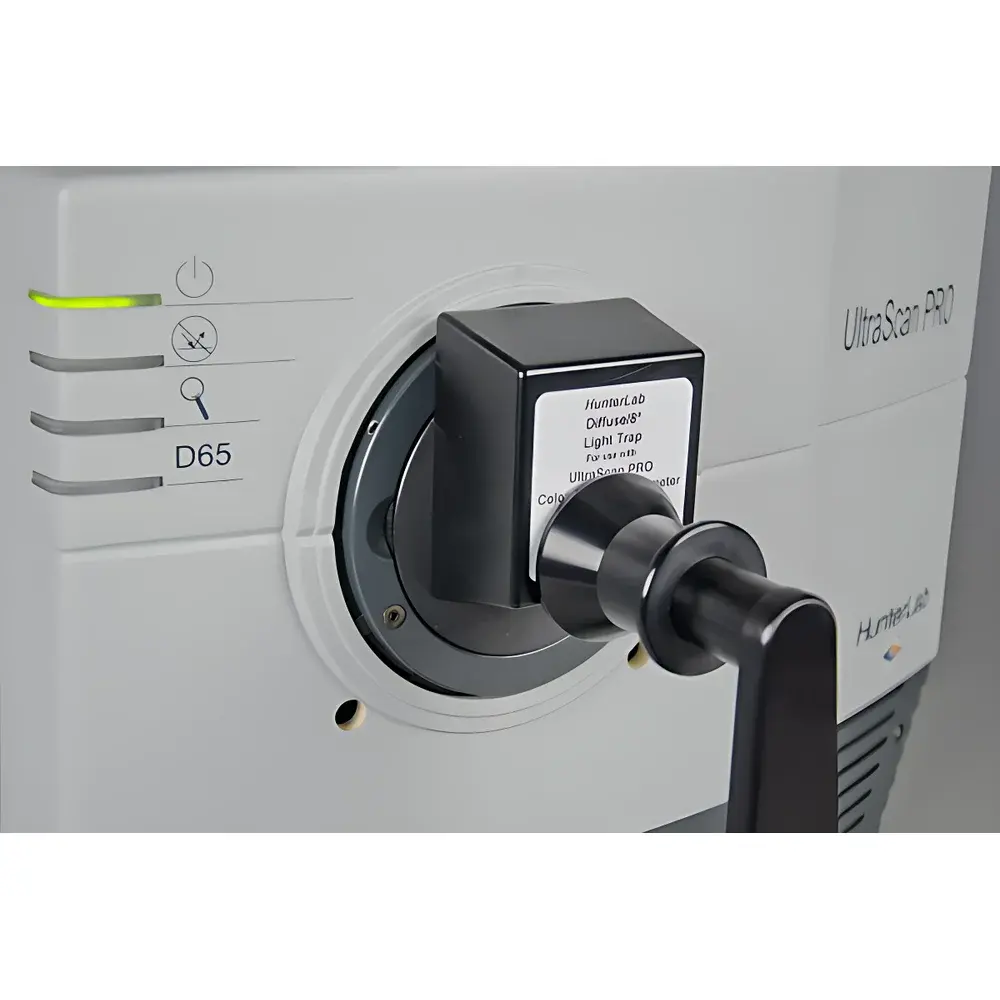
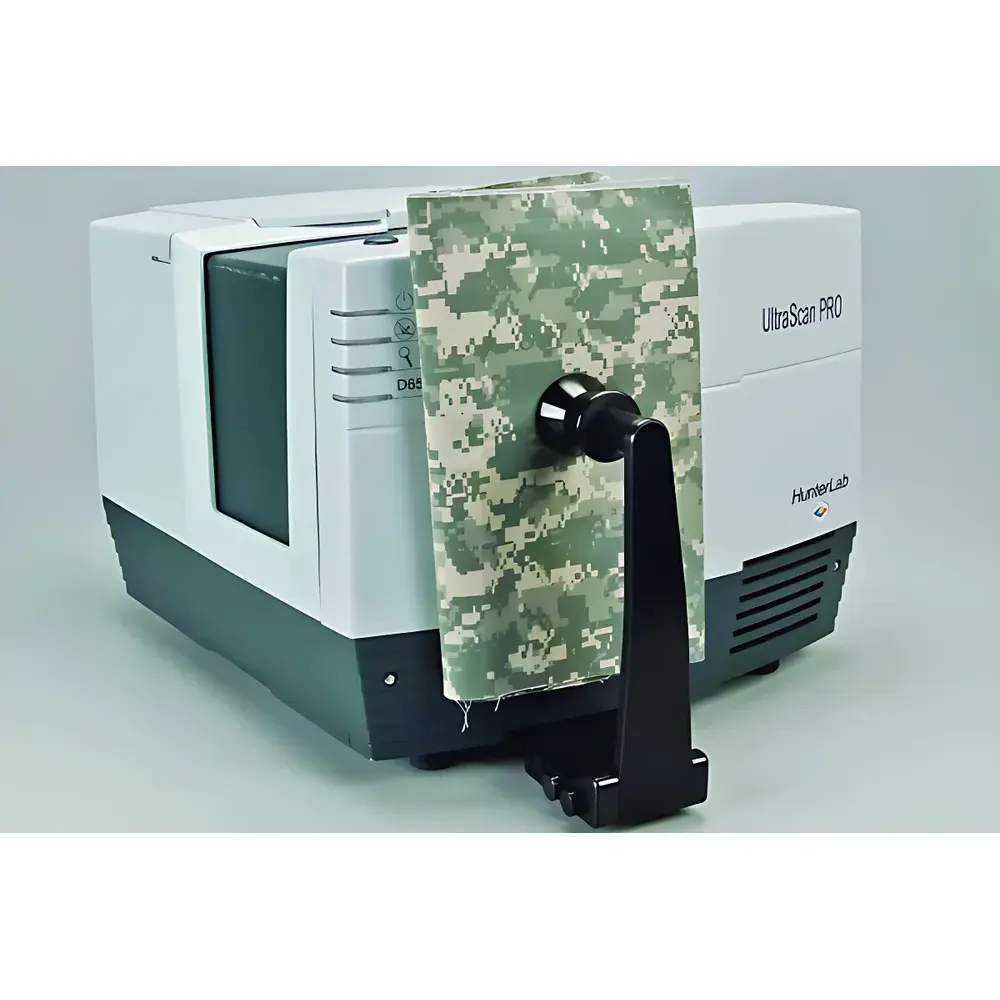
HunterLab UltraScan PRO Spectrophotometer
| Brand | HunterLab |
|---|---|
| Origin | USA |
| Model | UltraScan PRO |
| Instrument Type | Benchtop |
| Optical Geometry | d/8° integrating sphere |
| Light Source | Pulsed xenon lamp |
| Spectral Range | 350 nm – 1050 nm |
| Spectral Interval (Acquisition) | 2 nm |
| Reporting Interval | 5 nm |
| Optical Bandwidth | 5 nm |
| Repeatability | < 0.03 ΔE* |
| Detector | 512-element diode array with extended IR sensitivity |
| Mirror Finish Options | Specular Component Included/Excluded (SCI/SCE) |
| Aperture Sizes | LAV (25 mm), SAV (13 mm), XSAV (7 mm) |
| Minimum Liquid Volume | 0.4 mL |
| Compliance | CIE No. 15, ASTM E308, ASTM D2244, ASTM E2539, USP <631>, ISO 7724, ISO 11664, FDA 21 CFR Part 11 (via EasyMatch QC software) |
Overview
The HunterLab UltraScan PRO is a high-precision benchtop spectrophotometer engineered for rigorous color measurement, spectral reflectance and transmittance analysis, and haze quantification across solid, liquid, translucent, and transparent samples. Utilizing a dual-beam optical architecture with a high-stability pulsed xenon light source and a precision 5 nm effective bandwidth diffraction grating, the instrument delivers exceptional photometric accuracy and long-term stability. Its d/8° integrating sphere geometry ensures compliance with CIE, ASTM, and ISO standards for diffuse illumination and viewing—critical for measuring textured, glossy, or turbid materials. Unlike continuous-source instruments, the xenon flash system emits no heat during operation, eliminates warm-up time, minimizes ambient light interference, and enables rapid full-spectrum acquisition (350–1050 nm) in under two seconds at 2 nm data intervals (reported at 5 nm). The optical platform is constructed from rigid stainless steel and features a vibration-damped base, precision-machined baffles, and spectrally optimized internal coatings to suppress stray light and ensure consistent inter-instrument agreement.
Key Features
- Triple-pulsed xenon lamp system delivering high color rendering index (CRI > 95) and stable spectral output across UV-VIS-NIR without thermal drift
- Dual-mode specular handling: automated SCI (Specular Component Included) and SCE (Specular Component Excluded) measurements for independent assessment of surface gloss and texture effects
- Three interchangeable apertures: Large Area View (LAV, 25 mm), Small Area View (SAV, 13 mm), and Extra Small Area View (XSAV, 7 mm) — enabling spatially resolved color evaluation on heterogeneous or patterned surfaces
- UV-enabled transmission path with dedicated sample compartment accommodating oversized specimens, including coated glass, ophthalmic lenses, solar filters, and UV-blocking films
- Low-volume liquid measurement capability (as little as 0.4 mL) using standardized cuvette holders with path-length calibration
- Integrated status indicators and ergonomic front-panel trigger button for hands-free, repeatable operator interaction
- Robust mechanical design featuring a massive aluminum optical bench, sealed detector housing, and temperature-compensated electronics for laboratory and production-floor reliability
Sample Compatibility & Compliance
The UltraScan PRO supports a broad range of physical sample forms—including powders, pellets, granules, films, molded plastics, textiles, coatings, gels, emulsions, and clear or hazy liquids—without requiring reconfiguration of core optics. Its large transmission port accommodates thick or irregularly shaped objects (e.g., bottle preforms, architectural glazing, composite panels), while its reflectance port accepts curved, rough, or flexible substrates via optional fixtures. All measurements adhere to internationally recognized metrological frameworks: spectral data conforms to CIE Publication 15:2018; color difference calculations follow ASTM E2539 and ISO 11664-6; haze and clarity metrics comply with ASTM D1003 and ISO 14782; and pharmaceutical applications meet USP requirements for solution color and absorbance uniformity. When operated with validated EasyMatch QC software, the system supports audit trails, electronic signatures, and 21 CFR Part 11 compliance for regulated environments.
Software & Data Management
The UltraScan PRO operates exclusively with HunterLab’s EasyMatch QC software—a GxP-ready platform designed for quality control laboratories. It provides real-time spectral visualization, multi-parameter reporting (L*a*b*, L*C*h*, Yellowness Index ASTM E313/E313, Whiteness Index CIE/ASTM, Delta E metrics), custom tolerance setting, statistical process control (SPC) charting, and automated pass/fail decision logic. Raw spectral data is stored in vendor-neutral formats (CSV, XML) and supports integration with LIMS and MES systems via OPC UA or RESTful API. Software validation documentation, IQ/OQ/PQ protocols, and change control logs are available upon request. All user actions—including method edits, calibration events, and result approvals—are timestamped and attributable, satisfying GLP and GMP traceability requirements.
Applications
This instrument serves critical roles in R&D and QC workflows across diverse sectors: polymer formulation (color consistency of resins, masterbatches, and injection-molded parts); pharmaceutical manufacturing (excipient color verification, tablet coating uniformity, liquid dosage appearance); food and beverage (browning index in juices, pigment stability in dairy, opacity control in sauces); automotive (paint batch matching, interior trim color fidelity, headlight lens clarity); and consumer goods (fabric dye lot approval, cosmetic lipstick shade repeatability, packaging film yellowness monitoring). Its ability to quantify both fluorescence (under D65 UV-enhanced illumination) and non-fluorescent components makes it indispensable for evaluating optical brighteners in detergents, paper, and textiles.
FAQ
Does the UltraScan PRO support measurement of fluorescent samples?
Yes—the instrument uses a D65-simulated pulsed xenon source with calibrated UV output, enabling accurate quantification of fluorescent whitening agents and other UV-excitable materials per ASTM E308 and USP .
Can it measure haze and clarity in addition to color?
Yes—it complies with ASTM D1003 and ISO 14782 for total transmittance, diffuse transmittance, and haze calculation using the same optical path and detector array.
Is instrument-to-instrument agreement guaranteed?
HunterLab certifies inter-instrument agreement to ΔE* < 0.08 for BCRA Series II tiles and maintains traceability to NIST SRM 2020 and 2035 through factory calibration and optional annual verification services.
What regulatory standards does the system support out-of-the-box?
CIE No. 15, ISO 7724, ISO 11664, ASTM E308, ASTM D2244, ASTM E2539, USP , and FDA 21 CFR Part 11 (when configured with EasyMatch QC v5.5+ and enabled security settings).
How is thermal drift managed during extended operation?
The pulsed xenon source generates negligible heat; combined with thermally stabilized optics and real-time dark-current compensation, the system maintains spectral baseline stability over multi-hour measurement sessions without recalibration.





