
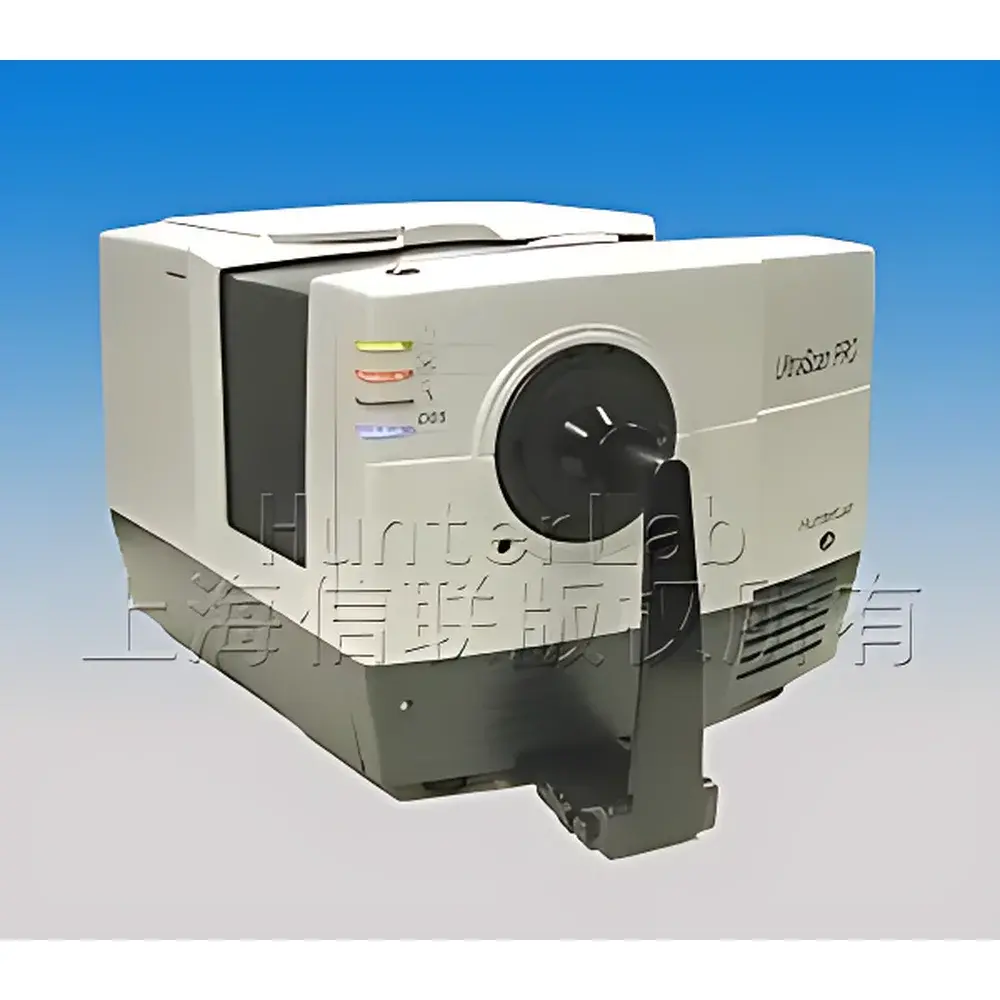
HunterLab UltraScan PRO Spectrophotometer
| Brand | HunterLab |
|---|---|
| Origin | USA |
| Model | UltraScan PRO |
| Product Type | Benchtop Spectrophotometric Color Measurement Instrument |
| Optical Geometry | d/8° Integrating Sphere (with Specular Component Included or Excluded) |
| Light Source | Pulsed Xenon Lamp |
| Spectral Range | 350 nm – 1050 nm |
| Wavelength Accuracy | ±5 nm |
| Repeatability (ΔE*ab, White Tile) | ≤0.03 |
| Aperture Sizes | 19 mm, 9 mm, 4 mm |
| Transmission Path Length | 80 mm |
| UV Calibration & Control | Automatic Real-Time UV Intensity Adjustment for Fluorescent Sample Measurement |
| Compliance | ASTM E308, ISO/CIE 11664 (CIE S 014), ISO 7724, USP <1061>, FDA 21 CFR Part 11 Ready (with optional software configuration) |
Overview
The HunterLab UltraScan PRO is a high-precision benchtop spectrophotometer engineered for absolute color measurement accuracy across the ultraviolet, visible, and near-infrared (UV-VIS-NIR) spectral domains — from 350 nm to 1050 nm. Unlike conventional colorimeters limited to visible light, the UltraScan PRO employs a dual-beam pulsed xenon lamp and real-time UV intensity control to deliver traceable, photometrically stable illumination under standardized illuminants such as CIE D65 — including full spectral compensation for UV-induced fluorescence. This capability is critical for measuring optically brightened textiles, fluorescent pigments, security inks, and NIR-responsive materials (e.g., camouflage fabrics and thermochromic coatings), where conventional instruments fail to resolve excitation-emission interactions. Its d/8° integrating sphere geometry complies with ISO 7724-1 and ASTM E1164, enabling both specular component included (SCI) and excluded (SCE) measurements via motorized baffle — essential for distinguishing surface appearance from inherent material color.
Key Features
- Extended spectral coverage (350–1050 nm) with 5 nm nominal bandwidth and ±5 nm wavelength accuracy — validated per CIE S 014/E308 spectral bandpass requirements
- Real-time UV calibration and dynamic UV output control ensures consistent excitation energy for fluorescent samples under D65, F2, and other CIE illuminants
- Three user-selectable measurement apertures (19 mm, 9 mm, 4 mm) with integrated sample-viewing lamp and rear-view mirror for precise positioning and optical sealing
- 80 mm transmission path length and tri-directional transparent sample compartment accommodate thick, irregular, or multi-layered transmissive specimens
- Pulsed xenon light source rated for >1 million flashes — eliminating thermal drift and lamp aging effects common in tungsten-halogen systems
- Motorized specular component control enables seamless switching between SCI (total reflectance) and SCE (surface color) modes without manual intervention
- Robust industrial-grade housing with ESD-safe enclosure and IP20-rated electronics for laboratory and production floor deployment
Sample Compatibility & Compliance
The UltraScan PRO measures reflectance and transmittance of solids, liquids, powders, pastes, and gels — irrespective of opacity, texture, or geometric form. Its large-diameter integrating sphere (≥150 mm) minimizes edge effects on textured or low-gloss surfaces. The instrument conforms to international standards governing colorimetric instrumentation: ISO/CIE 11664 (colorimetry fundamentals), ISO 7724-1 (instrument geometry), ASTM D2244 (color difference calculation), and ASTM E308 (spectral data conversion). For regulated environments, it supports 21 CFR Part 11-compliant audit trails and electronic signatures when paired with HunterLab’s QualColor QC software (v6.0+), meeting GLP and GMP documentation requirements.
Software & Data Management
The UltraScan PRO operates natively with HunterLab’s EasyMatch QC and QualColor QC software suites — both compliant with ISO/IEC 17025 data integrity protocols. These platforms provide automated pass/fail tolerancing against AATCC, ISO, or custom color standards; batch reporting with statistical process control (SPC) charts; and export to L*a*b*, L*C*h*, XYZ, and spectral reflectance tables. Raw spectral data (350–1050 nm at 10 nm intervals) is stored in ASTM E2512-compliant .qtx format. Optional network integration enables centralized instrument management across multi-site facilities via secure HTTPS API endpoints.
Applications
- Textile & Apparel: Quantification of optical brightener effects in cotton, polyester, and blends under D65 + UV; NIR spectral analysis of military camouflage efficacy
- Paints & Coatings: Fluorescent pigment validation, metamerism assessment, and weathering-induced spectral shift tracking beyond 700 nm
- Plastics & Packaging: Color consistency of UV-stabilized films, NIR-absorbing additives, and recycled polymer batches
- Pharmaceuticals: USP compliance for capsule shell color uniformity; excipient fluorescence interference correction
- Academic Research: Fundamental studies of photoluminescence quantum yield, upconversion materials, and multispectral reflectance modeling
FAQ
Does the UltraScan PRO support CIE illuminant A or F-series sources?
Yes — all CIE standard illuminants (A, C, D50, D65, F2, F7, F11) are calculated mathematically from its full 350–1050 nm spectral data; physical UV adjustment is only applied during D65 and F-series measurements requiring UV excitation.
Can it measure translucent or backlit materials?
Yes — the 80 mm transmission path and dual-beam design enable accurate transmittance measurement of frosted glass, diffuser films, and LED encapsulants with minimal stray light error.
Is spectral data export compatible with third-party analysis tools like MATLAB or Python?
Yes — ASCII-delimited spectral files (.csv) and ASTM E2512-compliant .qtx files are fully supported; spectral interpolation and CIE tristimulus calculations can be replicated using NIST-traceable algorithms.
How is UV stability verified during long-term operation?
Each measurement cycle includes an internal reference tile scan; UV output is adjusted in real time to maintain constant irradiance at 365 nm, logged in every measurement record for full traceability.
What maintenance is required for the integrating sphere coating?
The barium sulfate-coated sphere is sealed and non-user-serviceable; HunterLab recommends annual performance verification using NIST-traceable standards (SRM 2020, SRM 2035) — documented in IQ/OQ/PQ protocols.





