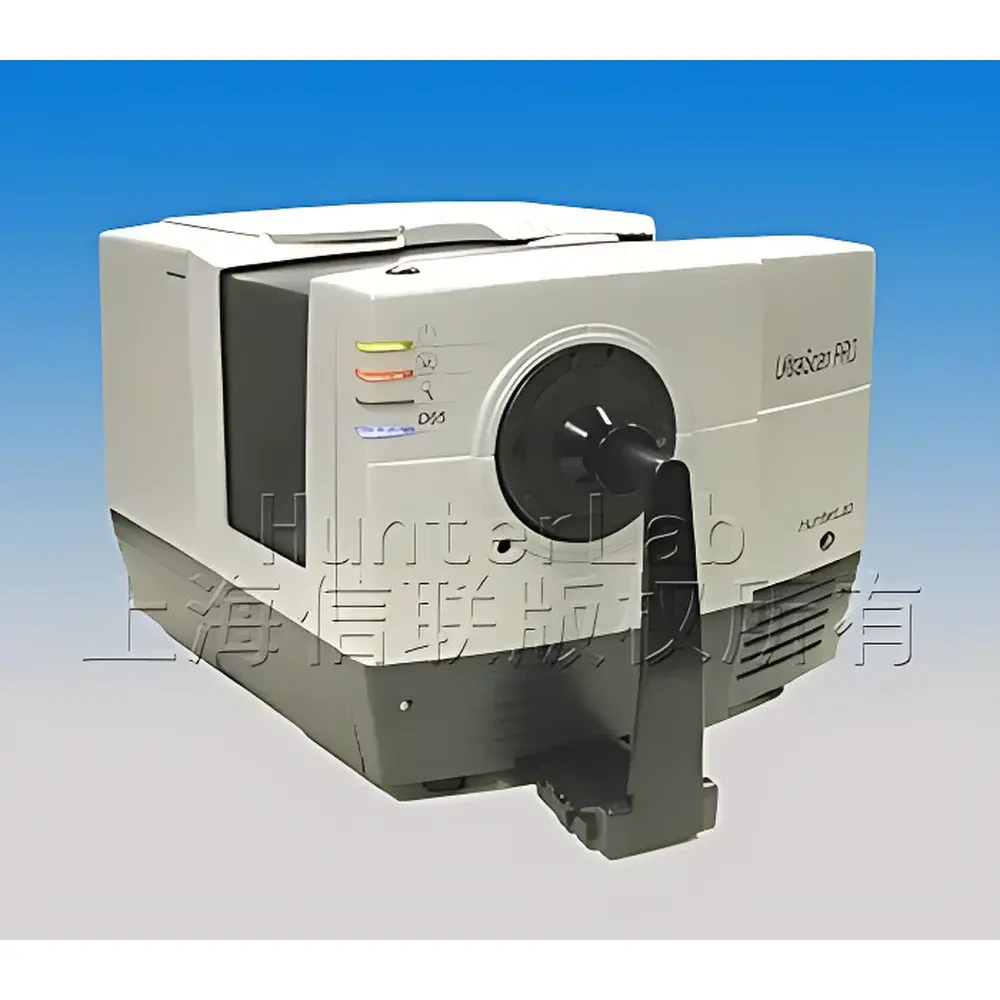
HunterLab UltraScan Pro Spectrophotometric Colorimeter
| Brand | HunterLab |
|---|---|
| Origin | USA |
| Model | UltraScan Pro |
| Product Type | Spectrophotometric Colorimeter |
| Instrument Type | Benchtop |
| Optical Geometry | d/8° Integrating Sphere |
| Light Source | Pulsed Xenon Lamp |
| Spectral Range | 350–1050 nm |
| Wavelength Interval | 5 nm |
| Spectral Bandwidth (FWHM) | 5 nm |
| Wavelength Accuracy | ±0.1 nm |
| Wavelength Repeatability | <2 nm (1.37 nm typical) |
| Reflectance/Transmittance Range | 0–200% |
| Photometric Resolution | 0.003% (displayed to 0.01%) |
| Colorimetric Repeatability | ΔE*ab ≤ 0.03 |
| Measurement Time | ≤ 2 s |
| Aperture Options | 19 mm (LAV), 9 mm (MAV), 4 mm (SAV) |
| Transmission Chamber | Up to 80 mm path length |
| Interface | USB / RS-232C |
| Compliance | ASTM E308, ISO/CIE 11664, CIE No. 15, USP <1061>, FDA 21 CFR Part 11 (with EasyMatch-QC audit trail enabled) |
Overview
The HunterLab UltraScan Pro is a high-precision benchtop spectrophotometric colorimeter engineered for rigorous color measurement and spectral analysis of transparent, translucent, and opaque solid materials—including optical lenses, architectural and automotive glass, coated substrates, and polymer-based optical components. Operating on the CIE-compliant d/8° integrating sphere geometry with dual-beam compensation, the instrument delivers exceptional inter-instrument agreement and long-term stability across global manufacturing and quality control environments. Its 350–1050 nm spectral range—spanning ultraviolet through near-infrared—enables full-spectrum characterization critical for evaluating anti-reflective coatings, tinted lens filters, UV-blocking performance, and spectral transmittance curves required by ISO 8980-3, ANSI Z80.3, and EN 1836 standards. The pulsed xenon lamp provides flash-based illumination that eliminates thermal drift and ensures consistent spectral output without warm-up delay, while the 512-element silicon photodiode array coupled with a precision holographic diffraction grating achieves a nominal 5 nm full-width half-maximum (FWHM) bandwidth and wavelength accuracy of ±0.1 nm.
Key Features
- Dual-beam d/8° optical design with automatic specular component included/excluded (SCI/SCE) switching for comprehensive surface and body color assessment.
- 15.2 cm (6″) integrating sphere coated with Spectraflect®—a highly diffuse, spectrally neutral barium sulfate-based material ensuring uniform light distribution and minimal spectral deviation.
- Full-spectrum measurement from 350 nm to 1050 nm at 5 nm data intervals; supports calculation of CIE XYZ, L*a*b*, L*C*h°, ΔE*ab, ΔE00, Yellowness Index (YI), Whiteness Index (WI), and custom spectral metrics.
- Three interchangeable apertures (19 mm LAV, 9 mm MAV, 4 mm SAV) accommodate diverse sample geometries—from large flat lens blanks to small ophthalmic lens segments—while maintaining calibrated field-of-view consistency.
- Large transmission compartment with three-sided access accommodates cuvettes up to 80 mm in path length, enabling precise quantification of spectral transmittance for multi-layer coated optics and IR-absorbing substrates.
- On-instrument start button and intuitive status LED indicators streamline operator workflow in regulated production settings where SOP adherence is mandatory.
- Compliant power supply (100–240 VAC, 47–63 Hz) and environmental operating range (10–40 °C, 10–90% RH non-condensing) ensure deployment flexibility across QC labs, R&D facilities, and cleanroom-adjacent staging areas.
Sample Compatibility & Compliance
The UltraScan Pro is validated for measurement of rigid, planar, and semi-rigid optical substrates including float glass, borosilicate lens blanks, polycarbonate and CR-39 ophthalmic lenses, AR-coated mirrors, and laminated safety glazing. Its optical design meets ASTM E308 requirements for tristimulus computation and aligns with ISO/CIE 11664-4 for spectral reflectance/transmittance reporting. When paired with EasyMatch-QC software, the system supports 21 CFR Part 11-compliant electronic records, including user authentication, audit trails, and immutable data archiving—essential for GLP/GMP-regulated optical product certification. It is routinely deployed by Tier-1 automotive glazing suppliers (e.g., Fuyao, NSG), ophthalmic lens manufacturers (e.g., Zeiss, Hoya), and third-party testing laboratories accredited to ISO/IEC 17025.
Software & Data Management
The UltraScan Pro operates natively with HunterLab’s EasyMatch-QC software—a scalable, database-driven platform supporting method-driven workflows, statistical process control (SPC), and automated pass/fail reporting against AQL-based tolerances. Optional EasyMatch-Coatings extends functionality for film-thickness-correlated color prediction and batch-to-batch coating consistency validation. All spectral data are stored in vendor-neutral .qtx or ASCII .csv formats, enabling integration with LIMS, MES, and enterprise analytics platforms. Software modules support calibration verification via NIST-traceable standards, instrument-to-instrument matching reports, and spectral difference overlays for comparative coating analysis.
Applications
- Quantitative evaluation of anti-reflective (AR), hydrophobic, and oleophobic coating uniformity on spectacle and camera lenses.
- Spectral transmittance profiling of UV-filtering and blue-light-blocking ophthalmic lenses per ISO 8980-3 Annex B.
- Color consistency monitoring during mass production of tinted automotive glazing and smart glass prototypes.
- Batch release testing of optical-grade glass substrates per ASTM C1036 and EN 572 specifications.
- Development and validation of interference filter stacks used in biomedical imaging optics and laser systems.
- Regulatory submission support for FDA 510(k) and CE marking documentation requiring objective, traceable color and spectral data.
FAQ
Does the UltraScan Pro support both reflectance and transmittance measurements on the same instrument?
Yes—the integrated d/8° sphere and dedicated transmission port enable seamless switching between reflectance mode (using standard white tile or black trap) and transmittance mode (using matched air/blank references), with no hardware reconfiguration required.
Is spectral data export compatible with third-party modeling tools such as MATLAB or Python?
Yes—all raw and processed spectra are exportable in plain-text CSV format with wavelength and intensity columns, facilitating direct ingestion into computational optical modeling environments.
How frequently must the instrument be recalibrated to maintain compliance with ISO 17025?
HunterLab recommends daily verification using supplied calibration tiles and annual full recalibration by an ISO/IEC 17025-accredited service laboratory; calibration certificates include uncertainty budgets traceable to NIST SRM 2035 and 2036.
Can the UltraScan Pro measure curved or non-planar lens surfaces?
It is optimized for flat or gently curved samples with minimal deviation from planarity; for highly aspheric or freeform lenses, contact measurement fixtures or integrating sphere accessories with sample holders designed for curvature compensation are recommended.
What cybersecurity protocols does EasyMatch-QC implement for FDA-regulated environments?
EasyMatch-QC v5.0+ supports role-based access control (RBAC), encrypted local database storage, electronic signatures compliant with 21 CFR Part 11 §11.200, and configurable audit trail retention policies aligned with FDA guidance on computerized systems in manufacturing.