
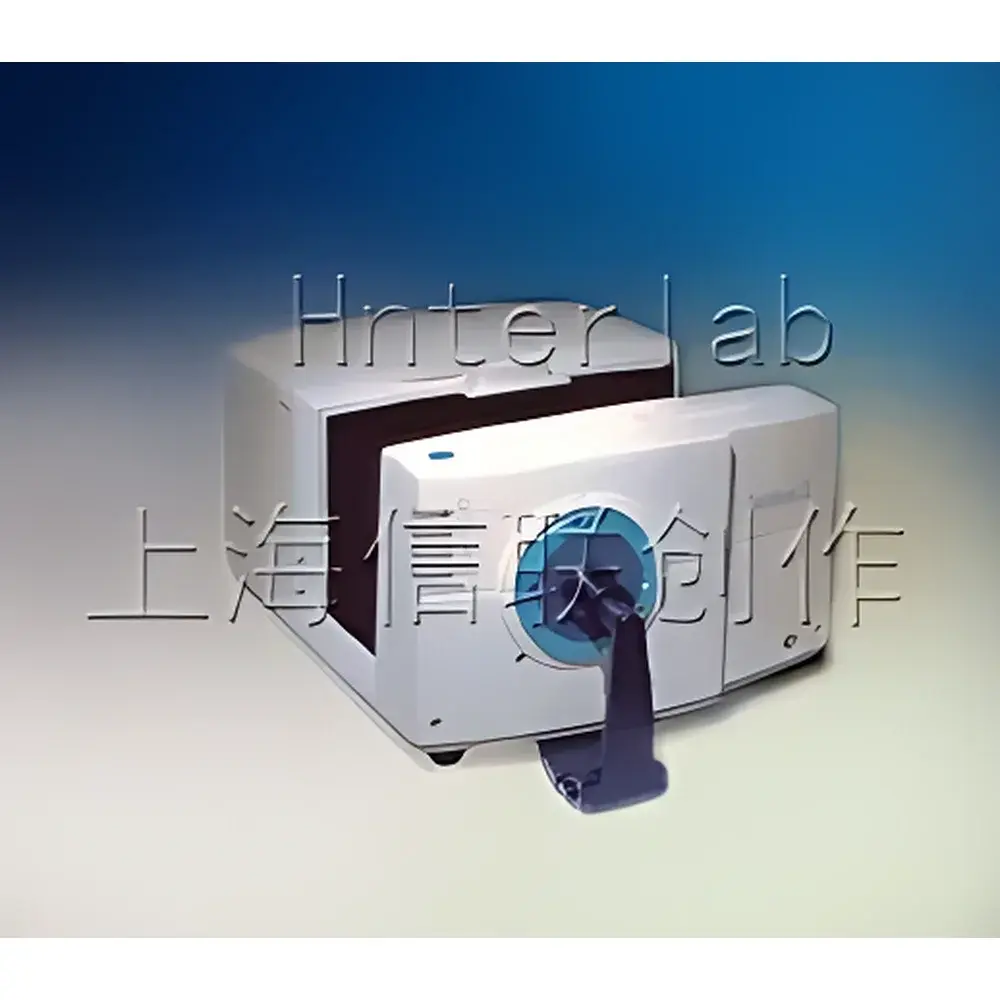
HunterLab UltraScan VIS Benchtop Spectrophotometer
| Brand | HunterLab |
|---|---|
| Origin | USA |
| Model | UltraScan VIS |
| Product Type | Benchtop Spectrophotometer |
| Optical Geometry | d/8° integrating sphere with specular component included/excluded (SCI/SCE) |
| Light Source | Pulsed xenon lamp |
| Spectral Range | 360–780 nm |
| Optical Resolution | 10 nm |
| Repeatability | ΔE*ab ≤ 0.03 |
| Measurement Apertures | 19 mm (0.75 in) and 6.3 mm (0.25 in) |
| UV Control | Adjustable |
| Interface | USB and RS-232C |
| Viewing Port | Retroview small-area viewing mirror |
| Compliance | ASTM E308, ISO 11664, CIE No. 15, USP <1061>, FDA 21 CFR Part 11 (via optional software configuration) |
Overview
The HunterLab UltraScan VIS is a high-precision benchtop spectrophotometer engineered for laboratory-grade color measurement across reflective and transmissive materials. It operates on the principle of diffuse/8° (d/8°) geometry with an integrating sphere, enabling simultaneous capture of both diffusely scattered and specularly reflected light—configurable via software to include or exclude specular component (SCI/SCE modes). This dual-mode capability ensures metrological consistency for samples exhibiting gloss, texture, or optical brighteners. The instrument employs a pulsed xenon lamp as its broadband light source, delivering stable, flash-based illumination that simulates CIE Standard Illuminant D65 without thermal drift or lamp aging effects. Its spectral acquisition covers the full visible range from 360 nm to 780 nm at 10 nm optical resolution, supporting CIE tristimulus calculations (XYZ), CIELAB (L*a*b*), CIELCH, and multiple color difference metrics (ΔE*ab, ΔE00, ΔEcmc). Designed for traceable, repeatable measurements, the UltraScan VIS meets foundational requirements for ISO/IEC 17025-compliant color laboratories and supports audit-ready workflows under GLP and GMP frameworks.
Key Features
- Automated d/8° optical geometry with motorized SCI/SCE switching—no manual port covers or mechanical adjustments required.
- Pulsed xenon lamp with >1 million flashes lifetime; eliminates warm-up time, photometric drift, and spectral shift associated with tungsten-halogen sources.
- Dual aperture selection (19 mm and 6.3 mm) controlled via software; ideal for heterogeneous surfaces, small parts, or textured textiles.
- Retroview viewing mirror integrated adjacent to the sample port—enables precise visual alignment of sub-centimeter samples without parallax error.
- Front-panel macro button for one-touch measurement initiation; reduces operator dependency and minimizes procedural variability.
- Ergonomic sample clamp designed for textile specimens—maintains consistent compression and orientation during reflectance analysis.
- Large transmission compartment accommodating bottles, films, and molded plastics up to 50 mm in height; optimized for liquid and solid transparent media.
- Real-time mode indicator LEDs—clear visual feedback for current geometry (SCI/SCE), UV level, aperture size, and measurement status.
Sample Compatibility & Compliance
The UltraScan VIS accommodates diverse physical forms: opaque solids (paints, plastics, ceramics), translucent films, liquids (beverages, pharmaceutical solutions), powders (pigments, cosmetics), and woven/nonwoven textiles. Its UV-adjustable illumination allows quantification of optical brightening agents (OBAs) per ISO 105-J03 and AATCC TM183. Instrument calibration adheres to NIST-traceable standards and supports verification using certified reference tiles (e.g., BCRA Series II). Regulatory compliance includes ASTM D2244 (color difference), ASTM E308 (computing color from spectral data), ISO 11664 (colorimetry), and CIE Publication 15:2018. When paired with HunterLab’s EasyMatch QC software configured for electronic records, the system satisfies FDA 21 CFR Part 11 requirements—including user authentication, audit trails, and electronic signatures—for regulated industries such as pharmaceuticals and medical devices.
Software & Data Management
The UltraScan VIS integrates natively with HunterLab’s EasyMatch QC software—a validated platform for method development, spectral database management, and statistical process control (SPC). Users define custom tolerances, generate pass/fail reports, and export spectral data in ASTM E2534-compliant CSV or XML formats. The software supports multi-instrument synchronization, batch reporting, and automated PDF certificate generation. All measurement events—including parameter changes, calibration logs, and user actions—are timestamped and stored in an immutable audit trail. Raw spectral data (360–780 nm at 10 nm intervals) is retained in proprietary .spc format and convertible to industry-standard JDF or CGATS.2 files for cross-platform interoperability with ERP, LIMS, and PLM systems.
Applications
- Quality assurance of automotive interior trim, where gloss and metamerism must be controlled across supplier batches.
- Pharmaceutical tablet coating consistency monitoring—detecting subtle hue shifts indicative of excipient variation or drying kinetics.
- Textile dye lot approval against master standards under multiple illuminants (D65, A, F2) and observer angles (2°/10°).
- Food and beverage color stability testing—tracking anthocyanin degradation in juices or caramelization in dairy products over shelf life.
- Plastics recycling sorting—discriminating polymer types based on spectral fingerprinting beyond conventional CIELAB thresholds.
- Paint formulation R&D—correlating spectral reflectance curves with pigment concentration and dispersion quality.
FAQ
What is the difference between SCI and SCE measurement modes?
SCI (Specular Component Included) captures total reflectance—including both diffuse and mirror-like reflection—and is used for appearance matching under controlled lighting. SCE (Specular Component Excluded) measures only diffuse reflectance, better representing how humans perceive color on glossy or textured surfaces.
Can the UltraScan VIS measure fluorescent or optically brightened samples?
Yes—the instrument features adjustable UV energy output and spectral correction algorithms compliant with ISO 105-J03, enabling accurate color assessment of samples containing OBAs.
Is the instrument suitable for regulatory submissions in pharmaceutical manufacturing?
When deployed with validated EasyMatch QC software and documented IQ/OQ/PQ protocols, the UltraScan VIS supports color-related release testing aligned with ICH Q5E and USP .
How often does the instrument require calibration verification?
HunterLab recommends daily verification using a white tile and annual full recalibration against NIST-traceable standards; automated diagnostic routines monitor lamp stability and sphere coating integrity in real time.
Does the system support networked deployment across multiple lab locations?
Yes—EasyMatch QC supports centralized database hosting, role-based access control, and synchronized method libraries via secure LAN or VPN connections.




