
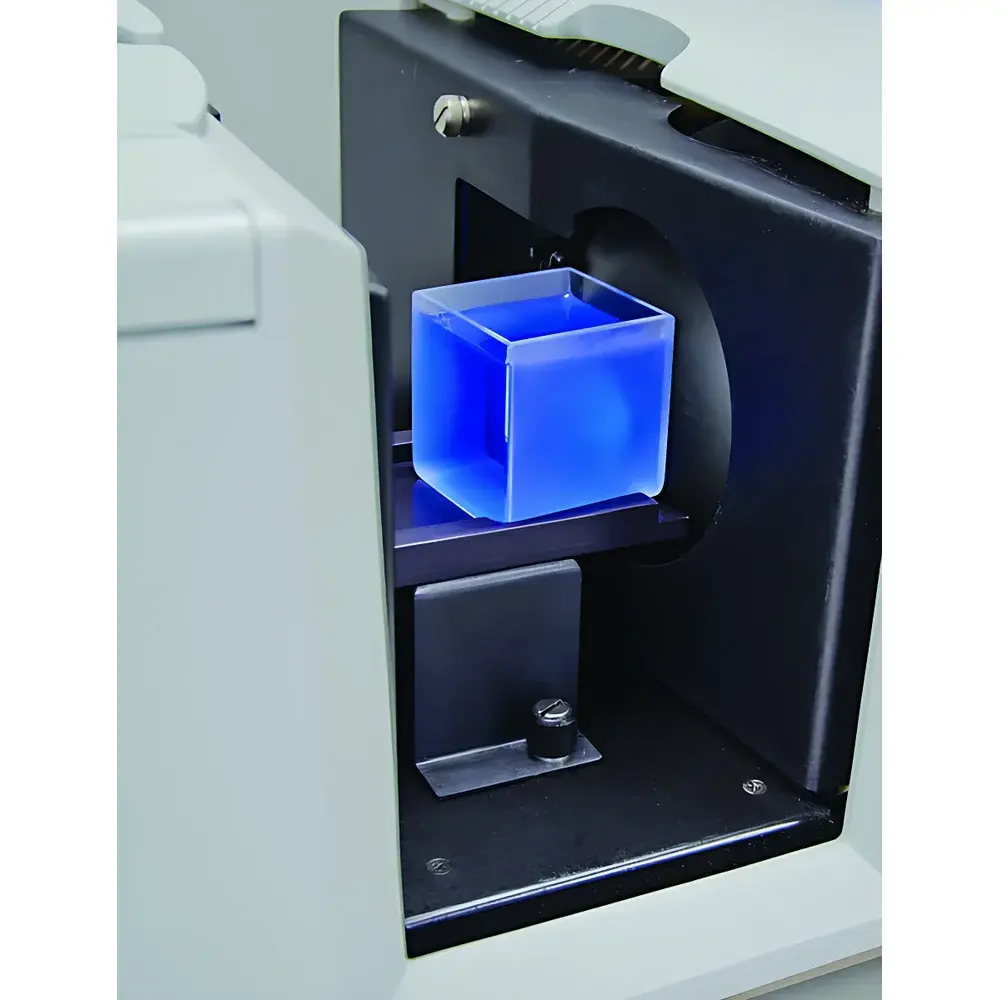
HunterLab UltraScan VIS Benchtop Spectrophotometer for Pharmaceutical Formulations
| Brand | HunterLab |
|---|---|
| Origin | USA |
| Model | UltraScan VIS |
| Instrument Type | Benchtop |
| Optical Geometry | d/8° integrating sphere (with specular component included/excluded) |
| Light Source | Pulsed xenon lamp |
| Spectral Range | 360–780 nm |
| Spectral Resolution | 10 nm |
| Repeatability (ΔE*ab) | ≤ 0.03 |
| Compliance | ASTM D2244, ASTM E308, ISO 7724, CIE No. 15, USP <1061>, AATCC Evaluation Procedure 1 |
| Data Output | CIE XYZ, L*a*b*, L*C*h°, ΔE*ab, ΔE00, Whiteness (CIE, Ganz), Yellowness (ASTM D1925), APHA/Pt-Co, Gardner, Haze, Turbidity, Opacity, Transmittance, Reflectance |
Overview
The HunterLab UltraScan VIS Benchtop Spectrophotometer is a high-precision, research-grade spectrophotometric color measurement system engineered for rigorous pharmaceutical formulation development, quality control, and regulatory compliance. Operating on the CIE-recommended d/8° integrating sphere geometry with automated specular component inclusion/exclusion, it delivers metrologically traceable color data across the full visible spectrum (360–780 nm). Its pulsed xenon light source eliminates thermal loading and photodegradation during measurement—critical for light-sensitive formulations such as suspensions, emulsions, gels, and ophthalmic solutions. The instrument implements dual-beam diode array detection with 10 nm effective bandwidth, enabling robust spectral acquisition even for low-reflectance or high-chroma samples commonly encountered in active pharmaceutical ingredient (API) characterization, excipient blending verification, and final-dose color consistency assessment.
Key Features
- Automated d/8° optical geometry compliant with ASTM D2244, ISO 7724-1, and CIE Publication 15:2018—supports both SCI (specular component included) and SCE (specular component excluded) modes for accurate surface vs. body color evaluation.
- Pulsed xenon illumination ensures stable spectral output over time, eliminating lamp drift and minimizing sample heating—essential for temperature-sensitive liquid formulations and thermolabile APIs.
- Full-spectrum measurement from 360 nm enables UV-inclusive transmittance analysis, supporting USP requirements for clarity and color assessment of injectables, syrups, and topical solutions.
- Dual-path optical design with matched diode array detectors provides high signal-to-noise ratio and exceptional inter-instrument agreement (ΔE*ab < 0.08 between units), validated per HunterLab’s proprietary calibration protocol traceable to NIST SRMs.
- Ergonomic sample interface includes adjustable reflectance port fixtures, large transmission compartment accommodating vials up to 50 mm pathlength, and programmable macro-button operation for rapid batch testing under GLP/GMP workflows.
- Real-time self-diagnostic routines include onboard white tile validation, wavelength accuracy verification via certified interference filters, and automatic dark-current compensation prior to each measurement cycle.
Sample Compatibility & Compliance
The UltraScan VIS accommodates diverse pharmaceutical sample formats without modification: opaque tablets and capsules (via reflectance mode), translucent gels and ointments (using diffuse transmittance), clear liquids (in cuvettes or vials), and semi-solid suspensions (with optional magnetic stirrer integration). It supports standardized measurements per USP (Color and Clarity of Solutions), ASTM D1209 (APHA), ASTM D1500 (Gardner), and ISO 2813 (gloss-independent color). All firmware and software modules are designed to meet FDA 21 CFR Part 11 requirements—including electronic signatures, audit trails, user access controls, and immutable raw spectral data archiving—ensuring full traceability for regulatory submissions and internal quality audits.
Software & Data Management
Equipped with Vision™ 4.0 software, the UltraScan VIS provides validated, 21 CFR Part 11-compliant data acquisition, analysis, and reporting. Users can define custom pass/fail tolerances using multiple color spaces (CIELAB, CMC, DIN99o, DE2000), generate trend reports aligned with ICH Q5E stability protocols, and export spectral data in ASTM E2534-compliant CSV or XML formats. The software integrates seamlessly with LIMS platforms via ODBC and supports automated report generation in PDF/A-1b format for archival compliance. Raw spectral files retain full metadata—including date/time stamp, operator ID, instrument serial number, calibration status, and environmental sensor readings (ambient temperature/humidity)—enabling full forensic reconstruction of any measurement event.
Applications
- Formulation development: Quantifying batch-to-batch color variation in oral suspensions, chewable tablets, and transdermal patches.
- Stability studies: Monitoring oxidative discoloration of lipid-based formulations or UV-induced degradation in light-exposed samples.
- Raw material qualification: Verifying color consistency of excipients (e.g., titanium dioxide, iron oxides) against supplier specifications.
- Process validation: Confirming uniformity of color distribution in fluidized bed granulation or roller compaction processes.
- Regulatory documentation: Generating auditable color data packages for ANDA, NDA, and MA submission dossiers under ICH M4Q(R2) guidelines.
- Reference standard management: Establishing and maintaining in-house color standards traceable to NIST-traceable reference materials.
FAQ
Does the UltraScan VIS support measurement of highly viscous or non-homogeneous pharmaceutical suspensions?
Yes—when paired with optional magnetic stirrer accessories and temperature-controlled sample holders, it enables reproducible transmittance measurements of suspensions up to 10,000 cP viscosity while maintaining laminar flow conditions required by USP .
Can spectral data be exported for third-party chemometric modeling (e.g., PCA, PLS regression)?
Absolutely—the instrument exports full 360–780 nm spectra at 10 nm intervals in ASCII-delimited format, compatible with MATLAB, Unscrambler®, and Python-based scikit-learn workflows for predictive quality modeling.
How frequently must the instrument be recalibrated to maintain compliance with pharmacopeial standards?
Daily verification using the supplied ceramic white tile and black trap is recommended; full recalibration with NIST-traceable standards is required every 12 months or after any optical service event—both procedures are fully documented within the Vision™ 4.0 audit trail.
Is the system validated for use in an ISO 17025-accredited laboratory?
Yes—HunterLab provides IQ/OQ/PQ documentation templates, uncertainty budgets per GUM (JCGM 100:2008), and metrological traceability statements aligned with ISO/IEC 17025:2017 clause 6.4.10 for optical measurement systems.





