
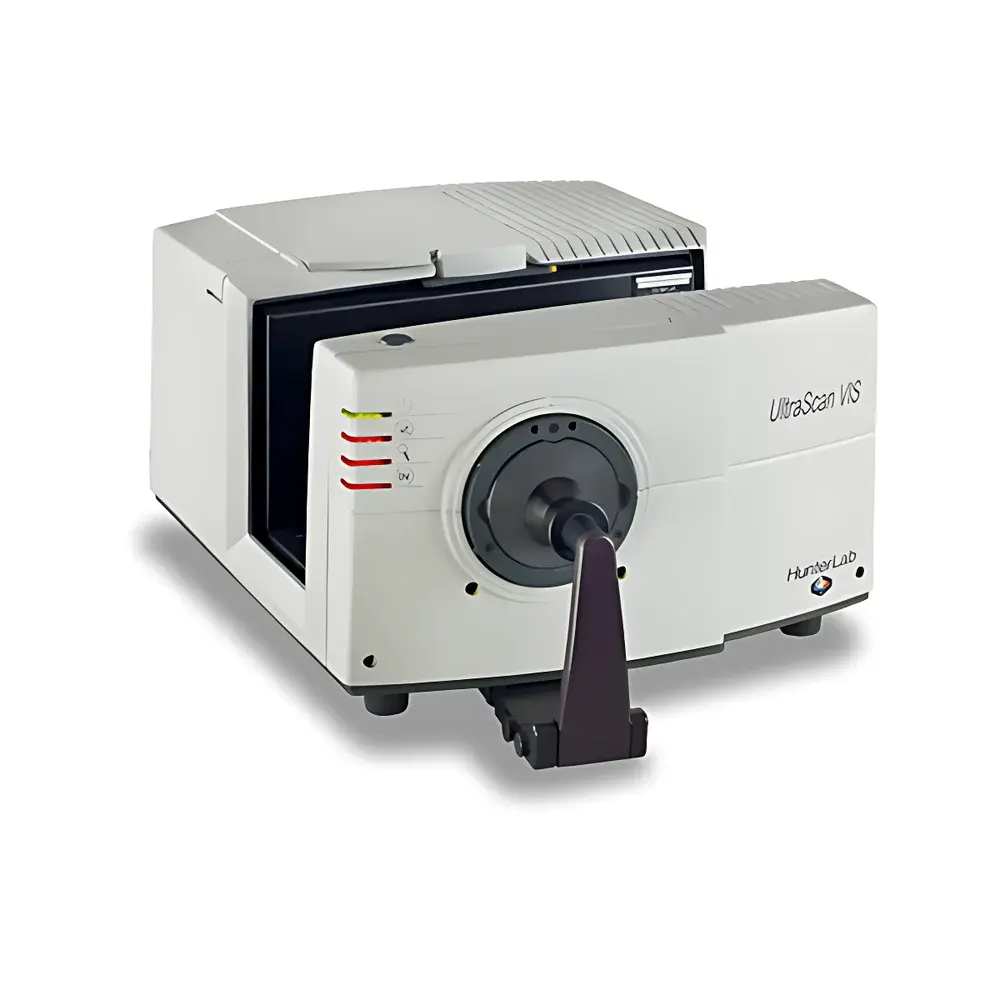
HunterLab Ultrascan VIS Colorimeter with Yellowness Index Capability
| Brand | HunterLab |
|---|---|
| Origin | USA |
| Model | Ultrascan VIS |
| Instrument Type | Benchtop |
| Optical Geometry | d/8° integrating sphere |
| Light Source | Pulsed xenon lamp simulating CIE Standard Illuminant D65 |
| Spectral Range | 360 nm – 780 nm |
| Repeatability | < 0.03 ΔE* (CIE L*a*b*, white tile, 10 measurements) |
| Sample Types | Opaque, transparent, and translucent solids & liquids |
| Measurement Modes | Specular Component Included (SCI) and Specular Component Excluded (SCE) |
| Aperture Sizes | 25 mm and 9.5 mm |
| Compliance | Meets CIE No. 15:2018, ASTM E308, ASTM D6290 (Yellowness Index), ISO 7724-1, ISO 11664-4 |
Overview
The HunterLab Ultrascan VIS is a high-precision benchtop colorimeter engineered for rigorous color measurement across the full CIE-recommended visible spectrum (360–780 nm). Based on dual-beam silicon photodiode array technology and calibrated against NIST-traceable standards, it implements the d/8° integrating sphere optical geometry—ensuring uniform illumination and collection of diffuse and specular reflectance or transmittance. Its pulsed xenon light source accurately replicates CIE Standard Illuminant D65, enabling stable, repeatable spectral acquisition without thermal drift. Critically, the instrument supports Yellowness Index (YI) calculation per ASTM D6290 and ASTM E313, making it indispensable for quality control in polymer, pharmaceutical, food, and chemical industries where yellowing—due to oxidation, UV exposure, or thermal degradation—is a key stability indicator. The system’s optical architecture includes a rigid stainless-steel optical platform, precision-machined internal baffles, and spectrally optimized sphere coating to minimize stray light and maximize signal fidelity.
Key Features
- Dual-beam silicon photodiode array with real-time reference correction at every wavelength point, delivering high photometric accuracy and long-term stability.
- Pulsed xenon lamp with >1 million flash lifetime—eliminates filament aging, ensures consistent spectral power distribution, and enables rapid (<2 s) full-spectrum acquisition.
- Configurable aperture sizes (25 mm and 9.5 mm) accommodate diverse sample geometries—from large plastic panels to small-volume liquid cuvettes.
- Integrated SCI/SCE mode switching via motorized baffle—enables simultaneous assessment of surface appearance (SCE) and total color contribution including gloss (SCI).
- Ergonomic sample compartment with three-sided open access, accommodating oversized or irregularly shaped specimens (e.g., automotive glass, molded bottle preforms, textile swatches).
- UV-enhanced optical path with optional UV-filtered and UV-included measurement modes—supports detection of fluorescence in optically brightened materials (e.g., detergents, paper, polymers).
- Robust mechanical construction: aerospace-grade aluminum housing, stainless-steel fasteners, vibration-damped optical baseplate, and hermetically sealed electronics for laboratory and production-floor reliability.
Sample Compatibility & Compliance
The Ultrascan VIS measures opaque, translucent, and transparent samples—including powders (e.g., titanium dioxide, silica), liquids (milk, juices, solvents), films (PET, polyolefin), molded plastics (bottle preforms, automotive lenses), and textured surfaces (carpets, woven fibers). Its large transmission port accommodates cuvettes up to 50 mm pathlength and solid samples up to 40 mm thick. All optical components meet ISO 11664-4 (CIE colorimetry) and ASTM E308 (computation of tristimulus values). Yellowness Index reporting conforms strictly to ASTM D6290 (for plastics) and ASTM E313 (general-purpose YI), with built-in validation using certified ceramic tiles and quartz interference filters. The instrument supports GLP/GMP workflows via audit-trail-enabled software and complies with FDA 21 CFR Part 11 requirements when deployed with validated EasyMatch QC configurations.
Software & Data Management
Controlled exclusively through HunterLab’s EasyMatch QC software (v5.0+), the Ultrascan VIS provides full spectral data export (CSV, XML), customizable pass/fail tolerancing, statistical process control (SPC) charting, and multi-instrument network synchronization. Software modules support advanced color difference metrics (ΔE₀₀, ΔEcmc), whiteness/yellowness trending, batch comparison, and automated report generation compliant with ISO/IEC 17025 documentation standards. All measurement events—including operator ID, timestamp, calibration status, and environmental metadata—are logged with immutable audit trails. Data integrity is reinforced via role-based user permissions, electronic signatures, and encrypted database storage—meeting regulatory expectations for pharmaceutical (ICH Q5, Q7), food safety (HACCP), and industrial QA environments.
Applications
- Quality assurance of polymer yellowness in PET bottle preforms, polycarbonate lenses, and silicone elastomers.
- Stability testing of pharmaceutical excipients and APIs under accelerated aging (ICH Q1A).
- Color consistency monitoring in paint, ink, and pigment manufacturing per ISO 12647-2.
- Transparency and haze evaluation of automotive glazing and optical films (ASTM D1003).
- Whiteness and brightness grading of paper, textiles, and detergents incorporating fluorescent whitening agents (FWAs).
- Batch-to-batch verification of liquid products—including dairy, beverages, and cosmetics—where subtle chromatic shifts indicate formulation drift or microbial activity.
- Research-grade spectral analysis of scattering media (e.g., milk, emulsions, colloidal suspensions) using integrated sphere transmittance geometry.
FAQ
Does the Ultrascan VIS support Yellowness Index calculation per ASTM D6290?
Yes—YI is computed directly from CIE XYZ tristimulus values using the ASTM D6290 equation (YI = 100(2.87*Cx − 1.83*Cy)/Z), with automatic correction for observer angle (CIE 10° standard observer) and illuminant D65.
Can it measure highly absorbing or dark-colored samples?
Yes—the dual-beam design and high dynamic range detector array enable accurate spectral capture even for saturated blacks and deep reds, with no loss of linearity down to 0.1% reflectance.
Is UV fluorescence compensation available?
Yes—by selecting “UV-Included” mode and using the instrument’s built-in UV-transmitting quartz window, fluorescence emission induced by UV energy below 400 nm is captured and integrated into the final colorimetric result.
What calibration standards are supplied and how often must they be replaced?
Each system ships with NIST-traceable white and green ceramic calibration tiles, plus a quartz transmission filter. Annual recalibration is recommended; tile replacement is required only if physical damage or contamination occurs.
Is remote operation and data integration possible?
Yes—EasyMatch QC supports OPC UA and RESTful API interfaces for integration into MES, LIMS, and SCADA systems, enabling automated data ingestion and centralized analytics across global manufacturing sites.





